

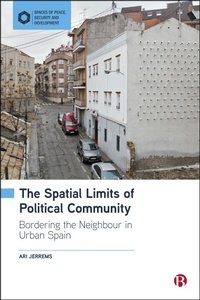
The Spatial Limits of Political Community
Bordering the Neighbour in Urban Spain
1st Edition
Published on 4. September 2025
196 pages
978-1-5292-4331-4 (ISBN)
Description

Through analysis of political events in Madrid, Spain, this book explores what the figure of the neighbour can tell us about the current political conjuncture and interrogates the possibilities it offers for imagining new, and more just, forms of political community.
The book traces the emergence of contemporary forms of neighbouring through social formations and moments of crisis in Spain. Its analysis provides insights into how neighbouring has been envisaged and contested. It reveals both changing conceptions of space and community while underlining how previous conflicts reverberate in the physical landscape, ideas and memories which inform contemporary political interventions.
The book traces the emergence of contemporary forms of neighbouring through social formations and moments of crisis in Spain. Its analysis provides insights into how neighbouring has been envisaged and contested. It reveals both changing conceptions of space and community while underlining how previous conflicts reverberate in the physical landscape, ideas and memories which inform contemporary political interventions.
Reviews / Votes
'In this insightful book, Ari Jerrems explores how the ambiguous and contested figure of the neighbour shapes political space in urban Madrid. Theorising neighbouring as a concrete relation that enables a reimagination of politics and space, Jerrems importantly uncovers a range of "makeshift" forms of solidarity through which relations between citizens and migrants are reconfigured amidst "crisis".' Vicki Squire, The University of Warwick 'This engaging book develops the politics of neighbouring as its research method and autogestion as its political standpoint. By exploring a Madrid neighbourhood during the financial crisis, it shows how the politics of neighbouring can decode current global political crises and how autogestion can counteract them. This book serves as an inspiration for scholars seeking to break free from disciplinary neighbouring.' Engin Isin, Queen Mary University of London 'Tangling with the figure of the neighbour, this beautifully written book redefines political community by showing how borders both bring us together and pull us apart.' Brett Neilson, Western Sydney UniversityMore details
Series
Edition
First Edition
Language
English
Place of publication
Bristol
United Kingdom
Target group
Professional and scholarly
Illustrations
3 s/w Abbildungen
3 Illustrations, black and white
File size
1,05 MB
ISBN-13
978-1-5292-4331-4 (9781529243314)
Copyright in bibliographic data and cover images is held by Nielsen Book Services Limited or by the publishers or by their respective licensors: all rights reserved.
Schweitzer Classification
Other editions
Additional editions
Book
09/2025
1st Edition
Bristol University Press
€105.50
Shipment within 3-4 weeks
Person
Ari Jerrems is Lecturer of International Relations and Political Science at the University of Western Australia.
Content
1. Introduction: Bordering the Crisis
2. Neighbouring in Global Politics
3. Neighbour-as-Archive
4. Toward a Spatial History of the Possible
5. Neighbouring in Crisis
6. Bordering the Neighbour
7. Makeshift Political Community
8. Conclusion: The Crisis of Political Space, Again
2. Neighbouring in Global Politics
3. Neighbour-as-Archive
4. Toward a Spatial History of the Possible
5. Neighbouring in Crisis
6. Bordering the Neighbour
7. Makeshift Political Community
8. Conclusion: The Crisis of Political Space, Again
