

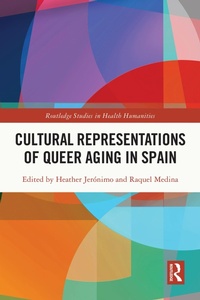
Cultural Representations of Queer Aging in Spain
Published on 2. June 2025
238 pages
978-1-040-36076-7 (ISBN)
Description

This collection examines representations of Spanish queer aging through investigations of literary and cinematic representations of this demographic, offering a showcase for research on communities often made invisible due to age and sexual identity in Spanish culture with wider implications for queer aging studies research.
The volume builds on theoretical foundations established by queer aging studies scholars and the ways in which queer aging differs from heterosexual aging, examining negative topics that arise in literature and film (such as the AIDS crisis, the silencing of queer aging individuals, and social stigmas against this group), in addition to positive topics (like the creation of communities and spaces for queer aging characters). Chapters are structured in conversation with one another about key themes in depictions of queer aging in Spanish culture. Several chapters examine such topics as the aging body, stereotypes and discrimination, old age tropes, and queer invisibility, while others highlight positive representations in exploring the importance of the connection to home, family, and community spaces for queer communities. The collection represents a critical step in future work on queer aging to take future research beyond the Spanish context to extend to new geographic and disciplinary borders.
This book will be of interest to scholars in aging studies, gerontology studies, queer theory, health humanities, and Spanish literature and culture.
The volume builds on theoretical foundations established by queer aging studies scholars and the ways in which queer aging differs from heterosexual aging, examining negative topics that arise in literature and film (such as the AIDS crisis, the silencing of queer aging individuals, and social stigmas against this group), in addition to positive topics (like the creation of communities and spaces for queer aging characters). Chapters are structured in conversation with one another about key themes in depictions of queer aging in Spanish culture. Several chapters examine such topics as the aging body, stereotypes and discrimination, old age tropes, and queer invisibility, while others highlight positive representations in exploring the importance of the connection to home, family, and community spaces for queer communities. The collection represents a critical step in future work on queer aging to take future research beyond the Spanish context to extend to new geographic and disciplinary borders.
This book will be of interest to scholars in aging studies, gerontology studies, queer theory, health humanities, and Spanish literature and culture.
More details
Series
Language
English
Place of publication
London
United Kingdom
Publishing group
Taylor & Francis Ltd
Target group
College/higher education
Illustrations
7 Halftones, black and white; 7 Illustrations, black and white
File size
2,94 MB
ISBN-13
978-1-040-36076-7 (9781040360767)
Copyright in bibliographic data and cover images is held by Nielsen Book Services Limited or by the publishers or by their respective licensors: all rights reserved.
Schweitzer Classification
Other editions
Additional editions
Heather Jeronimo | Raquel Medina
Cultural Representations of Queer Aging in Spain
Book
06/2025
1st Edition
Routledge
€206.40
Shipment within 10-20 days
Persons
Heather Jeronimo is Associate Professor of Spanish at the University of Northern Iowa, USA.
Raquel Medina is a visiting research fellow at Aston University, UK, and Dean of Area Studies at International Education of Students (IES Abroad Barcelona).
Raquel Medina is a visiting research fellow at Aston University, UK, and Dean of Area Studies at International Education of Students (IES Abroad Barcelona).
Content
List of Contributors
Acknowledgements
Introduction
Heather Jeronimo and Raquel Medina
Chapter 1: Reinscribing the Older Lesbian Subject on the Periphery: Age, Disability, and Abjection in Salir del ropero (2019)
Ruth Z. Yuste-Alonso
Chapter 2: The Tribe's Power: Older Lesbians and New Beginnings in Elogio del Happy End (2012) by Isabel Franc
Garbine Vidal-Torreira
Chapter 3: Drawn from Memory: Queer Aging and Reparative Reading in Marina Velasco Marta's Que no se olvide (2023)
Caroline B. Colquhoun
Chapter 4: Age, Success, and Struggle in Jaime de Arminan's Mi querida senorita (1972)
Alicia Herraiz Gutierrez
Chapter 5: Documenting Aging as a Trans Experience in Cantando en las azoteas (2022)
Raquel Medina
Chapter 6: Veneno (2020): Resistance, Trangender Rage, and Resilience Despite Invisibilization and Discrimination
Hernando C. Gomes Prada
Chapter 7: Generativity, Intergenerationality, and Older Gay Men in Contemporary Spanish Cinema
Christopher R. Carter
Chapter 8: Doce Fabulas (2007) by Lluis Maria Todo as a Queer Aging Archive of Barcelona
Heather Jeronimo
Chapter 9: And the Ghosts Danced With Us: Intergenerational Dialogues in AIDS Performance
Isaias Fanlo
Index
Acknowledgements
Introduction
Heather Jeronimo and Raquel Medina
Chapter 1: Reinscribing the Older Lesbian Subject on the Periphery: Age, Disability, and Abjection in Salir del ropero (2019)
Ruth Z. Yuste-Alonso
Chapter 2: The Tribe's Power: Older Lesbians and New Beginnings in Elogio del Happy End (2012) by Isabel Franc
Garbine Vidal-Torreira
Chapter 3: Drawn from Memory: Queer Aging and Reparative Reading in Marina Velasco Marta's Que no se olvide (2023)
Caroline B. Colquhoun
Chapter 4: Age, Success, and Struggle in Jaime de Arminan's Mi querida senorita (1972)
Alicia Herraiz Gutierrez
Chapter 5: Documenting Aging as a Trans Experience in Cantando en las azoteas (2022)
Raquel Medina
Chapter 6: Veneno (2020): Resistance, Trangender Rage, and Resilience Despite Invisibilization and Discrimination
Hernando C. Gomes Prada
Chapter 7: Generativity, Intergenerationality, and Older Gay Men in Contemporary Spanish Cinema
Christopher R. Carter
Chapter 8: Doce Fabulas (2007) by Lluis Maria Todo as a Queer Aging Archive of Barcelona
Heather Jeronimo
Chapter 9: And the Ghosts Danced With Us: Intergenerational Dialogues in AIDS Performance
Isaias Fanlo
Index
