

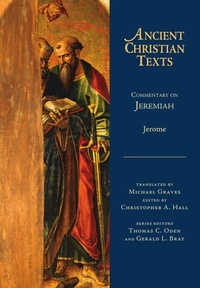
Commentary on Jeremiah
Description

Jerome (c. 347-419), one of the West's four doctors of the church, was recognized early on as one of the church's foremost translators, commentators and advocates of Christian asceticism. Skilled in Hebrew and Greek in addition to his native Latin, he was thoroughly familiar with Jewish traditions and brought them to bear on his understanding of the Old Testament. In 405 Jerome completed his Latin translation of the Old Testament, based on the Hebrew text, and not long afterward began to workon commentaries devoted to the major prophets--Daniel (407), Isaiah (408-410), Ezekiel (410-414), culminating with Jeremiah but reaching only through chapter 32 before his death in 419.
Throughout the commentary Jerome displays his familiaritywith both Hebrew and Greek texts of Jeremiah, often establishing the literal meaning through the Hebrew text and offering a spiritual interpretation that draws on the Septuagint. He frequently interacts with other translations known from Origen's Hexapla. Jerome's extensive education in the classics and Jewish tradition as well as in both Antiochene and Alexandrian exegesis shine through the commentary at every point. Here for the first time Michael Graves supplies readers with a highly readable translation in English, useful textual notes and a helpful introduction.
Ancient Christian Texts are new English translations of full-length commentaries or sermon series from ancient Christian authors that allow you to study key writings ofthe early church fathers in a fresh way.
More details
Other editions
Additional editions
Persons
Thomas C. Oden (1931-2016), was the general editor of the Ancient Christian Commentary on Scripture and the Ancient Christian Doctrine series as well as the author of Classic Christianity, a revision of his three-volume systematic theology. His books also include The African Memory of Mark, Early Libyan Christianity, and How Africa Shaped the Christian Mind. He was the director of the Center for Early African Christianity at Eastern University in Pennsylvania and he also served as the Henry Anson Buttz Professor of Theology at the Graduate School and The Theological School of Drew University in Madison, New Jersey.
Michael Graves (Ph.D., Hebrew Union College) is associate professor of Old Testament at Wheaton College, Wheaton, Illinois, and the author of Jerome's Hebrew Philology.
Christopher A. Hall (PhD, Drew University) is the president of Renovaré. He is associate editor of the Ancient Christian Commentary on Scripture, and his books include Reading Scripture with the Church Fathers, Learning Theology with the Church Fathers, and Worshiping with the Church Fathers. Hall previously served at Eastern University for over twenty years in several roles, including chancellor, provost, dean of Palmer Seminary, dean of the Templeton Honors College, distinguished professor of theology, and director of academic spiritual formation.
Gerald L. Bray (PhD, La Sorbonne) is a professor at Beeson Divinity School of Samford University in Birmingham, Alabama, and director of research for the Latimer Trust. He has written and edited a number of books on different theological subjects, including Galatians, Ephesians in the Reformation Commentary on Scripture series, Biblical Interpretation: Past and Present, The Doctrine of God, and Romans in the Ancient Christian Commentary on Scripture series. A priest of the Church of England, Bray has also edited the post-Reformation Anglican canons.
Content
Contents General Introduction / Page VII Abbreviations / Page XV Translator?s Introduction / Page XXlll Commentary on the Prophet Jeremiah in Six Books: Eusebius Hieronymus (Jerome) Prologue / Page 1 BookOne: Jeremiah 1:-5:19 / Page 2 Book Two: Jeremiah 5:20-11:23 / Page 37 Book Three: Jeremiah 12:1-17:27 / Page 76 Book Four: Jeremiah 18:1-23:40 / Page 111 Book Five: Jeremiah 24:1-29:32 / Page 148 Book Six: Jeremiah 30:1-32:34 / Page 183 Bibliography / Page 219 Subject Index / Page 221 Scripture Index / Page 225
