

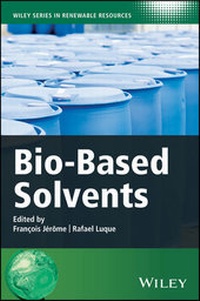
Bio-Based Solvents
Description

More details
Other editions
Additional editions
Persons
Content
List of Contributors ix
Series Preface xi
Foreword xiii
1 Glycerol as Eco-Efficient Solvent for Organic Transformations 1
Palanisamy Ravichandiran and Yanlong Gu
1.1 Introduction 1
1.2 Metal-Free Organic Transformations in Glycerol 3
1.3 Metal-Promoted Organic Transformations in Glycerol 15
1.4 Conclusions and Perspectives 23
Acknowledgements 23
References 23
2 Aromatic Bio-Based Solvents 29
Egid B. Mubofu, James Mgaya, and Joan J. E. Munissi
2.1 Introduction 29
2.2 Resorcinolic Lipids 30
2.2.1 General Description 30
2.2.2 Occurrence of Alkylresorcinols 30
2.2.3 Extraction of Alkylresorcinols 31
2.2.4 Scientific Interest in Alkylresorcinols 35
2.3 Cashew Nut Shell Liquid 38
2.3.1 Description and Occurrence 38
2.3.2 Extraction of Cashew Nut Shell Liquid 38
2.3.3 Scientific Interest in Cashew Nut Shell Liquid 39
2.4 Conclusion 43
References 43
3 Solvents from Waste 49
Fergal Byrne, Saimeng Jin, James Sherwood, C. Rob McElroy, Thomas J. Farmer, James H. Clark, and Andrew J. Hunt
3.1 Introduction 49
3.2 Lignocellulosic Waste as a Feedstock for the Production of Solvents 52
3.2.1 Chemical Transformations of Sugars 53
3.2.2 Fermentation of Lignocellulosic Waste 60
3.3 Solvents from Used Cooking Oil 65
3.4 Terpenes and Derivatives 67
3.5 Conclusion 71
References 73
4 Deep Eutectic and Low-Melting Mixtures 83
Karine de Oliveira Vigier and Joaquín García-Álvarez
4.1 Introduction 83
4.2 Deep Eutectic and Low-Melting Mixtures: Definition and Composition 85
4.3 Deep Eutectic and Low-Melting Mixtures in Metal-Catalysed Organic Reactions 87
4.3.1 Metal-Catalysed Organic Reactions in ChCl-Based Deep Eutectic Solvents 87
4.3.2 Metal-Catalysed Organic Reactions in Low-Melting Mixtures 90
4.4 Conversion of Carbohydrates 92
4.4.1 Synthesis of 5-Hydroxymethylfurfural from Carbohydrates in Low-Melting Mixture 95
4.4.2 Synthesis of Furanic Compounds (Furfural and 5-Hydroxymethylfurfural) in ChCl-Based Deep
Eutectic Solvents 101
4.5 Extraction with or from Deep Eutectic Solvents 104
4.6 Conclusion 107
References 108
5 Organic Carbonates: Promising Reactive Solvents for Biorefineries and Biotechnology 115
Paula Bracco and Pablo Domínguez de María
5.1 The Quest for Sustainable Solvents and the Emerging Role of Organic Carbonates 115
5.2 Carbonate Solvents in Biorefineries 117
5.3 Biotechnology: from Enzymatic Synthesis of Organic Carbonates to Enzyme Catalysis in these Non-Conventional Media 124
5.4 Concluding Remarks 127
References 127
6 Life Cycle Assessment for Green Solvents 131
Philippe Loubet, Michael Tsang, Eskinder Gemechu, Amandine Foulet, and Guido Sonnemann
6.1 Introduction 131
6.2 Life Cycle Assessment: an Overview 133
6.3 Application of Life Cycle Assessment for Conventional Solvents 136
6.4 Critical Review of Life Cycle Assessment Applied to Green Solvents 137
6.4.1 Criteria of the Review 137
6.4.2 Results of the Review 137
6.5 Discussion: Methodological Challenges 143
6.5.1 Life Cycle Inventory Analysis: from Lab, to Pilot, to Industrial Scale 143
6.5.2 Life Cycle Inventory Analysis: Use of Up-to-Date Methods 143
6.5.3 Coupling Life Cycle Analysis with Other Environmental Assessment Methods 144
6.5.4 Using Multi-Criteria Decision Approaches for Life Cycle Analysis 145
6.5.5 Broadening the Scope of the Application of Life Cycle Analysis for Solvents 145
6.6 Conclusion 146
References 146
7 Alkylphenols as Bio-Based Solvents: Properties, Manufacture and Applications 149
Yuhe Liao, Annelies Dewaele, Danny Verboekend, and Bert F. Sels
7.1 Introduction 149
7.2 Properties of Alkylphenols 151
7.3 Manufacture of Alkylphenols 152
7.3.1 Oil-Derived Synthesis 153
7.3.2 Separation from Coal Tar 154
7.3.3 (Methoxylated) Alkylphenols from Lignin 155
7.4 Alkylphenols as Solvent 158
7.5 Other Applications of Alkylphenols 162
7.6 Stability and Toxicity of Alkylphenols 163
7.7 Conclusions and Perspectives 164
Acknowledgements 164
References 165
Index 175
