

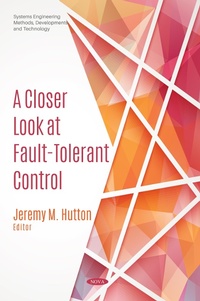
Closer Look at Fault-Tolerant Control
Published on 24. April 2020
348 pages
978-1-5361-7529-5 (ISBN)
Description

A Closer Look at Fault-Tolerant Control first presents the application of a fault tolerant control system on distillation processes, with automatic actuator faults containment capabilities and an atmospheric crude distillation unit. Following this, model-based fault-tolerant control and fault accommodation algorithms are presented for two challenging classes of distributed systems: a spatially distributed system that can be decomposed into interconnected subsystems, and a distributed parameter system where the system state is distributed over a continuous range of space. The authors present recent research on fault-tolerant control systems for unmanned aerial systems, particularly for multirotor-type vehicles commonly known as drones. An overview of tools for the analysis of the fundamental properties of an automated system is provided, allowing for any inherent redundancy in the controlled process to be utilised to maintain availability. Additionally, a reconfigurable fault-tolerant flight control system is proposed to combat sensor/actuator faults for autonomous underwater vehicles. The reconfigurable design and operation of complex systems is addressed, with emphasis on autonomous systems, building upon concepts of autonomy, incipient failure diagnosis and prognosis algorithms. The authors present a fault detection filter for induction motors speed as a class of nonlinear system in networked control systems subject to induced time delays. The multi-model approach for the modeling of induction motors is described using a set of linear models. In the concluding study, the construction of an induction motor is presented, and a review of induction motor failures is discussed.
More details
Other editions
Additional editions
Jeremy M. Hutton
A Closer Look at Fault-Tolerant Control
Book
05/2020
Nova Science Publishers Inc
€303.05
Shipment within 15-20 days
Content
- Intro
- Contents
- Preface
- Chapter 1
- Actuator Fault Tolerant Control System for Distillation Processes
- Abstract
- 1. Introduction
- 2. Review of Fault Tolerant Control System
- 2.1. Passive Fault Tolerant Control Systems
- 2.2. Active Fault Tolerant Control Systems
- 2.3. Fault Detection and Diagnosis
- 2.3.1. Model-Based Fault Detection and Diagnosis
- 2.3.1.1. Faulty System Model
- 2.3.1.2. State Estimation Approach
- 2.3.1.2.1. Observer Based Residual Generation
- 2.3.1.2.2. Unknown Input Observer
- 2.3.2. Data-Based Fault Detection and Diagnosis
- 2.3.2.1. Principal Component Analysis
- 2.3.2.2. Dynamic PCA
- 2.3.2.3. Projection to Latent Structure
- 2.4. Fault Tolerant Controllers
- 2.4.1. Fault Tolerant Model Predictive Control (FTMPC)
- 2.4.2. Distributed Model Predictive Control
- 3. Actuator Fault Tolerant Controllers
- 3.1. DPCA FDD Scheme
- 3.2. Control Strategies and Loop Pairing Assessment
- 3.2.1. Relative Gain Array
- 3.2.2. Dynamic Relative Gain Array (DRGA)
- 3.3. Reconfigurable PID Controllers
- 4. Implementation on Distillation Processes
- 4.1. Application to the Shell Heavy Oil Fractionator
- 4.1.1. Process Description and Control Loop Pairing
- 4.1.2. Process Simulation under Fault-Free and Faulty Conditions
- 4.1.3. Actuator Fault Detection and Diagnosis
- 4.1.4. Implementation of FTC on Identified Actuator Fault
- 4.1.5. Results and Discussions
- 4.2. Application to Crude Distillation Unit
- 4.2.1. Crude Distillation Unit Process Description
- 4.2.2. Development and Simulation of Interactive Dynamic Crude Distillation Units
- 4.2.3. Control Strategies Prior Assessment
- 4.2.4. Introduction of Actuator Faults
- 4.2.5. Diagnostic Model Development and Faults Detection and Identification
- 4.2.6. Implementation of the Actuator FTC on CDU for the Identified Actuator Faults
- 4.2.7. Discussion of Results
- Conclusion
- References
- Biographical Sketches
- Chapter 2
- Model-Based Fault-Tolerant Control for Distributed Systems
- Abstract
- 1. Introduction
- 2. Methods
- 2.1. Decentralized Fault-Tolerant Control of Spatially Distributed Systems
- 2.1.1. System Description
- 2.1.2. Decentralized Fault-Tolerant Controller
- 2.1.2.1. DFTC Design: General Case
- 2.1.2.2. DFTC Design: Special Case
- 2.2. Fault Accommodation for Distributed Parameter Systems Represented by Parabolic PDEs
- 2.2.1. System Description
- 2.2.2. Fault Accommodation for DPS with Output Measurements
- 2.2.2.1. Output Feedback Controller Design Under Healthy Conditions
- 2.2.2.2. Actuator Fault Detection and Accommodation
- 2.2.2.3. Sensor Fault Detection and Accommodation
- 2.2.2.4. Time to Accommodation (TTA)
- References
- Chapter 3
- Fault-Tolerant Systems for Unmanned Multirotor Aerial Vehicles
- Chapter 4
- Concepts and Methods in Fault Tolerant Control with Application to a Wind Turbine Simulated System
- Chapter 5
- Reconfıgurable Fault Tolerant Control Agaınst Sensor/Actuator Faults Applıed to Autonomous Underwater Vehıcle Dynamıcs
- Abstract
- 1. Introduction
- 2. Mathematical Model of AUV Steering Dynamics
- 2.1. Steering Subsystem of Sample AUV
- 2.2. Discretization of Steering Subsystem
- 3. KF for Estimation and Identification of AUV Dynamics
- 3.1. Optimum Linear KF for Estimation of AUV Dynamics
- 3.2. Robust Kalman Filter with the Filter Gain Correction
- 3.3. KF for Estimation and Identification of AUV Dynamics
- 4. Sensor/Actuator Fault Detection and Isolation
- 5. Reconfigurable Control Against Actuator Failures
- 6. Simulation Results And Comments
- 6.1. Simulation Results for Sensor/Actuator Fault Detection
- 6.3. OKF Simulation Results
- 6.4. RKF Simulation Results
- 6.5. Reconfigurable Control Simulation Results
- 6.5.1. Conventional LQR Control Results in the Presence of Actuator Faults
- 6.5.2. Reconfigurable LQR Control Results in the Presence of Actuator Faults
- Conclusion
- Acknowledgement
- References
- Biographical Sketches
- Chapter 6
- Self-Organization and Control Reconfiguration of Unmanned Autonomous Systems for Improved Resilience
- Abstract
- 1. Introduction/Motivation
- 2. Technical Approach
- 2.1. Situational Awareness
- 2.2. Fault Diagnosis and Failure Prognosis
- 2.3. Failure Prognosis and Long-Term Prediction
- 2.4. Particle Filtering - A Novel System Estimation Method
- 3. The "Smart" Knowledge Base-A Paradigm in Reasoning
- 4. Resilient Design of Unmanned Autonomous Systems
- 4.1. Definition: Resilient Systems
- 4.2. Resilient Design
- 4.3. The Modeling Framework
- 4.3.1. Graph-Based Approaches
- 4.3.2. Structural and Functional Modeling
- 4.4. Disturbance Factor Analysis
- 4.4.1. Dynamical System Models
- 5. Complex Adaptive Systems: A Rigorous Framework
- for Self-Organization and Control Reconfiguration of Complex Systems for Improved Resilience, Safety and Reliability
- 5.1. Disturbance/Hazard/Threat Analysis
- 5.2. CAS in Unmanned Autonomous Systems
- 5.3. Innovative Features of the Research and Development
- 5.4. Spontaneous Order and Self-Organization
- 6. Self-Organization: An Overview
- 6.1. The Modeling Framework
- 6.2. A Self-Organization Strategy for Unmanned Autonomous Systems
- 6.3. Spectral Graph Theory
- 6.4. Markov Decision Process
- 6.5. Dynamic Programming
- 6.6. Self-Organization Method for a Hexapod
- 6.7. Hexapod Dynamic/Kinematic Model
- 6.8. Failure Mode (Locked Joint Failure)
- 6.9. Hexapod Graph Model
- 6.10. Hexapod Epidemic Spreading Model
- 6.11. Hexapod MDP
- 6.12. Success Criteria (Lyapunov Stability)
- 6.13. Results
- 7. Fault-Tolerant Control (FTC) Strategies
- 7.1. Model Predictive Control (MPC)
- 8. Control Reconfiguration of Unmanned Autonomous Systems
- 8.1. Control Reconfiguration Fundamentals
- 8.2. Control Reconfiguration: The Design Process
- 8.3. The Reconfiguration Strategy
- 8.4. Low-Level Reconfiguration
- 8.5. Mid-Level Redistribution
- 8.6. High-Level Flight/Mission Adaptation
- 8.7. On-Line Reconfiguration: Mission Re-Planning
- 8.8. Receding Horizon Planning
- 8.9. Recursive RHP
- 8.10. Mission Reconfiguration with Goal Changes
- 9. Candidate Platforms
- 9.1. Hovercraft Dynamics Model
- 9.2. Fault Growth Model
- 9.3. Energy Consumption Model
- 9.4. Simulation Results and Discussion
- 10. Simulation Results
- Conclusion
- References
- Chapter 7
- Fault Detection of Nonlinear Networked Control System Based on Multimodal Approach Subject to Induced Delay
- Abstract
- 1. Introduction
- 2. General Information on Multi-Model Approach
- 2.1. Structure of the Multi-Model
- 2.1.1. Coupled Structure
- 2.1.2. Decoupled Structure
- 2.2. Principle of Multi-Model Modeling
- 2.2.1. Building Strategy of Local Models
- 3. Multimodel Modeling of Induction Motor
- 3.1. Database Acquisition
- 3.2. Data Classification
- 3.3. Identification of Local Models
- 3.3.1. Structural Identification
- 3.3.2. Parametric Identification
- 3.4. Fusion
- 3.4.1. Validity Computation
- 3.4.2. Residual Approach
- 4. Case Study: Application of Multi-Model Approach to Modeling Induction Motor
- 4.1. Database Acquisition
- 4.2. Database Clustering
- 4.3. Models Identification
- 4.4. Models Fusion
- 5. Networked Control System
- 6. Diagnostic of Induction Motor in Network
- 7. Simulation Results
- Conclusion
- References
- Chapter 8
- Diagnosis of Sensores Failure in Induction Motor
- Abstract
- Introduction
- 1. Failure Modes of Induction Motor
- The Induction Motors Failure Modes
- 2. Proportionnal-Integral Multiobserver Design
- 3. Induction Motor Sensor Fault Detection and Isolation
- Conclusion
- References
- Index
- Blank Page
