

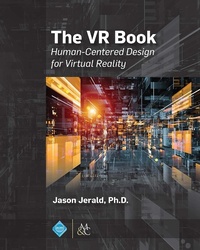
The VR Book
Description

This is a strong foundation of human-centric virtual reality design for anyone and everyone involved in creating VR experiences. Without a clear understanding of the human side of virtual reality (VR), the experience will always fail.
The VR Book bridges this gap by focusing on human-centered design. Creating compelling VR applications is an incredibly complex challenge. When done well, these experiences can be brilliant and pleasurable, but when done badly, they can result in frustration and sickness. Whereas limitations of technology can cause bad VR execution, problems are oftentimes caused by a lack of understanding human perception, interaction, design principles, and real users. This book focuses on the human elements of VR, such as how users perceive and intuitively interact with various forms of reality, causes of VR sickness, creating useful and pleasing content, and how to design and iterate upon effective VR applications.
This book is not just for VR designers, it is for managers, programmers, artists, psychologists, engineers, students, educators, and user experience professionals. It is for the entire VR team, as everyone contributing should understand at least the basics of the many aspects of VR design. The industry is rapidly evolving, and The VR Book stresses the importance of building prototypes, gathering feedback, and using adjustable processes to efficiently iterate towards success. It contains extensive details on the most important aspects of VR, more than 600 applicable guidelines, and over 300 additional references.
More details
Other editions
Additional editions
Person
Jason has been creating VR systems and applications for approximately 20 years. He has been heavily involved in over 60 VR-related projects across more than 30 organizations including Valve, Oculus, Virtuix, Sixense, NASA, General Motors, Raytheon, Lockheed Martin, three U.S. national laboratories, and five universities. Jason's work has been featured on ABC's Shark Tank, on the Discovery Channel, in the New York Times, and on the cover of the MIT Press Journal Presence: Teleoperators and Virtual Environments. He has held various technical and leadership positions including building and leading a team of ~300 individuals, and has served on the ACM SIGGRAPH, IEEE Virtual Reality, and IEEE 3D User Interface Committees.
Jason earned a Bachelor of Computer Science degree with an emphasis in Computer Graphics and Minors in Mathematics and Electrical Engineering from Washington State University. He earned a Master and a Doctorate degree in Computer Science from the University of North Carolina at Chapel Hill with a focus on perception of motion and latency in VR. The graduate work consisted of building a VR system with under 8ms of end-to-end latency; the development of a mathematical model relating latency, head motion, scene motion, and perceptual thresholds; and validation of the model through psychophysics experiments. Jason holds over 20 publications and patents directly related to VR.
