

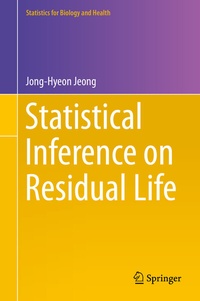
Statistical Inference on Residual Life
Description

This is a monograph on the concept of residual life, which is an alternative summary measure of time-to-event data, or survival data. The mean residual life has been used for many years under the name of life expectancy, so it is a natural concept for summarizing survival or reliability data. It is also more interpretable than the popular hazard function, especially for communications between patients and physicians regarding the efficacy of a new drug in the medical field. This book reviews existing statistical methods to infer the residual life distribution. The review and comparison includes existing inference methods for mean and median, or quantile, residual life analysis through medical data examples. The concept of the residual life is also extended to competing risks analysis. The targeted audience includes biostatisticians, graduate students, and PhD (bio)statisticians. Knowledge in survival analysis at an introductory graduate level is advisable prior to reading this book.
Reviews / Votes
"It is the very first book in its kind that is entirely devoted to the statistical methodologies aimed to analyze residual life and related quantities. . would be a must-have item for researchers who are interested in learning statistical theory on the quantile residual life functions. . would be a valuable asset to those who work on survival analysis. It would be beneficial to a wide group of audience who are interested in the analysis of quantile residual functions." (Sangwook Kang, Journal of Agricultural, Biological, and Environmental Statistics, Vol. 20, 2015)
"This book on the statistical analysis of life expectancy focuses on history, research achievements, and recent developments in statistical inference on quantile residual lifetime. . The intended audience includes graduate students and researchers both in academia and in industry who are interested in learning the theory and application of the residual life function. . This book is strongly recommended to beginning researchers and statistician who are interested in learning the theory and application of the residual life function." (Samit Bhatheja, Doody's Book Reviews, May, 2014)More details
Other editions
Additional editions
Person
Dr. Jong-Hyeon Jeong is a full professor of Biostatistics at the University of Pittsburgh. Dr. Jeong's main research area has been survival analysis and clinical trials. In survival analysis, he has worked on frailty modeling, efficiency of survival probability estimates from the proportional hazards model, weighted log-rank test, competing risks, quantile residual life, and likelihood theory such as empirical likelihood and hierarchical likelihood. In clinical trials, he has been involved in several phase III clinical trials on breast cancer treatment as the primary statistician. He has been teaching statistical theory courses and survival analysis in the Department of Biostatistics at the University of Pittsburgh. Dr. Jeong holds his PhD degree in statistics from the University of Rochester and has been an elected member of the International Statistical Institute (ISI) since 2007.
