

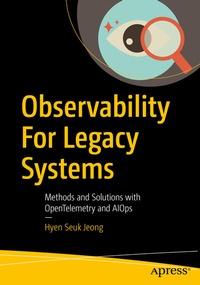
Observability For Legacy Systems
Description

Become an expert in implementing observability methods for legacy technologies and discover how to use AIOps and OpenTelemetry to analyze root causes and solve problems in banking and telecommunications. Through this book, you will engage with issues that occur in kernels, networks, CPU, and IO by developing skills to handle traces and logs, as well as Profiles (eBPF) and debugging. The real-world examples in the book will enable you to analyze and aggregate observability data, helping you gain competence in automating systems and resolving business-critical issues rapidly and efficiently.
The book will introduce you to new observability approaches, describe different types of errors, and explain how observability addresses them. It will provide training on how to develop dashboards and charts and design a root cause analysis process. Emphasizing trace-centric observability, you will gain expertise in using EAI servers to integrate legacy tech and using extensions to complement the OpenTelemetry Agent. You will also understand the varied practical uses of OpenTelemetry through examples from multiple industries, as well as an OpenTelemetry demo application.
The book then takes you through infrastructure observability and infrastructure anomaly detection, enabling you to visualize and trace problems, and helping you identify and proactively respond to anomalies in system resources. In the final chapters, you will learn how to aggregate and analyze observability data using Presto and Druid. Finally, you will familiarize yourself with AIOps and learn how to implement it with Langchain and RAGs.
By the end of this book, you will be fully trained in the practical implementation of observability and using observability data to identify, analyze, and solve problems for large industries like finance and telecommunications.
What You Will Learn
- Integrate observability with legacy technology
- Perform root cause analysis using observability platforms like OpenTelemetry
- Analyze and aggregate observability data to solve business problems
- Use AIOps and anomaly detection tools to automate operations and reduce costs
Who This Book Is For
System developers, data engineers, SREs, infrastructure engineers, system architects, Java developers, and DevOps engineers who are enthusiastic about observability and want to implement it with legacy technology.
More details
Other editions
Additional editions
Person
Hyen Seuk Jeong has worked as a systems engineer for 28 years at IBM, Oracle, and Accenture, and he is currently working as an SRE for a large financial firm in Australia. He has AWS and GCP certifications and has already published two books on observability in Korean.
Content
Chapter 1: Root Cause Analysis.- Chapter 2: The Observability Approach.- Chapter 3: Trace-centric Observability.- Chapter 4: Observability Examples by Industry.- Chapter 5: OpenTelemetry Demo Application.- Chapter 6: Infrastructure Observability.- Chapter 7: Infrastructure Anomaly Detection.- Chapter 8: Analyze Observability Data.- Chapter 9: Aggregate Observability Data.- Chapter 10: AIOps.
