

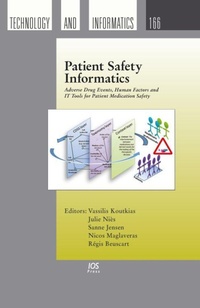
Patient Safety Informatics
Adverse Drug Events, Human Factors and IT Tools for Patient Medication Safety
1st Edition
Published on 15. May 2011
284 pages
978-1-60750-740-6 (ISBN)
Description

Improving patient safety and the quality of healthcare poses many challenges, and information technology (IT) can support the measures necessary to address these. Unfortunately, the risk of adverse drug events (ADEs) rises alongside the increasing sophistication of the health IT systems incorporated into hospital environments. These pose a risk to the safety of patients and incur considerable extra healthcare costs. Approaches introduced to eliminate ADEs raise a number of concerns, not least that the successful transferability and use of such tools into real clinical settings is only possible by means of a holistic, validated and qualitative approach.
This book is a collection of papers presented at the second workshop organized in the context of the EU-funded Patient Safety through Intelligent Procedures in medication (PSIP) project and held in May 2011 in Paris. The workshop provides an opportunity for experts active in the field to share ideas and experiences arising from many different perspectives. The 29 papers address current, novel methods and applications which have achieved concrete results and are relevant to the domain of patient safety as a whole, and are grouped into four main sections: designing IT systems for patient safety; methods and technologies for developing patient safety systems; novel applications to validate patient safety informatics and impact assessment studies for patient safety informatics outcomes.
Significant progress has been made in the field, but even greater challenges must still be faced if a successful transfer of research ideas and outcomes into clinical practice is to be accomplished. A new focus in healthcare IT is called for; one which specifically addresses the issue of patient safety.
This book is a collection of papers presented at the second workshop organized in the context of the EU-funded Patient Safety through Intelligent Procedures in medication (PSIP) project and held in May 2011 in Paris. The workshop provides an opportunity for experts active in the field to share ideas and experiences arising from many different perspectives. The 29 papers address current, novel methods and applications which have achieved concrete results and are relevant to the domain of patient safety as a whole, and are grouped into four main sections: designing IT systems for patient safety; methods and technologies for developing patient safety systems; novel applications to validate patient safety informatics and impact assessment studies for patient safety informatics outcomes.
Significant progress has been made in the field, but even greater challenges must still be faced if a successful transfer of research ideas and outcomes into clinical practice is to be accomplished. A new focus in healthcare IT is called for; one which specifically addresses the issue of patient safety.
More details
Series
Language
English
Place of publication
London
Netherlands
Publishing group
IOS Press
Target group
Professional and scholarly
File size
5,24 MB
ISBN-13
978-1-60750-740-6 (9781607507406)
Copyright in bibliographic data and cover images is held by Nielsen Book Services Limited or by the publishers or by their respective licensors: all rights reserved.
Schweitzer Classification
Other editions
Additional editions
Sanne Jensen | Nicos Maglaveras | Regis Beuscart
Patient Safety Informatics
Adverse Drug Events, Human Factors and IT Tools for Patient Medication Safety
Book
05/2011
1st Edition
IOS Press,US
€151.52
Article exhausted; check different version
Content
- Title page
- Preface
- Contents
- Part A. Keynote Papers on Patient Safety Informatics
- PSIP: An Overview of the Results and Clinical Implications
- The Future of Electronic Prescribing
- Accelerating Patient Safety Through the Innovative Use of Information Technology
- Part B. Invited Papers on Patient Safety Informatics
- EU-ADR Healthcare Database Network vs. Spontaneous Reporting System Database: Preliminary Comparison of Signal Detection
- 3,520 Medication Errors Evaluated to Assess the Potential for IT-Based Decision Support
- Drug Knowledge Expressed as Computable Semantic Triples
- Exploring the Relationship Between Usability and Technology-Induced Error: Unraveling a Complex Interaction
- ICT for Quality and Safety of Care: Beyond Interoperability
- Part C. Designing IT Systems for Patient Safety
- Four Principles for User Interface Design of Computerised Clinical Decision Support Systems
- Implementation of a Taxonomy Aiming to Support the Design of a Contextualised Clinical Decision Support System
- Medication Related Computerized Decision Support System (CDSS): Make It a Clinicians' Partner!
- Information Contextualization in Decision Support Modules for Adverse Drug Event Prevention
- Designing, Implementing and Evaluating e-Prescription: A Field Study and Comparison with PSIP Results
- Part D. Methods and Technologies for Developing Patient Safety Systems
- Shallow Medication Extraction from Hospital Patient Records
- Health Multi-Terminology Portal: A Semantic Added-Value for Patient Safety
- Towards a Standardised Representation of a Knowledge Base for Adverse Drug Event Prevention
- Analysis of the Medication-Use Process in North American Hospital Systems: Underlining Key Points for Adoption to Improve Patient Safety in French Hospitals
- An Approach to 'Dynamic - DDD (Defined Daily Dose) Monitoring' to Reduce Adverse Clinical Outcomes and Increase Patient Safety: Information Repositories and Event Triggers in Clinical Practice
- Part E. Novel Applications of Patient Safety Informatics
- The ADE Scorecards: A Tool for Adverse Drug Event Detection in Electronic Health Records
- Three Different Cases of Exploiting Decision Support Services for Adverse Drug Event Prevention
- Patient Summary and Medicines Reconciliation: Application of the ISO/CEN EN 13606 Standard in Clinical Practice
- Engineering the Electronic Health Record for Safety: A Multi-Level Video-Based Approach to Diagnosing and Preventing Technology-Induced Error Arising from Usability Problems
- Mapping the ATC Classification to the UMLS Metathesaurus: Some Pragmatic Applications
- Part F. Validation and Impact Assessment of Patient Safety Informatics Approaches
- Lessons Learnt from Conducting a High Fidelity Simulation Test in Health IT
- Impact Evaluation of Innovative Technology: Estimating the Impact of the PSIP Solutions
- Scorecards: A New Method to Prevent Adverse Drug Events? Preliminary Results from a Clinical Field Study
- Assessment of Three Systems to Empower the Patient and Decrease the Risk of Adverse Drug Events
- Validation of Completeness, Correctness, Relevance and Understandability of the PSIP CDSS for Medication Safety
- Completion of Structured Patient Descriptions by Semantic Mining
- Subject Index
- Author Index
