

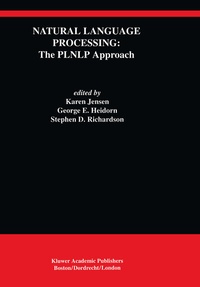
Natural Language Processing: The PLNLP Approach
Published on 6. December 2012
XVII, 324 pages
978-1-4615-3170-8 (ISBN)
Description

Natural language is easy for people and hard for machines. For two generations, the tantalizing goal has been to get computers to handle human languages in ways that will be compelling and useful to people. Obstacles are many and legendary.
Natural Language Processing: The PLNLP Approach describes one group's decade of research in pursuit of that goal. A very broad coverage NLP system, including a programming language (PLNLP) development tools, and analysis and synthesis components, was developed and incorporated into a variety of well-known practical applications, ranging from text critiquing (CRITIQUE) to machine translation (e.g. SHALT). This books represents the first published collection of papers describing the system and how it has been used. Twenty-six authors from nine countries contributed to this volume.
Natural language analysis, in the PLNLP approach, is done is six stages that move smoothly from syntax through semantics into discourse. The initial syntactic sketch is provided by an Augmented Phrase Structure Grammar (APSG) that uses exclusively binary rules and aims to produce some reasonable analysis for any input string. Its `approximate' analysis passes to the reassignment component, which takes the default syntactic attachments and adjusts them, using semantic information obtained by parsing definitions and example sentences from machine-readable dictionaries. This technique is an example of one facet of the PLNLP approach: the use of natural language itself as a knowledge representation language -- an innovation that permits a wide variety of online text materials to be exploited as sources of semantic information.
The next stage computes the intrasential argument structure and resolves all references, both NP- and VP-anaphora, that can be treated at this point in the processing. Subsequently, additional components, currently not so well developed as the earlier ones, handle the further disambiguation of word senses, the normalization of paraphrases, and the construction of a paragraph (discourse) model by joining sentential semantic graphs.
Natural Language Processing: The PLNLP Approach acquaints the reader with the theory and application of a working, real-world, domain-free NLP system, and attempts to bridge the gap between computational and theoretical models of linguistic structure. It provides a valuable resource for students, teachers, and researchers in the areas of computational linguistics, natural processing, artificial intelligence, and information science.
Natural Language Processing: The PLNLP Approach describes one group's decade of research in pursuit of that goal. A very broad coverage NLP system, including a programming language (PLNLP) development tools, and analysis and synthesis components, was developed and incorporated into a variety of well-known practical applications, ranging from text critiquing (CRITIQUE) to machine translation (e.g. SHALT). This books represents the first published collection of papers describing the system and how it has been used. Twenty-six authors from nine countries contributed to this volume.
Natural language analysis, in the PLNLP approach, is done is six stages that move smoothly from syntax through semantics into discourse. The initial syntactic sketch is provided by an Augmented Phrase Structure Grammar (APSG) that uses exclusively binary rules and aims to produce some reasonable analysis for any input string. Its `approximate' analysis passes to the reassignment component, which takes the default syntactic attachments and adjusts them, using semantic information obtained by parsing definitions and example sentences from machine-readable dictionaries. This technique is an example of one facet of the PLNLP approach: the use of natural language itself as a knowledge representation language -- an innovation that permits a wide variety of online text materials to be exploited as sources of semantic information.
The next stage computes the intrasential argument structure and resolves all references, both NP- and VP-anaphora, that can be treated at this point in the processing. Subsequently, additional components, currently not so well developed as the earlier ones, handle the further disambiguation of word senses, the normalization of paraphrases, and the construction of a paragraph (discourse) model by joining sentential semantic graphs.
Natural Language Processing: The PLNLP Approach acquaints the reader with the theory and application of a working, real-world, domain-free NLP system, and attempts to bridge the gap between computational and theoretical models of linguistic structure. It provides a valuable resource for students, teachers, and researchers in the areas of computational linguistics, natural processing, artificial intelligence, and information science.
More details
Other editions
Additional editions
Karen Jensen | George E. Heidorn | Stephen D. Richardson
Natural Language Processing: The PLNLP Approach
Book
02/2013
Springer
€53.49
Shipment within 7-9 days
Karen Jensen | George E. Heidorn | Stephen D. Richardson
Natural Language Processing: The PLNLP Approach
Book
10/1992
Kluwer Academic Publishers
€96.00
Article not available at the moment
Content
1. Introduction; K. Jensen, G. Heidorn, S. Richardson. 2. Towards Transductive Linguistics; A.M. Ramer. 3. PEG: The PLNLP English Grammar; K. Jensen. 4. Experience with an Easily Computed Metric for Ranking Alternative Parses; G. Heidorn. 5. Parse Fitting and Prose Fixing; K. Jensen, G. Heidorn, L. Miller, Y. Ravin. 6. Grammar Errors and Style Weaknesses in a Text-Critiquing System; Y. Ravin. 7. The Experience of Developing a Large-Scale Natural Language Processing System: Critique; S. Richardson, L. Braden-Harder. 8. A Prototype English-Japanese Machine Translation System; T. Tsutsumi. 9. Broad-Coverage Machine Translation; D. Santos. 10. Building a Knowledge Base from Parsed Definitions; J. Klavans, M. Chodorow, N. Wacholder. 11. A Semantic Expert Using an Online Standard Dictionary; J.-L. Binot, K. Jensen. 12. Structural Patterns versus String Patterns for Extracting Semantic Information from Dictionaries; S. Montemagni, L. Vanderwende. 13. SENS: The System for Evaluating Noun Sequences; L. Vanderwende. 14. Disambiguating and Interpreting Verb Definitions; Y. Ravin. 15. Tailoring a Broad-Coverage Systems for the Analysis of Dictionary Definitions; S. Montemagni. 16. PEGASUS: Deriving Argument Structures after Syntax; K. Jensen. 17. A Two-Stage Algorithm to Parse Multi-Lingual Argument Structures; J.-P. Chanod, B. Harriehausen, S. Montemagni. 18. C-SHALT: English-to-Chinese Machine Translation Using Argument Structures; Ee Ah Choo, Koh Mui Koong, Low Hwee Boon, Tong Loong Cheong, Wan Kwee Ngim, Wee Li Kwang. 19. Sense Disambiguation Using Online Dictionaries; L. Braden-Harder. 20. Word-Sense Disambiguation by Examples; T. Tsutsumi. 21. Nominalization of Semantic Graphs; F. Segond. 22. The Paragraph as a Semantic Unit; W. Zadrozny, K. Jensen. References. Index.
