

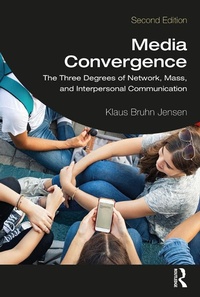
Media Convergence
The Three Degrees of Network, Mass, and Interpersonal Communication
2nd Edition
Published on 17. March 2022
226 pages
978-1-000-54562-3 (ISBN)
Description

This second edition furthers conversations about the ongoing society-wide and worldwide digitalization of human communication.
Reviewing the long lines in the history of media and communication - from writing via printing and broadcasting to computing - the book lays out three general types of media: the human body enabling face-to-face communication here and now; the technically reproduced means of mass communication across space and time; and the digital technologies integrating one-to-one, one-to-many, as well as many-to-many interactions. All these communicative practices coexist in contemporary media environments. Across cultures, genders, and age groups, people go on communicating in the flesh, via wires, and over the air, as illustrated though case studies of mobile communication on mundane matters, and of climate change as a global challenge for human communication and coexistence.
The second edition includes:
Updated accounts of research and public debate on digital media and communication
Analyses of current social media and an emerging internet of things
Systematic presentations of digital as well as traditional empirical methods
Discussion of the normative implications of digitalization, including the classic rights of information and communication, and a right not to be communicated about through surveillance
Interdisciplinary in scope to showcase the wide-reaching cultural consequences of media convergence, this book is ideal for advanced undergraduate students, graduate students, and scholars in the fields of media, communication, and cultural studies.
Reviewing the long lines in the history of media and communication - from writing via printing and broadcasting to computing - the book lays out three general types of media: the human body enabling face-to-face communication here and now; the technically reproduced means of mass communication across space and time; and the digital technologies integrating one-to-one, one-to-many, as well as many-to-many interactions. All these communicative practices coexist in contemporary media environments. Across cultures, genders, and age groups, people go on communicating in the flesh, via wires, and over the air, as illustrated though case studies of mobile communication on mundane matters, and of climate change as a global challenge for human communication and coexistence.
The second edition includes:
Updated accounts of research and public debate on digital media and communication
Analyses of current social media and an emerging internet of things
Systematic presentations of digital as well as traditional empirical methods
Discussion of the normative implications of digitalization, including the classic rights of information and communication, and a right not to be communicated about through surveillance
Interdisciplinary in scope to showcase the wide-reaching cultural consequences of media convergence, this book is ideal for advanced undergraduate students, graduate students, and scholars in the fields of media, communication, and cultural studies.
More details
Edition
2nd edition
Language
English
Place of publication
London
United Kingdom
Publishing group
Taylor & Francis Ltd
Target group
College/higher education
Product notice
Reflowable
Illustrations
8 Tables, black and white; 20 Line drawings, black and white; 20 Illustrations, black and white
ISBN-13
978-1-000-54562-3 (9781000545623)
Copyright in bibliographic data and cover images is held by Nielsen Book Services Limited or by the publishers or by their respective licensors: all rights reserved.
Schweitzer Classification
Other editions
Additional editions
Klaus Bruhn Jensen
Media Convergence
The Three Degrees of Network, Mass, and Interpersonal Communication
Book
03/2022
2nd Edition
Routledge
€60.10
Shipment within 10-20 days
Klaus Bruhn Jensen
Media Convergence
The Three Degrees of Network, Mass, and Interpersonal Communication
Book
03/2022
2nd Edition
Routledge
€206.30
Shipment within 10-20 days
Person
Klaus Bruhn Jensen is Professor in the Department of Communication, University of Copenhagen, Denmark. Recent publications include A Handbook of Media and Communication Research: Qualitative and Quantitative Methodologies, 3rd ed. (2021) and A Theory of Communication and Justice (2021). Current research centers on communication theory, media and communication history, and cross-cultural studies of communication systems.
Content
PART I - A CRITIQUE OF COMMUNICATION 1 Communication - the very idea 2 Erro, ergo sum - communication and pragmatism in the history of ideas 3 Differences that make a difference - the art and science of media and communication research PART II - MEDIA OF THREE DEGREES 4 Media matters - the material conditions of communication 5 Media meanings - the discourses, genres, and modalities of communication 6 Media institutions - between agency and structure PART III - THE DOUBLE HERMENEUTICS OF MEDIA AND COMMUNICATION RESEARCH 7 Media of science - doing communication research 8 Practicing communication - human rights, capabilities, and functionings
