

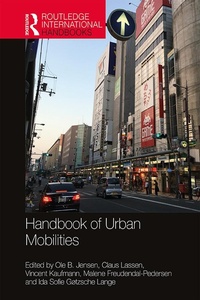
Handbook of Urban Mobilities
1st Edition
Published on 18. May 2020
448 pages
978-1-351-05874-2 (ISBN)
Description

This book offers the reader a comprehensive understanding and the multitude of methods utilized in the research of urban mobilities with cities and 'the urban' as its pivotal axis. It covers theories and concepts for scholars and researchers to understand, observe and analyse the world of urban mobilities.
The Handbook of Urban Mobilities facilitates the understanding of urban mobilities within a historic conscience of societal transformation. It explores key concepts and theories within the 'mobilities turn' with a particular urban framework, as well as the methods and tools at play when empirical, urban mobilities research is undertaken. This book also explores the urban mobilities practices related to commutes; particular modes of moving; the exploration of everyday life and embodied practices as they manifest themselves within urban mobilities; and the themes of power, conflict, and social exclusion. A discussion of urban planning, public control, and governance is also undertaken in the book, wherein the themes of infrastructures, technologies and design are duly considered.
With chapters written in an accessible style, this handbook carries timely contributions within the contemporary state of the art of urban mobilities research. It will thus be useful for academics and students of graduate programmes and post-graduate studies within disciplines such as urban geography, political science, sociology, anthropology, urban planning, traffic and transportation planning, and architecture and urban design.
The Handbook of Urban Mobilities facilitates the understanding of urban mobilities within a historic conscience of societal transformation. It explores key concepts and theories within the 'mobilities turn' with a particular urban framework, as well as the methods and tools at play when empirical, urban mobilities research is undertaken. This book also explores the urban mobilities practices related to commutes; particular modes of moving; the exploration of everyday life and embodied practices as they manifest themselves within urban mobilities; and the themes of power, conflict, and social exclusion. A discussion of urban planning, public control, and governance is also undertaken in the book, wherein the themes of infrastructures, technologies and design are duly considered.
With chapters written in an accessible style, this handbook carries timely contributions within the contemporary state of the art of urban mobilities research. It will thus be useful for academics and students of graduate programmes and post-graduate studies within disciplines such as urban geography, political science, sociology, anthropology, urban planning, traffic and transportation planning, and architecture and urban design.
Reviews / Votes
"Featuring the most prominent scholars in the field, the Handbook of Urban Mobilities is a must have for all those interested in the intersection of mobilities studies and urban spaces. The essays in the handbook focus on the ways in which mobilities provides a framework to study the urban, and all its related networks, such as people, technologies, geographies, and culture. As such, the authors constantly remind us that mobilities is not only about increased speed, but also about immobilities, moorings, and differential mobilities. Focusing on the the histories, theories, practices, infrastructures and methods to study the interdependence between cities and mobilities, the essays in this handbook constantly ask, "What is urban in mobilities?"- Adriana de Souza e Silva, Professor, Department of Communication, NC State University, USA
"The social sciences, humanities and design disciplines have become preoccupied with mobilities in the past two decades - and for good reason: the challenges and crises of our cities and our world are utterly linked to how people, things and flows move across the world.
In this superb collection, for the first time, readers can gain a state-of-the-art overview of this crucial 'mobilities turn'. Through fully 44 chapters from many of the leading lights in the movement, insightful reviews address all of its key dimensions. Justice, climate change, disability and gender; walking, cycling, driving and public transport; digitisation, 'smart' cities and 'Big Data'; questions of class, ethnicity, (dis)ability and the bodym, issues of design, planning, governance and architecture; the challenges of doing mobility research itself -- all receive expert treatment. The result is a truly definitive collection"
- Stephen Graham, Professor of Cities and Society, Newcastle University
"Cities pulse to the rhythms of mobilities. This expertly curated handbook is an essential reference guide for navigating the heady swirl of mobile technologies, infrastructures, practices and materialities that make cities what they are."
- David Bissell, The University of Melbourne
More details
Series
Edition
1. Auflage
Language
English
Place of publication
London
United Kingdom
Publishing group
Taylor & Francis Ltd
Target group
College/higher education
Illustrations
9 Tables, black and white; 11 Line drawings, black and white; 22 Halftones, black and white; 33 Illustrations, black and white
ISBN-13
978-1-351-05874-2 (9781351058742)
Copyright in bibliographic data and cover images is held by Nielsen Book Services Limited or by the publishers or by their respective licensors: all rights reserved.
Schweitzer Classification
Other editions
Additional editions
Ole B. Jensen | Claus Lassen | Vincent Kaufmann
Handbook of Urban Mobilities
Book
02/2022
1st Edition
Routledge
€73.60
Shipment within 15-20 days
Ole B. Jensen | Claus Lassen | Vincent Kaufmann
Handbook of Urban Mobilities
Book
06/2020
1st Edition
Routledge
€316.10
Shipment within 10-20 days
Persons
Ole B. Jensen is Professor of Urban Theory at the Department of Architecture, Design and Media Technology, Aalborg University (Denmark).
Claus Lassen is Associate Professor and Director of the Centre of Mobility and Urban Studies (C-MUS) at Aalborg University (Denmark).
Vincent Kaufman is Associate Professor of Urban Sociology and Mobility at Ecole Polytechnique Federale de Lausanne (EPFL, Switzerland).
Malene Freudendal-Pedersen is Professor in Urban Planning at Aalborg University (Denmark) and has an interdisciplinary background linking sociology, geography, urban planning and the sociology of technology.
Ida Sofie Gotzsche Lange is Assistant Professor at the Department of Architecture, Design and Media Technology, Aalborg University (Denmark).
Claus Lassen is Associate Professor and Director of the Centre of Mobility and Urban Studies (C-MUS) at Aalborg University (Denmark).
Vincent Kaufman is Associate Professor of Urban Sociology and Mobility at Ecole Polytechnique Federale de Lausanne (EPFL, Switzerland).
Malene Freudendal-Pedersen is Professor in Urban Planning at Aalborg University (Denmark) and has an interdisciplinary background linking sociology, geography, urban planning and the sociology of technology.
Ida Sofie Gotzsche Lange is Assistant Professor at the Department of Architecture, Design and Media Technology, Aalborg University (Denmark).
Content
List of contributors. Introduction. Section I: Histories, concepts and theories. 1 Mobility justice in urban studies. 2 Modern urbanization. 3 Networks, flows and the city of automobilities. 4 Mobility capital and motility. 5 Co-design times and mobilities. Section II: Methods, tools and approaches. 6 Mobile ethnographies of the city. 7 Mobile futures through present behaviours and discourses. 8 Digital approaches and mobilities in the Big Data era. 9 A methodological hybridization to analyze orientation experience in the urban environment. 10 Methodologies for understanding and improving pedestrian mobility. Section III: Commutes, modes and rhythms. 11 The walking commute: gendered and generationed. 12 The future of the car commute. 13 Ups and downs with urban cycling. 14 The train commute. 15 Waiting (for Departure). 16 Moving and pausing. 17 Providing and working in rhythms. Section IV: Everyday life, bodies and practices. 18 Life course and mobility. 19 Urban pram strolling. 20 The video-ethnography of embodied urban mobilities. 21 Routine and revelation: Dis-embodied urban mobilities. 22 Habit as a better way to understand urban mobilities. 23 Residential mobility. 24 Urban mobility and migrations. Section V: Power, conflict and social exclusion. 25 Mobility and social stratification. 26 The conflicted pedestrian: walking and mobility conflict in the city. 27 Transitions: methodology and the marginalisation of experience in transport practice. 28 Social implications of spatial mobilities. Section VI: Urban planning, design and governance. 29 Planning for urban mobilities and everyday life. 30 Mobilities design: cities, movements, and materialities. 31 The movement of public space. 32 Urban tourism. 33 The airport city. 34 Surveillance and urban mobility. Section VII: Infrastructures, technologies and sustainable development. 35 3D printing and the changing logistics of cities. 36 Mobility as a service: moving in the de-synchronized city. 37 Understanding multimodality through rhythm of life: empirical evidence from the Swiss case study. 38 Rethinking the large-scale mobility infrastructure projects in sustainable smart city perspective. 39 Smart cities. 40 Sustainable mobility. 41 Terminal Towns. Index.
