

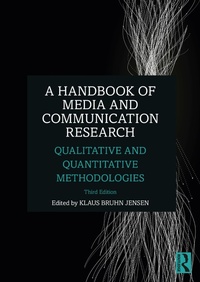
A Handbook of Media and Communication Research
Qualitative and Quantitative Methodologies
3rd Edition
Published on 29. December 2020
528 pages
978-1-351-02937-7 (ISBN)
Description

Thoroughly revised and updated, this third edition integrates perspectives from the social sciences and the humanities, focusing on methodology as a strategic level of analysis that joins practical applications with theoretical issues.
The Handbook comprises three main elements: historical accounts of the development of key concepts and research traditions; systematic reviews of media organizations, discourses, and users, as well as of the wider social and cultural contexts of communication; and practical guidelines with sample studies, taking readers through the different stages of a research process and reflecting on the social uses and consequences of research.
Updates to this edition include:
An overview of the interrelations between networked, mass, and interpersonal communication.
A new chapter on digital methods.
Three chapters illustrating different varieties of media and communication research, including industry-academic collaboration and participatory action research.
Presentation and discussion of public issues such as surveillance and the reconfiguration of local and global media institutions.
This book is an invaluable reference work for students and researchers in the fields of media, communication, and cultural studies.
The Handbook comprises three main elements: historical accounts of the development of key concepts and research traditions; systematic reviews of media organizations, discourses, and users, as well as of the wider social and cultural contexts of communication; and practical guidelines with sample studies, taking readers through the different stages of a research process and reflecting on the social uses and consequences of research.
Updates to this edition include:
An overview of the interrelations between networked, mass, and interpersonal communication.
A new chapter on digital methods.
Three chapters illustrating different varieties of media and communication research, including industry-academic collaboration and participatory action research.
Presentation and discussion of public issues such as surveillance and the reconfiguration of local and global media institutions.
This book is an invaluable reference work for students and researchers in the fields of media, communication, and cultural studies.
Reviews / Votes
This is a great example of interdisciplinarity at work.Elihu Katz, Annenberg School of Communication
This new edition offers a historical, philosophical, topical, and methodologica overview that manages to be both deep and wide-ranging. It will be of tremendous use for students and others seeking a better understanding of communication as both a topic and a field.
Nancy Baym, University of Kansas
As society becomes ever more mediated, reliant on and reconfigured by complex and fastchanging digital technologies, academic analysis is urgently in need of fresh thinking. Look no further: this volume offers a wealth of insightful concepts, critical questions and intellectual traditions to revitalise our field. Through a rigorous historical grounding, it simultaneously integrates and yet distinguishes among key approaches to pose a new research agenda for the digital world.
Sonia Livingstone, London School of Economics and Political Science.
A Handbook of Media and Communication Research is a guiding light of interdisciplinarity, arising from both the humanities and the social sciences. Klaus Bruhn Jensen and his stellar co-authors guide us through the various genres of media and communication (news, entertainment, etc.), as well as the effects of interpersonal media, mass media, and everything in-between. They look at how we study the phenomenon (qualitative, quantitative, digital), its cultural and historical dimensions, as well as the position of media industries. The book is a welcome beacon for all students and scholars navigating the current state of media and communication.
Rich Ling, Nanyang Technological University, Singapore This is a great example of interdisciplinarity at work.
Elihu Katz, Annenberg School of Communication
This new edition offers a historical, philosophical, topical, and methodologica overview that manages to be both deep and wide-ranging. It will be of tremendous use for students and others seeking a better understanding of communication as both a topic and a field.
Nancy Baym, University of Kansas
As society becomes ever more mediated, reliant on and reconfigured by complex and fastchanging digital technologies, academic analysis is urgently in need of fresh thinking. Look no further: this volume offers a wealth of insightful concepts, critical questions and intellectual traditions to revitalise our field. Through a rigorous historical grounding, it simultaneously integrates and yet distinguishes among key approaches to pose a new research agenda for the digital world.
Sonia Livingstone, London School of Economics and Political Science.
A Handbook of Media and Communication Research is a guiding light of interdisciplinarity, arising from both the humanities and the social sciences. Klaus Bruhn Jensen and his stellar co-authors guide us through the various genres of media and communication (news, entertainment, etc.), as well as the effects of interpersonal media, mass media, and everything in-between. They look at how we study the phenomenon (qualitative, quantitative, digital), its cultural and historical dimensions, as well as the position of media industries. The book is a welcome beacon for all students and scholars navigating the current state of media and communication.
Rich Ling, Nanyang Technological University, Singapore
More details
Edition
3rd edition
Language
English
Place of publication
London
United Kingdom
Publishing group
Taylor & Francis Ltd
Target group
College/higher education
Professional and scholarly
Illustrations
9 Tables, black and white; 51 Line drawings, black and white; 5 Halftones, black and white; 56 Illustrations, black and white
ISBN-13
978-1-351-02937-7 (9781351029377)
Copyright in bibliographic data and cover images is held by Nielsen Book Services Limited or by the publishers or by their respective licensors: all rights reserved.
Schweitzer Classification
Other editions
Additional editions
Klaus Bruhn Jensen
A Handbook of Media and Communication Research
Qualitative and Quantitative Methodologies
Book
12/2020
3rd Edition
Routledge
€63.30
Shipment within 10-20 days
Klaus Bruhn Jensen
A Handbook of Media and Communication Research
Qualitative and Quantitative Methodologies
Book
12/2020
3rd Edition
Routledge
€215.77
Shipment within 10-20 days
Person
Klaus Bruhn Jensen is a professor in the Department of Communication, University of Copenhagen, Denmark. His research centers on communication theory and empirical methodologies as they apply to digital media. Previous publications include Media Convergence (2010) and International Encyclopedia of Communication Theory and Philosophy (2016).
Content
1. Introduction: The state of convergence in media and communication research ; PART I - HISTORY: SOURCES OF MEDIA AND COMMUNICATION RESEARCH ; 2. The humanistic sources of media and communication research ; 3. The social-scientific sources of media and communication research ; PART II - SYSTEMATICS: PROCESSES OF COMMUNICATION ; Media organizations ; 4. The production of entertainment media ; 5. News production ; Media texts ; 6. Analyzing news discourse ; 7 Mediated fiction ; Media users ; 8. Media effects: Quantitative traditions ; 9. Media reception: Qualitative traditions ; Media contexts ; 10. Communication in contexts: Beyond mass-interpersonal and online-offline divides ; 11. The cultural contexts of media and communication ; 12. History, communication, and media ; PART III - PRACTICE: SCIENTIFIC APPROACHES AND SOCIAL APPLICATIONS ; Empirical research designs ; 13. Quantitative approaches to media and communication research ; 14. The qualitative research process ; 15. Digital methods for media and communication research ; 16. The complementarity of qualitative and quantitative methodologies in media and communication research ; Multiple media, multiple methods ; 17. Personal media in everyday life: A baseline study ; 18. Media industries and audience research: An analytic dialogue on the value of engagement ; 19. Employing media-rich participatory action research to foster youth voice ; Communicating research ; 20. The social origins and uses of media and communication research ; References
