

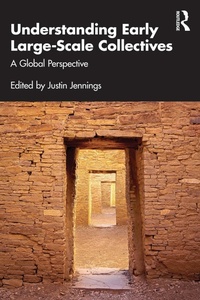
Understanding Early Large-Scale Collectives
A Global Perspective
1st Edition
Published on 30. June 2025
450 pages
978-1-040-36588-5 (ISBN)
Description

This volume brings together perspectives from different parts of the world that showcase the wide variety of practices, institutions, and ideologies that allowed for shared identities and coordinated actions across broad collectives. It shows that there are many ways that people can work together.
How did the world's first large-scale collectives come into being? For much of our discipline's history, the answer was the state. People learned how to be part of a larger community via political, economic, and social scaffolding that tended to build from earlier ways of living in a region. This scaffolding was often wobbly and always under construction-its flexibility often a design strength rather than a flaw. This book demonstrates that violence and rulers often played pivotal roles in large-scale collectives, but so did gender complementarity, markets, ritual centers, fictive kinship, and egalitarianism. Earlier evolutionary approaches tended to obscure both the variability and malleability of earlier political forms in a desire to find ideal types hidden beneath cross-cultural noise. This volume's authors argue that this noise was politics-in-action and that there was no state, or other kind of polity, that was above the fray and divorced from the daily practices that brought people, animals, and other things together.
A better understanding of early collective action strategies provides a richer understanding of past politics and, just as importantly, demonstrates governance alternatives for our contemporary society that struggles to address climate change, pandemics, and other pressing challenges. This book will interest archaeologists and historians, as well as anyone who is curious about other ways that we can work together to solve common problems.
How did the world's first large-scale collectives come into being? For much of our discipline's history, the answer was the state. People learned how to be part of a larger community via political, economic, and social scaffolding that tended to build from earlier ways of living in a region. This scaffolding was often wobbly and always under construction-its flexibility often a design strength rather than a flaw. This book demonstrates that violence and rulers often played pivotal roles in large-scale collectives, but so did gender complementarity, markets, ritual centers, fictive kinship, and egalitarianism. Earlier evolutionary approaches tended to obscure both the variability and malleability of earlier political forms in a desire to find ideal types hidden beneath cross-cultural noise. This volume's authors argue that this noise was politics-in-action and that there was no state, or other kind of polity, that was above the fray and divorced from the daily practices that brought people, animals, and other things together.
A better understanding of early collective action strategies provides a richer understanding of past politics and, just as importantly, demonstrates governance alternatives for our contemporary society that struggles to address climate change, pandemics, and other pressing challenges. This book will interest archaeologists and historians, as well as anyone who is curious about other ways that we can work together to solve common problems.
More details
Edition
1. Auflage
Language
English
Place of publication
London
United Kingdom
Publishing group
Taylor & Francis Ltd
Target group
College/higher education
Illustrations
3 Tables, black and white; 77 Halftones, black and white; 77 Illustrations, black and white
File size
45,85 MB
ISBN-13
978-1-040-36588-5 (9781040365885)
Copyright in bibliographic data and cover images is held by Nielsen Book Services Limited or by the publishers or by their respective licensors: all rights reserved.
Schweitzer Classification
Other editions
Additional editions

Book
06/2025
1st Edition
Routledge
€193.50
Shipment within 10-20 days
Book
06/2025
1st Edition
Routledge
€52.50
Shipment within 10-20 days
Person
Justin Jennings is Senior Curator of the Archaeology of the Americas at the Royal Ontario Museum and Associate Professor of Anthropology at the University of Toronto.
Content
List of Figures; List of Tables; List of Contributors; Preface; Chapter 1 - The State of Archaeology: An Introduction; Chapter 2 - Institutions and Governance in Northern Iroquoian Confederacies: Implications for Contact Period Geopolitics; Chapter 3 - The Visible and Invisible Workings of Cahokia; Chapter 4 - Networks of Power in the Chaco World: Practices, Institutions, and Ideologies of Collective Action; Chapter 5 - A Comparative Consideration of the Institutions of Governance of the Native American Polities of La Florida; Chapter 6 - The Emergence of a Large Community at Aguada Fenix and Its Legacy in Southeastern Mesoamerica; Chapter 7 - Multiscalar Collectivities and Governance in Precolonial Mexico, from Neighborhoods to Confederations; Chapter 8 - Kin, Ancestors, and Commensality: A New Vision for Wari Imperialism in Middle Horizon Peru; Chapter 9 - Resilient Margins: Innovative Political Conservatism in Crete beyond the Knossian State; Chapter 10 - Reimagining Governance in the Zimbabwe Culture: Archaeological and Anthropological Insights from Ancient Mberengwa; Chapter 11 - States of Mobilities: Nomadic Institutions as the Foundations of Large-Scale Polities; Chapter 12 - Public Goods, Entrainment, and Inequality: The Reconstitution of the Shang Kingdom under Wu Ding; Chapter 13 - Egalitarian Regimes: Inequality, Ideology, and Governance in the Indus Civilization of Bronze Age South Asia; Chapter 14 - Reimagining and Reengineering Political Complexity in Early Vietnam; Chapter 15 - Place-Making, Fire, and the Praxis of Becoming Angkor; Chapter 16 - Islands of Ideology: Exploring Group Formation and Governance in Hawai?i; Chapter 17 - Reframing Premodern Governance: Synthesis and Prospect; Index.
