

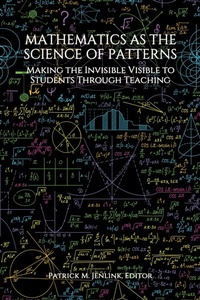
Mathematics as the Science of Patterns
Making the Invisible Visible to Students Through Teaching
1st Edition
Published on 1. February 2022
265 pages
978-1-64802-746-8 (ISBN)
Description

Mathematics as the Science of Patterns: Making the Invisible Visible to Students through Teaching introduces the reader to a collection of thoughtful, research-based works by authors that represent current thinking about mathematics, mathematics education, and the preparation of mathematics teachers. Each chapter focuses on mathematics teaching and the preparation of teachers who will enter classrooms to instruct the next generation of students in mathematics.
The value of patterns to the teaching and learning of mathematics is well understood, both in terms of research and application. When we involve or appeal to pattern in teaching mathematics, it is usually because we are trying to help students to extract greater meaning, or enjoyment, or both, from the experience of learning environments within which they are occupied, and perhaps also to facilitate remembering. As a general skill it is thought that the ability to discern a pattern is a precursor to the ability to generalize and abstract, a skill essential in the early years of learning and beyond.
Research indicates that the larger problem in teaching mathematics does not lie primarily with students; rather it is with the teachers themselves. In order to make changes for students there first needs to be a process of change for teachers. Understanding the place of patterns in learning mathematics is a predicate to understanding how to teach mathematics and how to use pedagogical reasoning necessary in teaching mathematics. Importantly, the lack of distinction created by the pedagogical use of patterns is not immediately problematic to the student or the teacher. The deep-seated cognitive patterns that both teachers and students bring to the classroom require change.
Chapter 1 opens the book with a focus on mathematics as the science of patterns and the importance of patterns in mathematical problem solving, providing the reader with an introduction. The authors of Chapter 2 revisit the work of Po lya and the development and implementation of problem solving in mathematics. In Chapter 3, the authors present an argument for core pedagogical content knowledge in mathematics teacher preparation. The authors of Chapter 4 focus on preservice teachers' patterns of conception as related to understanding number and operation. In Chapter 5 the authors examine the role of visual representation in exploring proportional reasoning, denoting the importance of helping learners make their thinking visible. The authors of Chapter 6 examine patterns and relationships, and the importance of each in assisting students' learning and development in mathematical understanding. The authors of Chapter 7 examine the use of worked examples as a scalable practice, with emphasis on the importance of worked examples in teaching fraction magnitude and computation is discussed. In Chapter 8, the authors expand on the zone of proximal development to investigate the potential of Zankov's Lesson in terms of students analyzing numerical equalities. The authors of Chapter 9 focus on high leverage mathematical practices in elementary pre-service teacher preparation, drawing into specific relief the APEX cycle to develop deep thinking. In Chapter 10, the author focuses on number talks and the engagement of students in mathematical reasoning, which provides opportunities for students to be sensemakers of mathematics. Chapter 11 presents an epilogue, focusing on the importance of recognizing the special nature of mathematics knowledge for teaching.
The value of patterns to the teaching and learning of mathematics is well understood, both in terms of research and application. When we involve or appeal to pattern in teaching mathematics, it is usually because we are trying to help students to extract greater meaning, or enjoyment, or both, from the experience of learning environments within which they are occupied, and perhaps also to facilitate remembering. As a general skill it is thought that the ability to discern a pattern is a precursor to the ability to generalize and abstract, a skill essential in the early years of learning and beyond.
Research indicates that the larger problem in teaching mathematics does not lie primarily with students; rather it is with the teachers themselves. In order to make changes for students there first needs to be a process of change for teachers. Understanding the place of patterns in learning mathematics is a predicate to understanding how to teach mathematics and how to use pedagogical reasoning necessary in teaching mathematics. Importantly, the lack of distinction created by the pedagogical use of patterns is not immediately problematic to the student or the teacher. The deep-seated cognitive patterns that both teachers and students bring to the classroom require change.
Chapter 1 opens the book with a focus on mathematics as the science of patterns and the importance of patterns in mathematical problem solving, providing the reader with an introduction. The authors of Chapter 2 revisit the work of Po lya and the development and implementation of problem solving in mathematics. In Chapter 3, the authors present an argument for core pedagogical content knowledge in mathematics teacher preparation. The authors of Chapter 4 focus on preservice teachers' patterns of conception as related to understanding number and operation. In Chapter 5 the authors examine the role of visual representation in exploring proportional reasoning, denoting the importance of helping learners make their thinking visible. The authors of Chapter 6 examine patterns and relationships, and the importance of each in assisting students' learning and development in mathematical understanding. The authors of Chapter 7 examine the use of worked examples as a scalable practice, with emphasis on the importance of worked examples in teaching fraction magnitude and computation is discussed. In Chapter 8, the authors expand on the zone of proximal development to investigate the potential of Zankov's Lesson in terms of students analyzing numerical equalities. The authors of Chapter 9 focus on high leverage mathematical practices in elementary pre-service teacher preparation, drawing into specific relief the APEX cycle to develop deep thinking. In Chapter 10, the author focuses on number talks and the engagement of students in mathematical reasoning, which provides opportunities for students to be sensemakers of mathematics. Chapter 11 presents an epilogue, focusing on the importance of recognizing the special nature of mathematics knowledge for teaching.
More details
Other editions
Additional editions
Patrick M. Jenlink
Mathematics as the Science of Patterns
Making the Invisible Visible to Students Through Teaching
Book
02/2022
Information Age Publishing
€119.80
Available immediately
Patrick M. Jenlink
Mathematics as the Science of Patterns
Making the Invisible Visible to Students Through Teaching
Book
02/2022
Information Age Publishing
€70.50
Shipment within 3-4 weeks
Content
- Cover
- Mathematics as the Science of Patterns: Making the Invisible Visible to Students Through Teaching
- Mathematics as the Science of Patterns: Making the Invisible Visible to Students Through Teaching
- Copyright Page
- Dedication
- Contents
- Preface
- Acknowledgments
- 1. Mathematics-The Science of Patterns: The Importance of Patterns in Teaching and Learning Mathematics
- Introduction
- Mathematical Patterns in Teaching Mathematics
- Problem Solving-A Focus on Pattern and Patterning
- Pattern Tasks and Problem Solving
- Conclusion
- 2. Pólya Revisited: The Development and Implementation of a Problem-Solving Self-Efficacy Instrument With Preservice Elementary Mathematics Teachers
- INTRODUCTION
- PERSPECTIVES
- Elementary Teacher Preparation and Problem Solving
- Problem Solving Self-Efficacy
- Problem Solving Processes
- Attitudes Toward Mathematics
- METHODOLOGY
- Participants
- Treatment
- Data Collection
- RESULTS
- Exploratory Factor Analysis
- Paired t-test
- DISCUSSION
- CONCLUSION
- APENDIX A
- Instrument
- REFERENCES
- 3. What Should We Teach in Elementary Mathematics Methods Courses?: The Argument for Core Pedagogical Content Knowledge in K-5
- INTRODUCTION
- Schulman's Three Types of Teaching Knowledge
- Guiding Standards for Elementary Mathematics TeacherEducation
- CAEP K-5 Elementary Teacher Standards and AMTE Upper Elementary and Early Childhood Standards
- Guiding Frameworks for Elementary MathematicsTeacher Education
- Significance of Content Knowledge
- Significance of Pedagogical Knowledge
- The Case for Intertwining Content and Pedagogy: Strengthening Pedagogical Content Knowledge
- A CASE FOR CORE PEDAGOGICAL CONCEPT KNOWLEDGE IN K-5 MATHEMATICS TEACHER EDUCATION
- THRESHOLD CONCEPTS
- CONCLUSIONS
- REFERENCES
- 4. Effectiveness of Diagnostic Interviews: Preservice Teachers' Patterns of Conceptions in Student Understanding of Number and Operation
- INTRODUCTION
- THEORETICAL FRAMEWORK
- METHODOLOGY
- Design of the Diagnostic Interview
- Analysis of Data
- RESULTS
- Hilary's Interpretation of the Student's Mathematical Activity
- Hilary's Suggestions for Implications for Future Teaching
- Elayne's Interpretation of the Student's Mathematical Activity
- Elayne's Suggestions for Implications for Future Teaching
- Erin's Interpretation of the Student's Mathematical Activity
- Erin's Suggestions for Implications for Future Teaching
- IMPLICATIONS
- CONCLUSIONS
- REFERENCES
- 5. Using Visual Representations to Explore Proportional Reasoning With Future Teachers
- INTRODUCTION
- THEORETICAL PERSPECTIVES
- Visual Representations and Reasoning Across Representations
- Reasoning With Measured Quantities
- Proportional Reasoning
- METHODS
- The Daffodil Problem
- The Paint Problem
- RESULTS
- The Daffodil Problem
- Division Versus Proportion: Part A of the Daffodil Problem
- Quantifying an Object
- Finding Equivalence
- The Paint Problem
- Drawing, Labeling, and the Equal Sign
- Creating Equations
- DISCUSSION
- CONCLUSION
- REFERENCES
- 6. Patterns and Relationships Within Ratio Contexts: Students' Emerging Ideas Through Tables
- INTRODUCTION
- THEORETICAL FRAMEWORK
- Connections Between Reasoning With Patterns and Ratios
- Ratio Table as a Tool to Teach Proportional Reasoning
- Ratio and Proportion Instructional Sequence
- METHODOLOGY
- Research Design
- Participants
- Data Collection Instruments
- Data Collection Process
- Data Analysis
- FINDINGS
- Repeating Pattern as a Problem-Solving Strategy
- Growing Number Patterns With Addition
- Growing Number Patterns With Multiplication
- DISCUSSION
- CONCLUSION
- REFERENCES
- 7. Using Worked Examples as a Scalable Practice for Teaching Fraction Magnitude and Fraction Computation
- INTRODUCTION
- The Key to Improving Students' Mathematical Proficiency
- Fraction Learning Difficulties and Instructional Implications
- The Present Study
- METHODS
- Participants
- Measures
- Intervention
- Procedure
- RESULTS
- Data Analysis Plan
- Research Question 1: Impact of Example-Based Worksheets on Fraction Computation
- Research Question 2: Impact of Example-Based Worksheets on Fraction Magnitude
- Research Question 3: Effects of Magnitude on Computation and Computation on Magnitude
- DISCUSSION
- Influences on Fraction Magnitude Knowledge
- Influences on Fraction Computation Knowledge
- Educational Implications
- CONCLUSION
- ACKNOWLEDGMENTS
- REFERENCES
- 8. Expanding a Collective Zone of Proximal Development: Investigating the Potential of Zankov's Lesson With Elementary Students Analyzing Numerical Equalities
- INTRODUCTION
- Students' Difficulty With the Algebraic Perspective
- THEORETICAL PERSPECTIVES OF DEVELOPMENTAL TEACHING BASED ON ZANKOV'S APPROACH
- A Developmental Approach to Algebraic Thinking
- PLANNING AND IMPLEMENTING A ZANKOV'S LESSON: OUR STUDY
- RESULTS: INVESTIGATING THE PROCESS OF COCONSTRUCTION OF THE ZPD DURING THE LESSON
- Students' Initial Engagement With the Tasks: Actual Zone of Development
- First Movement Toward Coconstructing the ZPD
- Further Changes in Students' Perspectives as Result of "Togethering" in Small Groups
- Deepening Collective Awareness of a Novel Perspective
- Students Taking Control of the Lesson, "Creative Polyphony"
- LESSONS FROM "ZANKOV'S LESSON": THE ROLES OF THE TEACHERS, THE STUDENTS, AND THE CLASSROOM IN PROVIDING THE CONDITIONS FOR COCONSTRUCTING A ZPD
- Actions by the Participants, Relevant to the Coconstruction of the ZPD
- Properties of the Classroom, Relevant to the Coconstruction of the ZPD
- CONCLUSIONS
- REFERENCES
- 9. Engaging Elementary Preservice Teachers With High Leverage Mathematical Practices
- INTRODUCTION
- THE APEX CYCLE-PEDAGOGY TO DEVELOP MATHEMATICAL KNOWLEDGE FOR TEACHING
- IMPLEMENTING THE APEX CYCLE
- WHAT DID WE LEARN?
- CONCLUDING THOUGHTS
- ACKNOWLEDGMENTS
- REFERENCES
- 10. Number Talks: Engaging Students in Mathematical Reasoning
- INTRODUCTION
- FRAMING IDEAS
- What Are Number Talks?
- The Role of Mental Computation During Number Talks
- Creating Opportunities to Practice Mathematical Reasoning
- Conceptual Framework
- METHODS
- Participants
- Researcher Positionality
- Data Collection and Analysis
- FINDINGS
- Pressing to Tell Why
- Telling Why and Noticing Commonalities
- From Justification to Generalization During Number Talks
- A Theoretical Model for Leveraging Number Talks to Facilitate Mathematical Reasoning
- DISCUSSION
- The Role of Mental Computation Practicing Mathematical Reasoning
- Justification as a Learning Practice
- Implications for Practice
- Limitations & Directions for Future Research
- CONCLUSION
- NOTES
- REFERENCES
- 11. Epilogue: Recognizing the Special Nature of Mathematics Knowledge for Teaching
- INTRODUCTION
- Habits of Mind-Mental Acts
- Mathematical Proficiencies
- Mathematical-Task Knowledge
- CONCLUSIONS
- NOTES
- REFERENCES
- About the Editor and Authors
- ABOUT THE EDITOR
- ABOUT THE AUTHORS
