

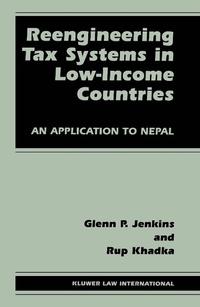
Reengineering Tax Systems in Low-Income Countries
An Application to Nepal
Published on 1. April 2002
192 pages
978-90-411-7856-5 (ISBN)
Description

This book evolved out of a series of fiscal studies prepared by a team from Harvard University of which Dr. Jenkins was the director. It analyzes the many constraints and economic characteristics found in low-income countries that affect the type of modern tax system that can work in these countries. It specifically looks at Nepal and reengineering the tax system there in terms of policy and administration.
More details
Other editions
Additional editions
Glenn Jenkins
Reengineering Tax Systems in Low-Income Countries:An Application to Nepal
An Application to Nepal
Book
04/2002
1st Edition
Kluwer Law International
€69.55
Shipment within 10-20 days
Content
- Cover
- Half Title Page
- Title Page
- Copyright Page
- PREFACE
- Table of Contents
- LIST OF TABLES
- LIST OF ANNEXES
- CHAPTER I: FRAMEWORK FOR TAX REFORM
- 1.1 Background
- 1.2 Objectives of Tax Reform
- 1.2.1 Revenue Productivity
- 1.2.2 Simplicity
- 1.2.3 Economic Neutrality
- 1.2.4 Equity
- 1.3 Elements of Tax Reform
- 1.3.1 Broadening the Tax Base
- 1.3.2 Leveling the Structure of Tax Rates
- 1.3.3 Simplifying Tax System
- 1.3.4 Improving Tax Administration
- 1.3.5 Inter-Relations of Reforms
- 1.4 Process of Tax Reform
- 1.4.1 Organization Responsible for Designing the Tax Reform Package
- 1.4.2 Designers of the Tax Reform Program
- 1.4.3 Tax Secrecy
- 1.4.4 Incremental vs. Comprehensive
- 1.5 Feasibility of Tax Reform
- 1.5.1 Political Environment
- 1.5.2 Supportive Senior Bureaucrats and Motivated Tax Administrators
- 1.5.3 Macro Economic Environment
- 1.5.4 Perception of Public Towards the Tax System
- 1.5.5. Foreign Pressure
- 1.5.6 International Reform Environment
- CHAPTER II: DOMESTIC INDIRECT TAXES
- 2.1 Introduction
- 2.2 Revenue Importance
- 2.3 Guiding Principles of Domestic Indirect Tax Reform
- 2.4 Domestic Indirect Tax Reform in Nepal in the 1990s
- 2.4.1 Excises
- 2.4.1.1 Policy
- 2.4.1.2 Administration
- 2.4.2 Sales Tax
- 2.4.2.1 Policy
- 2.4.2.2 Administration
- 2.4.3 Minor Domestic Indirect Taxes
- 2.5 Adoption of VAT
- 2.5.1 Rationale for the VAT in Low-Income Countries
- 2.5.1.1 Broaden the Tax Base
- 2.5.1.2 VAT and Tax Neutrality
- 2.5.1.3 Establishing an Account-Based System of Taxation
- 2.5.2 VAT Design for Low-Income Countries
- 2.5.2.1 Type of VAT
- 2.5.2.2 Methods of Tax Computation
- 2.5.2.3 Tax Credit Mechanism
- 2.5.2.4 VAT Coverage in Terms of Stages of Production and Distribution
- 2.5.2.5 Geographical Coverage
- 2.5.2.6 Rate
- 2.5.2.7 Exemptions
- 2.5.2.8 Zero Rating versus Exemption
- 2.5.2.9 Treatment of Special Sectors, Organizations and Transactions Agriculture
- 2.5.2.10 Administrative Procedures
- 2.5.3 VAT Development
- 2.5.4 Taxpayers Education Program
- 2.5.4.1 Interaction Programs
- 2.5.4.2 Brochures, Articles, Posters, and Video Films
- 2.5.4.3 Visits/Telephone Calls
- 2.5.5 Administration, Computerization, and Training
- 2.5.5.1 Organizational Structure
- 2.5.5.2 Computerization
- 2.5.5.3 Personnel System
- 2.5.5.4 Training
- 2.5.6 VAT Implementation
- 2.5.6.1 Registration
- 2.5.6.2 Return Submission/Non-filers
- 2.5.6.3 VAT Visits/Audits
- 2.5.6.4 Revenue Collection
- 2.6 Conclusions
- CHAPTER III: INCOME TAXES
- 3.1 Introduction
- 3.2 Income Tax Reform Efforts in Low-Income Countries
- 3.3 Rationale of Income Taxes
- 3.4 Tax Policy Considerations
- 3.4.1 Territoriality vs. Worldwide Principle
- 3.4.2 Global vs. Scheduler System
- 3.4.3 Integration between the Individual and Corporate Income Tax
- 3.4.4 Tax Base
- 3.4.4.1 Fringe Benefits
- 3.4.4.2 Retirement Savings
- 3.4.4.3 Insurance
- 3.4.4.4 Capital Gains
- 3.4.4.5 Export Income
- 3.4.4.6 Tax Incentives
- 3.4.4.7 Rent
- 3.4.4.8 Interest
- 3.4.4.9 Other Sources of Income
- 3.4.5 Tax Rates
- 3.4.6 Tax Deduction at Source
- 3.4.7 Basic Allowance vs. Tax Credit
- 3.4.7.1 Basic Allowance
- 3.4.7.2. Tax Credits
- 3.4.8 Tax Unit
- 3.4.9 Deductible Expenses
- 3.4.10 Depreciation
- 3.4.11 Carry Forward Losses
- 3.4.12 Previous vs. Current Year Basis
- 3.4.13 Adjustment for Inflation
- 3.4.14 Unilateral Relief vs. Tax Treaties
- 3.4.15 Focus on Administrative Reform
- 3.5. Conclusions
- CHAPTER IV: INTERNATIONAL TRADE TAXES
- 4.1. Background
- 4.2. Changing Structure of International Trade Taxes
- 4.3 Customs Procedures
- 4.3.1 Background
- 4.3.2 Book Value
- 4.3.3 Transaction Value
- 4.3.4 Customs Documents
- 4.3.5 Customs Inspection
- 4.3.6 Duty Drawback
- 4.4. Rationalization of International Trade Taxes
- 4.5. Preshipment Inspection (PSI) for Customs Administrative Reform
- 4.6. Conclusions
- CHAPTER V: CENTRAL-LOCAL FISCAL RELATIONS
- 5.1 Background
- 5.2 Central-Local Fiscal Relations
- Central Level Revenue Sources
- Local Level Revenue Sources
- 5.2.1 Allocation of Basic Economic Functions
- 5.2.2 Basic Revenue Allocation Options
- 5.2.2.1 Independent Local Taxes
- 5.2.2.2 Centrally Assisted Local Taxes
- 5.2.2.3 Surcharges
- 5.2.2.4 Tax Sharing
- 5.2.2.5 General Revenue Sharing
- 5.2.2.6 Selection of Taxes and Their Structure
- 5.3 Application to Nepal
- 5.3.1 Existing Nepalese Scenario
- 5.3.2 Local Tax Issues
- 5.3.2.1 Property Taxes
- 5.3.2.2 Land Transfer Tax
- 5.3.2.3 The Octroi
- 5.3.2.4 Local Development Tax
- 5.3.2.5 Motor Fuel Tax
- 5.3.2.6 Other Taxes
- 5.3.2.7 Other Measures
- 5.3.3 User Charges
- 5.3.4 Grants
- 5.3.5 Borrowings
- 5.4 Conclusions
- CHAPTER VI: TAX ADMINISTRATION
- 6.1 Tax Administration Issues
- 6.1.1 Background
- 6.1.2 Issues Related to Inappropriate Tax Mix
- 6.1.3 Revenue Targets
- 6.1.4 Defective Organizational Structure
- 6.1.5 Lack of Appropriate Human Resource Development Strategy
- 6.1.6 Complex Laws and Traditional Administrative Procedures
- 6.1.7 Primitive Management Information System
- 6.1.8 Lack of Taxpayer Education Program
- 6.1.9 Ineffective Penal System
- 6.1.10 Weak System of Appeals
- 6.2 Strategy for the Reform of the Tax Administration
- 6.2.1 Appropriate Tax Mix
- 6.2.2 Tax Liability as Per the Law
- 6.2.3 Unified Functional Organization
- 6.2.4 Human Resource Development Strategy
- 6.2.5 Simplification of Tax Laws and Procedures
- 6.2.6 Use of Information Technology
- 6.2.7 Taxpayer Education Program
- 6.2.8 Effective Penal System
- 6.2.9 Efficient System of Appeals
- 6.3 The Existing Structure versus the Revenue Authority
- 6.3.1 The Concept of the Revenue Authority
- 6.3.2 Rationale for the Revenue Authority
- 6.3.3 The Structure of the Revenue Authority
- 6.3.3.1 Governing Body
- 6.3.3.2 Scope of the Revenue Authority
- 6.3.4 Financing the Revenue Authority
- 6.3.5 Transition to the Revenue Authority
- 6.3.6 Experience with the Revenue Authority
- 6.4 Conclusions
- CHAPTER VII: CONCLUDING OBSERVATIONS
- 7.1 Approaches to the Tax Reform
- 7.2 Rationalization of International Trade Taxes
- 7.3 Reform of Domestic Indirect Taxes
- 7.4 Improvement in Income Taxation
- 7.5 Central-Local Fiscal Relations
- 7.6 Modernization of Tax Administration
- 7.7 Conclusions
- SELECTED BIBLIOGRAPHY
- Back Cover
