

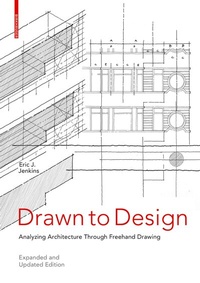
Drawn to Design
Description

Ein Studien- und Arbeitsbuch für das Zeichnen von Hand als Mittel des architektonischen Analyse- und Gestaltungsprozesses. Anhand einer systematisch gegliederten Auswahl von Zeichnungen des Autors werden die Methoden und Techniken in einer schrittweisen Darstellung detailliert vorgeführt und erläutert.
Zeichnen dient nicht der Illustration, sondern der Exploration, der Erkundung und Analyse - dies ist die Grundannahme des Buches. Im einleitenden Teil werden Theorien und Methoden des Freihandzeichnens beschrieben - bewusst parallel zu den digitalen Darstellungstechniken. Den Großteil des Buches nehmen jene Kapitel ein, die zusammen eine Typologie der wichtigsten Teile und Bereiche des Hochbaus und des Städtebaus ergeben; beispielsweise werden für die Aufgabe "Fassade" mit schematischen Skizzen die besonderen Fragestellungen herausgearbeitet und Schritt für Schritt zeichnerisch entwickelt.
In der erweiterten Neuausgabe stellt ein zusätzlicher Teil die Fragen und Erfahrungen dar, die insbesondere große Architekturbüros beim Einsatz des Freihandzeichnens für ihre Aufgaben gesammelt haben.
Das Buch reagiert auf eine sich abzeichnende Entwicklung, in der die unproduktive Konfrontation digitaler und analoger Techniken überwunden wird zugunsten der Nutzung einer breiten Auswahl von Entwurfswerkzeugen, zu denen auch das Freihandzeichnen gehört. "Drawn to Design" will zugleich die Entfaltung grundlegender menschlicher Fähigkeiten bei der Gestaltung der gebauten Umwelt fördern.
More details
Other editions
Additional editions
Person
Content
- Intro
- Contents
- Preface
- Introduction
- PART I SKETCHING, THINKING, LEARNING
- SKETCHING, THINKING, LEARNING
- Sketching: A Means to Different Ends
- Analysis: From Looking to Understanding
- What Is a Diagram?
- Diagrams and Design Practice
- Developing Spatial Knowledge and Material Analogies
- Synthesizing: From Analysis to Design
- Conclusion
- PART II DESIGN ACTS
- Introduction
- MAPPING THE PLAN
- TRAVERSING THE SECTION
- FACING THE BUILDING
- PROBING THE DETAILS
- ENGAGING THE CONTEXT
- PART III HOLISTIC ACTS
- Introduction
- Sketching Apparent Simplicity
- Representing a Layered Experience
- Conceptual Memory of Place
- Simply Complex
- Sketching Essentials
- Speculate on Systems
- A Meditative Experience
- 2D to 3D
- What Makes a Place Unique
- Lines of Thought
- Visible Guidelines
- Working All over the Page
- Acts of Appreciation
- Self-Awareness in Drawing
- Encounters
- The Nature of Entry and Threshold
- A Holistic Journey
- Conceptual and Perceptual Drawings
- PART IV SKETCHING IN CONTEMPORARY PRACTICE
- Introduction
- AECOM
- CallisonRTKL
- CannonDesign
- Corgan
- DLR Group
- HDR
- HKS
- IBI Group
- Jacobs
- Leo A Daly
- NBBJ
- Perkins Eastman
- Perkins&
- Will
- Populous
- SmithGroup
- Stantec
- APPENDIX
- Bibliography
- Interview Bibliography
- Illustration Credits
- On the Author
- Acknowledgments
- Index of Buildings
- Index of Building Types
- Index of Locations
- Index of Media
- Index of Persons and Firms
- Index of Subjects
