

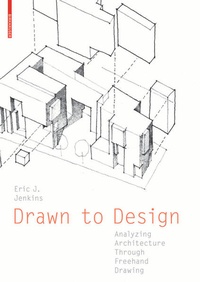
Drawn to Design
Description

Ein Studien- und Arbeitsbuch für das Zeichnen von Hand als Mittel des architektonischen Analyse- und Gestaltungsprozesses. Anhand einer systematisch gegliederten Auswahl von Zeichnungen des Autors werden die Methoden und Techniken in einer schrittweisen Darstellung detailliert vorgeführt und erläutert.
Zeichnen dient nicht der Illustration, sondern der Exploration, der Erkundung und Analyse - dies ist die Grundannahme des Buches. Im einleitenden Teil werden Theorien und Praktiken der Anwendung von Freihand-zeichnungen an Universitäten und in Büros beschrieben - bewusst parallel zu den digitalen Darstellungstechniken. Den Großteil des Buches nehmen jene Kapiteln ein, die zusammen eine Typologie der wichtigsten Teile und Bereiche des Hochbaus und des Städtebaus ergeben; beispielsweise werden für die Aufgabe "Fassade" mit schematischen Skizzen die besonderen Fragestellungen herausgearbeitet und Schritt für Schritt zeichnerisch entwickelt.
Das Buch reagiert auf eine sich abzeichnende Entwicklung, in der die unproduktive Konfrontation digitaler und analoger Techniken überwunden wird zugunsten der Nutzung einer breiten Auswahl von Entwurfswerkzeugen, zu denen auch das Freihandzeichnen gehört. "Drawn to Design" will zugleich die Entfaltung grundlegender menschlicher Fähigkeiten bei der Gestaltung der gebauten Umwelt fördern.
More details
Other editions
Additional editions
Person
Content
- Intro
- Preface
- introduction
- PART I. sketching, thinking, learning
- sketching, Thinking, Learning
- sketching as a Bodily skill
- Learning (and Re-Learning) to Draw
- Learning to Sketch Without Thinking
- Practicing to Practice
- sketching and Thinking
- What is Analysis?
- The Context-bound Position
- The Autonomous Position
- Formal Analysis
- Context-bound Critical Analysis
- Analysis from a Dynamic Intermediate Position
- Not All Sketches are Equal: Syntactic Sketch Diagrams
- What are Diagrams?
- How are Diagrams Used?
- Developing Spatial Knowledge and Material Analogies
- Sketching as a Physical Analogy
- sketching and Learning
- what to Use and How to Use It
- Tools of the Trade
- Drawing the Lines
- Building a Drawing
- Habits to Help Development of Tool Use
- Reflective Practice
- SPQR
- Line and Time Budgets
- Drawing Types for Advanced study
- Sketching in Axonometric
- Putting Things in Perspective
- Placing the Diagrams on a Page
- The Exquisite Corpse
- Collage Diagrams
- PART II. DEsiGN ACTs
- Introduction
- Mapping the Plan
- Clarifying Public/Private
- Delineating Service and Served
- Demarcating Profane and Sacred
- Relating Materials
- Filling Walls
- Responding to Light
- Connecting Rooms and Paths
- Uniting Connections
- Aligning Edges and Centers
- Stitching Tartans
- Shifting Geometries
- Overlapping Spatial Patterns
- Engaging the Landscape
- Fashioning Order and Disorder
- Resolving Geometries
- Extracting Voids from Poché
- Composing Tectonic Order
- Reconciling Structure and Enclosure
- Disposing Walls
- Classifying Type: the Infill
- Classifying Type: the Bar
- Classifying Type: the Courtyard
- Traversing the section
- Orchestrating Sequence
- Entering the Building
- Passing through Buildings
- Articulating Path and Room
- Ascending Stairs
- Stepping with the Landscape
- Considering Circulation
- Compressing and Expanding Sequences
- Walking beneath Portals
- Moving through Layers
- Linking Profane with Sacred
- Interfacing Public with Private
- Interlocking Sections
- Carving Voids
- Shaping the Floor
- Reinforcing with Tectonics
- Expanding Atria
- Sensing Scale
- Reconciling Ideal and Real
- Arranging Voids
- Sculpting Light
- Facing the Building
- Revealing Tartans
- Disposing Symmetry and Asymmetry
- Addressing Entry
- Alternating Edges and Centers
- Establishing and Then Breaking Order
- Diagnosing Proportional Systems
- Connecting Scales
- Understanding Continuity
- Attaching to Context
- Harmonizing Forms
- Arranging Mass
- Balancing Mass
- Subtracting Voids/Adding Figures
- Expressing Planes
- Weaving Structure and Enclosure
- Viewing Layers
- Relating Base-Middle-Top
- Topping the Building
- Turning the Corner
- Seeing Windows
- Highlighting Shadows
- Probing the Details
- Finding Rooms within Rooms
- Sheltering within a Room
- Opening Doors
- Framing Views
- Shading Glass
- Adjusting Panels
- Incorporating Furniture
- Categorizing Joints
- Expressing Connections
- Joining Wood
- Assembling with Third Things
- Aligning Seams
- Changing Material
- Interlocking Masonry
- Organizing Geometries
- Gripping the Rail
- Grasping Knobs
- Studying Unintended Consequences 1
- Studying Unintended Consequences 2
- Engaging the Context
- Orienting Oneself
- Discovering Lynch's Elements
- Coordinating Object and Fabric
- Resolving Geometries
- Mediating with Shifts
- Rotating and Pivoting
- Screening Spaces
- Lining with Trees
- Layering Space
- Corresponding Solid and Void
- Highlighting Space in Fabric
- Drawing the Nolli
- Passing Laterally
- Identifying Building Types
- Emphasizing Types
- Enclosing Urban Rooms
- Informing the Street Section
- Negotiating Stairs and Ramps
- Strolling through Place
- PART III. Holistic acts
- Introduction
- Typological Study of Place
- Discover Artificiality
- Conceptual Memory of Place
- Simply Complex
- Capturing Sense of Place
- A Set of Partial Interpretations
- Speculate on Systems
- A Meditative Experience
- 2D to 3D
- What Makes a Place Unique
- Lines of Thought
- Visible Guidelines
- The Gem and the Setting
- In Focus
- Acts of Appreciation
- Self-Awareness in Drawing
- Encounters
- The Nature of Entry and Threshold
- A Holistic Journey
- Conceptual and Perceptual Drawings
- Appendix
- Bibliography
- Photo Credits
- On the Author
- Acknowledgements
- Index of Buildings
- Index of Building Types
- Subject Index
- Index of Locations
- Index of Persons
- Index of Media
