

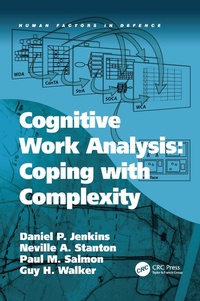
Cognitive Work Analysis: Coping with Complexity
Published on 18. September 2017
298 pages
978-1-317-16470-8 (ISBN)
Description

'Complex sociotechnical systems' are systems made up of numerous interacting parts, both human and non-human, operating in dynamic, ambiguous and safety critical domains. Cognitive Work Analysis (CWA) is a structured framework specifically developed for considering the development and analysis of these complex socio-technical systems. Unlike many human factors approaches, CWA does not focus on how human-system interaction should proceed (normative modelling) or how human-system interaction currently works (descriptive modelling). Instead, through a focus on constraints, it develops a model of how work can be conducted within a given work domain, without explicitly identifying specific sequences of actions (formative modelling). The framework leads the analyst to consider the environment the task takes place within, and the effect of the imposed constraints on the way work can be conducted. It provides guidance through the process of answering the questions of why the system exists, what activities can be conducted within the domain as well as how these activities can be achieved, and who can perform them. The first part of the book contains a comprehensive description of CWA, introducing it to the uninitiated. It then presents a number of applications in complex military domains to explore and develop the benefits of CWA. Unlike much of the previous literature, particular attention is placed on exploring the CWA framework in its entirety. This holistic approach focuses on the system environment, the activity that takes place within it, the strategies used to conduct this activity, the way in which the constituent parts of the system (both human and non-human) interact and the behaviour required. Each stage of this analysis identifies the constraints governing the system; it is contended that through this holistic understanding of constraints, recommendations can be made for the design of system interaction; increasing the ability of users to cope with unanticipated, unexpected situations. This book discusses the applicability of the approach in system analysis, development and evaluation. It provides process to what was previously a loosely defined framework.
Reviews / Votes
'The book Cognitive Work Analysis: Coping with Complexity, elegantly, intuitively and compellingly makes the case for why cognitive work analysis (CWA) is different from, and provides great value added to, the two more traditional human factors techniques of hierarchical task analysis, and participatory user-centered design. Such value is particularly relevant in the emerging domain of complex multi-operator, multi-agent systems; which must react appropriately to unexpected and unpredicted events (the world's economy being a recent example). The focus of the CWA technique is not so much on what should be done in system interaction (the traditional techniques), but what could be done, given the combination of constraints from human cognition, physical capabilities and the environment. As such, the authors have built on the foundational work of Rasmussen and Vicente, but have gone beyond in three important respects: First, in an effort to reach a wide audience, they have started with simple systems (basic interface design), to gradually move the reader's understanding toward the more complex systems; second, they ultimately consider a wide variety of system applications beyond the process control domain where CWA had most traditionally been applied. The applications to command and control systems are particularly insightful; third, they place considerable emphasis on teaching the reader how to do CWA, in a way that can bring this technique closer to a wide variety of applications. Because the book is also clearly and intuitively written, with plenty of examples, it should be a valuable addition to the toolbox of human factors practitioners, who must confront the many complex, distributed net-centric and ill-defined tasks, carried out increasingly by workers in the information age of the 21st century.' Christopher D. Wickens, University of Illinois and University of Colorado, USA 'How do you deal with burgeoning and interactive sources of uncertainty while all theMore details
Series
Language
English
Place of publication
London
United Kingdom
Publishing group
Taylor & Francis Ltd
Target group
College/higher education
Product notice
Reflowable
File size
14,11 MB
ISBN-13
978-1-317-16470-8 (9781317164708)
Copyright in bibliographic data and cover images is held by Nielsen Book Services Limited or by the publishers or by their respective licensors: all rights reserved.
Schweitzer Classification
Other editions
Additional editions
Daniel P. Jenkins | Neville A. Stanton | Guy H. Walker
Cognitive Work Analysis: Coping with Complexity
Coping with Complexity
Book
03/2017
1st Edition
CRC Press
€86.50
Shipment within 10-20 days
Daniel P. Jenkins | Neville A. Stanton | Guy H. Walker
Cognitive Work Analysis: Coping with Complexity
Coping with Complexity
Book
12/2008
1st Edition
Ashgate Publishing Limited
€241.30
Shipment within 10-20 days
Persons
Daniel P. Jenkins, Neville A. Stanton, Guy H. Walker
Content
Contents: Introduction; It's a complex world; Interaction design; Application of CWA in familiar domains; Applications of CWA in a complex world; Using CWA to design for dynamic allocation of function; Designing interfaces using CWA; Development of a CWA software tool; Does the tool make the CWA process any quicker or easier?; Conclusions; Appendix; Bibliography; Index.
