

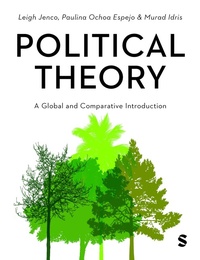
Political Theory
A Global and Comparative Introduction
1st Edition
Published on 19. February 2025
272 pages
978-1-0362-0262-0 (ISBN)
Description

This groundbreaking work presents a transformative perspective on political theory. This text is not just an introduction to political theory, it's a call to broaden the discipline's horizons, making it more globally aware and methodologically diverse.
The authors introduce a novel approach to political theory that expands the scope of the discipline beyond traditional philosophical texts and Eurocentric perspectives. The text integrates canonical Western texts with diverse sources of political thought from a wide range of times and places - spanning the Vedas to the Quran, the Upanishads to the Popol Vuh. This is the first introductory text to incorporate such a variety of texts and authors with each thinker (whether Plato or Laozi, Du Bois or Confucius) introduced in a way that's both accessible and relevant today.
The text also demonstrates the possibilities for comparison and connections in teaching political theory. Cross-cutting themes of gender, race and colonialism connect disparate ideas across time periods and geographies, forging a comprehensive network of political thought.
This pioneering textbook reshapes the way political theory is taught and understood and is an essential companion for all undergraduate and postgraduate students of political theory as much as it will be for anyone interested in global political thought. This text is a must-read for anyone looking to understand the full spectrum of political thought and its application in today's interconnected world.
The authors introduce a novel approach to political theory that expands the scope of the discipline beyond traditional philosophical texts and Eurocentric perspectives. The text integrates canonical Western texts with diverse sources of political thought from a wide range of times and places - spanning the Vedas to the Quran, the Upanishads to the Popol Vuh. This is the first introductory text to incorporate such a variety of texts and authors with each thinker (whether Plato or Laozi, Du Bois or Confucius) introduced in a way that's both accessible and relevant today.
The text also demonstrates the possibilities for comparison and connections in teaching political theory. Cross-cutting themes of gender, race and colonialism connect disparate ideas across time periods and geographies, forging a comprehensive network of political thought.
This pioneering textbook reshapes the way political theory is taught and understood and is an essential companion for all undergraduate and postgraduate students of political theory as much as it will be for anyone interested in global political thought. This text is a must-read for anyone looking to understand the full spectrum of political thought and its application in today's interconnected world.
More details
Edition
1. Auflage
Language
English
Place of publication
United Kingdom
Publishing group
SAGE Publishing (Digital)
Target group
College/higher education
Product notice
Reflowable
ISBN-13
978-1-0362-0262-0 (9781036202620)
Copyright in bibliographic data and cover images is held by Nielsen Book Services Limited or by the publishers or by their respective licensors: all rights reserved.
Schweitzer Classification
Other editions
Additional editions
Leigh Jenco | Paulina Ochoa Espejo | Murad Idris
Political Theory
A Global and Comparative Introduction
Book
02/2025
1st Edition
SAGE Publications Ltd
€237.30
Shipment within 3-4 weeks
Leigh Jenco | Paulina Ochoa Espejo | Murad Idris
Political Theory
A Global and Comparative Introduction
Book
02/2025
1st Edition
SAGE Publications Ltd
€48.79
Shipment within 3-4 weeks
Persons
Leigh Jenco is Professor of Political Theory at the London School of Economics and Political Science. She has taught at universities all over the world, including Singapore, Taiwan, Germany and the US. Her research specialism is Chinese political thought, from the late imperial to the modern era. Her publications include Changing Referents: Learning Across Space and Time in China and the West (Oxford University Press, 2015) and Making the Political: Founding and Action in the Political Theory of Zhang Shizhao (Cambridge University Press, 2010). She is also co-editor (with Murad Idris and Megan Thomas) of the definitive Oxford Handbook of Comparative Political Theory (Oxford University Press, 2020).
Paulina Ochoa Espejo is Professor of Politics at the University of Virginia in the USA. She has written on democratic theory, territorial rights, and Latin American political thought. She is the author of On Borders: Territories, Legitimacy and the Rights of Place (Oxford University Press, 2020) and The Time of Popular Sovereignty: Process and the Democratic State (Penn State University Press, 2011) co-editor of the Oxford Handbook of Populism (Oxford University Press, 2017) and of articles in Political Theory the American Journal of Political Science, Journal of Political Philosophy and the Journal of Politics among others. She has taught "Introduction to Political Theory" for almost 20 years, both at liberal arts colleges and research universities.
Murad Idris is Associate Professor of Political Science at the University of Michigan in the US. He writes on war, peace, empire, anticolonialism, religion, and Islamic political thought. He is the author of War for Peace: Genealogies of a Violent Ideal in Western and Islamic Thought (Oxford University Press, 2019) and co-editor with Leigh Jenco and Megan Thomas of The Oxford Handbook of Comparative Political Theory (Oxford University Press, 2020). His articles have appeared in Perspectives on Politics, Critical Times, Political Theory, Modern Intellectual History, and European Journal of Political Theory, among others. At the University of Michigan, he teaches classes that span the history of ancient, modern, and contemporary political thought.
Paulina Ochoa Espejo is Professor of Politics at the University of Virginia in the USA. She has written on democratic theory, territorial rights, and Latin American political thought. She is the author of On Borders: Territories, Legitimacy and the Rights of Place (Oxford University Press, 2020) and The Time of Popular Sovereignty: Process and the Democratic State (Penn State University Press, 2011) co-editor of the Oxford Handbook of Populism (Oxford University Press, 2017) and of articles in Political Theory the American Journal of Political Science, Journal of Political Philosophy and the Journal of Politics among others. She has taught "Introduction to Political Theory" for almost 20 years, both at liberal arts colleges and research universities.
Murad Idris is Associate Professor of Political Science at the University of Michigan in the US. He writes on war, peace, empire, anticolonialism, religion, and Islamic political thought. He is the author of War for Peace: Genealogies of a Violent Ideal in Western and Islamic Thought (Oxford University Press, 2019) and co-editor with Leigh Jenco and Megan Thomas of The Oxford Handbook of Comparative Political Theory (Oxford University Press, 2020). His articles have appeared in Perspectives on Politics, Critical Times, Political Theory, Modern Intellectual History, and European Journal of Political Theory, among others. At the University of Michigan, he teaches classes that span the history of ancient, modern, and contemporary political thought.
Content
Chapter 1: What is political theory?
Chapter 2: Great texts
Chapter 3: The origins of politics
Chapter 4: War and violence
Chapter 5: The state and its alternatives
Chapter 6: Political action
Chapter 7: Property and territory
Chapter 8: Equality and hierarchy
Chapter 9: Ritual
Chapter 10: Development and progress
Chapter 11: Gender, race, and colonialism
Chapter 2: Great texts
Chapter 3: The origins of politics
Chapter 4: War and violence
Chapter 5: The state and its alternatives
Chapter 6: Political action
Chapter 7: Property and territory
Chapter 8: Equality and hierarchy
Chapter 9: Ritual
Chapter 10: Development and progress
Chapter 11: Gender, race, and colonialism
