

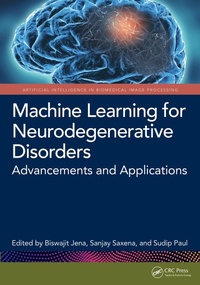
Machine Learning for Neurodegenerative Disorders
Advancements and Applications
1st Edition
Published on 31. March 2025
264 pages
978-1-040-31791-4 (ISBN)
Description

This book explores the application of machine learning to the understanding, early diagnosis, and management of neurodegenerative disorders. With a specific focus on its role in ongoing clinical trials, the book covers essential topics such as data collection, pre-processing, feature extraction, model development, and validation techniques. It delves into the applications of neuroimaging techniques like magnetic resonance imaging (MRI), computed tomography (CT), and positron emission tomography (PET) in the diagnosis and understanding of neurodegenerative disorders. Additionally, the book examines various machine-learning algorithms employed for biomarker discovery in neurodegenerative disorders. It highlights the role of neuroinformatics and big data analysis in advancing the understanding and management of neurodegenerative disorders. Furthermore, the book reviews future prospects and presents the ethical considerations and regulatory challenges associated with implementing machine learning approaches in the diagnosis, treatment, and prevention of neurodegenerative disorders. This comprehensive resource is intended for neuroscientists, students, researchers, and neurologists to understand the emerging scope of machine learning in neurodegenerative disorders.
More details
Series
Edition
1. Auflage
Language
English
Place of publication
London
United Kingdom
Publishing group
Taylor & Francis Ltd
Target group
College/higher education
Professional and scholarly
Illustrations
21 Tables, black and white; 64 Line drawings, color; 8 Line drawings, black and white; 64 Illustrations, color; 8 Illustrations, black and white
File size
17,32 MB
ISBN-13
978-1-040-31791-4 (9781040317914)
Copyright in bibliographic data and cover images is held by Nielsen Book Services Limited or by the publishers or by their respective licensors: all rights reserved.
Schweitzer Classification
Other editions
Additional editions
Biswajit Jena | Sanjay Saxena | Sudip Paul
Machine Learning for Neurodegenerative Disorders
Advancements and Applications
Book
03/2025
1st Edition
CRC Press
€204.40
Shipment within 10-20 days
Persons
Dr. Biswajit Jena is an assistant professor in the Computer Science and Engineering Department at ITER, SOA (Deemed to be University), Bhubaneswar, India. He received his PhD from IIIT-Bhubaneswar, India, in Biomedical Image Analysis, which employs Artificial Intelligence, and his MTech degree in Computer Science and Engineering from NIT, Rourkela, India. His broad research interests are biomedical image processing, neuro-oncology, radiogenomics, machine learning, and deep learning. He has published over 30 journal and conference papers and has contributed his knowledge as an editorial board member and reviewer for multiple international journals.
Dr. Sanjay Saxena is the Director and CEO of Research, Innovation, Projects, Incubation and Technology Transfer (RIPITT) Foundation and serves as Assistant Professor in the Computer Science Department at IIIT Bhubaneswar. He obtained his PhD from the Indian Institute of Technology (BHU), Varanasi, Uttar Pradesh, India, and completed his postdoctoral research at the Artificial Intelligence in Biomedical Imaging Lab, University of Pennsylvania, Philadelphia, PA, United States. Dr. Saxena's primary research area includes developing AI-based methods for brain cancer analysis, with a broader focus on data science, machine learning, deep learning, and the emerging fields of radiomics and radiogenomics. His tenure under Professor Christos Davatzikos at the University of Pennsylvania was instrumental in his significant learning about radiomics/radiogenomics. He has presented his work at globally recognized universities such as Imperial College London, Stony Brook University, and Vienna University of Technology and has made substantial scholarly contributions to several peer-reviewed journals, conference publications, books, and book chapters.
Dr. Sudip Paul is currently an Associate Professor in the Department of Biomedical Engineering at North-Eastern Hill University, Shillong, India. He completed his post-doctoral research at the School of Computer Science and Software Engineering, the University of Western Australia, Perth, under the scheme of Biotechnology Overseas Associateship for the Scientists working in the North Eastern States of India: 2017-18, supported by the Department of Biotechnology, Government of India. He received his PhD from the Indian Institute of Technology (Banaras Hindu University), Varanasi, with a specialization in electrophysiology and brain signal analysis. He also organized many workshops and conferences, most significant are the Indian Academy of Neuroscience Annual Meeting 2022, IEEE Conference on Computational Performance Evaluation 2020 and 2021; IRBO/APRC Associate School 2017; IBRO Global Engagement 2021; IBRO Meeting 2021 and the 29th Annual meeting of the Society for Neurochemistry, India 2015. Dr. Sudip has published nearly 60 international/national journal papers and more than 40 conference papers on different international/national platforms. He filed eight patents, of which four were granted. He completed 20 book projects with Springer Nature, Elsevier, IGI Global, etc., as an editor/author. Dr. Sudip is a senior member of IEEE and also a member of different societies and professional bodies, including IEEE-IAS, APSN, ISN, IBRO, etc. He received many awards, especially the World Federation of Neurology (WFN) traveling fellowship, Young Investigator Award, IBRO Travel Awardee, and ISN Travel Awardee. Dr. Sudip also contributed his knowledge in different international journals as an editorial board member and reviewer. He has presented his research accomplishments in many countries, such as the USA, Greece, France, South Africa, and Australia.
Dr. Sanjay Saxena is the Director and CEO of Research, Innovation, Projects, Incubation and Technology Transfer (RIPITT) Foundation and serves as Assistant Professor in the Computer Science Department at IIIT Bhubaneswar. He obtained his PhD from the Indian Institute of Technology (BHU), Varanasi, Uttar Pradesh, India, and completed his postdoctoral research at the Artificial Intelligence in Biomedical Imaging Lab, University of Pennsylvania, Philadelphia, PA, United States. Dr. Saxena's primary research area includes developing AI-based methods for brain cancer analysis, with a broader focus on data science, machine learning, deep learning, and the emerging fields of radiomics and radiogenomics. His tenure under Professor Christos Davatzikos at the University of Pennsylvania was instrumental in his significant learning about radiomics/radiogenomics. He has presented his work at globally recognized universities such as Imperial College London, Stony Brook University, and Vienna University of Technology and has made substantial scholarly contributions to several peer-reviewed journals, conference publications, books, and book chapters.
Dr. Sudip Paul is currently an Associate Professor in the Department of Biomedical Engineering at North-Eastern Hill University, Shillong, India. He completed his post-doctoral research at the School of Computer Science and Software Engineering, the University of Western Australia, Perth, under the scheme of Biotechnology Overseas Associateship for the Scientists working in the North Eastern States of India: 2017-18, supported by the Department of Biotechnology, Government of India. He received his PhD from the Indian Institute of Technology (Banaras Hindu University), Varanasi, with a specialization in electrophysiology and brain signal analysis. He also organized many workshops and conferences, most significant are the Indian Academy of Neuroscience Annual Meeting 2022, IEEE Conference on Computational Performance Evaluation 2020 and 2021; IRBO/APRC Associate School 2017; IBRO Global Engagement 2021; IBRO Meeting 2021 and the 29th Annual meeting of the Society for Neurochemistry, India 2015. Dr. Sudip has published nearly 60 international/national journal papers and more than 40 conference papers on different international/national platforms. He filed eight patents, of which four were granted. He completed 20 book projects with Springer Nature, Elsevier, IGI Global, etc., as an editor/author. Dr. Sudip is a senior member of IEEE and also a member of different societies and professional bodies, including IEEE-IAS, APSN, ISN, IBRO, etc. He received many awards, especially the World Federation of Neurology (WFN) traveling fellowship, Young Investigator Award, IBRO Travel Awardee, and ISN Travel Awardee. Dr. Sudip also contributed his knowledge in different international journals as an editorial board member and reviewer. He has presented his research accomplishments in many countries, such as the USA, Greece, France, South Africa, and Australia.
Content
1. Introduction to Brain Diseases. 2. Introduction to Machine Learning for Neurodegenerative Disorders. 3. Multi-modal Neuroimaging Techniques and Fusion in Neurodegenerative Disorders. 4. Data Collection and Pre-processing for Neurodegenerative Disorders. 5. Machine Learning Fundamentals for Analysis of Neurodegenerative Disorders. 6. Deep Learning in Neurodegenerative Disorder. 7. Harnessing the Power of Neuroinformatics and Big Data Analysis against Neurodegenerative Disorders. 8. Machine Learning Applications in Neurodegenerative Diseases. 9. Machine Learning in Stroke Analysis and Rehabilitation. 10. Biomarker Identification in Neurodegenerative Disorders through Machine Learning. 11. Future Directions and Challenges in Machine Learning Approaches for Analysis of Neurodegenerative Disorders
