

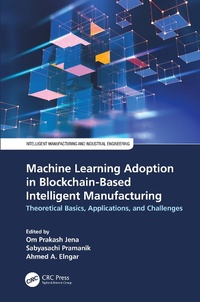
Machine Learning Adoption in Blockchain-Based Intelligent Manufacturing
Theoretical Basics, Applications, and Challenges
1st Edition
Published on 22. June 2022
204 pages
978-1-000-60027-8 (ISBN)
Description

This book looks at industry change patterns and innovations (such as artificial intelligence, machine learning, big data analysis, and blockchain support and efficiency technology) that are speeding up industrial transformation, industrial infrastructure, biodiversity, and productivity.
This book focuses on real-world industrial applications and case studies to provide for a wider knowledge of intelligent manufacturing. It also offers insights into manufacturing, logistics, and supply chain, where systems have undergone an industrial transformation. It discusses current research of machine learning along with blockchain techniques that can fill the gap between research and industrial exposure. It goes on to cover the effects that the Fourth Industrial Revolution has on industrial infrastructures and looks at the current industry change patterns and innovations that are accelerating industrial transformation activities.
Researchers, scholars, and students from different countries will appreciate this book for its real-world applications and knowledge acquisition. This book targets manufacturers, industry owners, product developers, scientists, logistics, and supply chain engineers.
Focuses on real-world industrial applications and case studies to provide for a wider knowledge of intelligent manufacturing
Offers insights into manufacturing, logistics, and supply chain where systems have undergone an industrial transformation
Discusses current research of machine learning along with blockchain techniques that can fill the gap between research and industrial exposure
Covers the effects that the 4th Industrial Revolution has on industrial infrastructures
Looks at industry change patterns and innovations that are speeding up industrial transformation activities
This book focuses on real-world industrial applications and case studies to provide for a wider knowledge of intelligent manufacturing. It also offers insights into manufacturing, logistics, and supply chain, where systems have undergone an industrial transformation. It discusses current research of machine learning along with blockchain techniques that can fill the gap between research and industrial exposure. It goes on to cover the effects that the Fourth Industrial Revolution has on industrial infrastructures and looks at the current industry change patterns and innovations that are accelerating industrial transformation activities.
Researchers, scholars, and students from different countries will appreciate this book for its real-world applications and knowledge acquisition. This book targets manufacturers, industry owners, product developers, scientists, logistics, and supply chain engineers.
Focuses on real-world industrial applications and case studies to provide for a wider knowledge of intelligent manufacturing
Offers insights into manufacturing, logistics, and supply chain where systems have undergone an industrial transformation
Discusses current research of machine learning along with blockchain techniques that can fill the gap between research and industrial exposure
Covers the effects that the 4th Industrial Revolution has on industrial infrastructures
Looks at industry change patterns and innovations that are speeding up industrial transformation activities
More details
Series
Edition
1. Auflage
Language
English
Place of publication
London
United Kingdom
Publishing group
Taylor & Francis Ltd
Target group
College/higher education
Professional and scholarly
Illustrations
12 Tables, black and white; 28 Line drawings, black and white; 43 Halftones, black and white; 71 Illustrations, black and white
ISBN-13
978-1-000-60027-8 (9781000600278)
Copyright in bibliographic data and cover images is held by Nielsen Book Services Limited or by the publishers or by their respective licensors: all rights reserved.
Schweitzer Classification
Other editions
Additional editions
Om Prakash Jena | Sabyasachi Pramanik | Ahmed A. Elngar
Machine Learning Adoption in Blockchain-Based Intelligent Manufacturing
Theoretical Basics, Applications, and Challenges
Book
10/2024
1st Edition
CRC Press
€73.60
Shipment within 10-20 days
Om Prakash Jena | Sabyasachi Pramanik | Ahmed A. Elngar
Machine Learning Adoption in Blockchain-Based Intelligent Manufacturing
Theoretical Basics, Applications, and Challenges
Book
06/2022
1st Edition
CRC Press
€206.10
Shipment within 10-20 days
Persons
Om Prakash Jena is currently working as an Assistant Professor in the Department of Computer Science, Ravenshaw University, Cuttack, Odisha, India. He has 11 years of teaching and research experience in the undergraduate and postgraduate levels. He has published several technical papers in international journals/conferences/edited book chapters of reputed publications. He is a member of IEEE, IETA, IAAC, IRED, IAENG, and WACAMLDS. His current research interest includes Database, Pattern Recognition, Cryptography, Network Security, Artificial Intelligence, Machine Learning, Soft Computing, Natural Language Processing, Data Science, Compiler Design, Data Analytics, and Machine Automation. He has many edited books, published by Wiley, CRC press, Bentham Publication to his credit, and he is also the author of two textbooks under Kalyani Publisher. He serves as a review committee member and editor of many international journals and has five patents in national as well as international approval.
Sabyasachi Pramanik is a Professional IEEE member. He obtained his Ph.D. in Computer Science and Engineering from the Sri Satya Sai University of Technology and Medical Sciences, Bhopal, India. Presently, he is an Assistant Professor in the Department of Computer Science and Engineering, Haldia Institute of Technology, India. He has many publications in various reputed international conferences, journals, and online book chapter contributions (Indexed by SCIE, Scopus, ESCI, etc.). He is researching the field of Artificial Intelligence, Data Privacy, IoT, Network Security, and Machine Learning. He is also serving as the editorial board member of many international journals. Dr. Pramanik is a reviewer of journal articles from IEEE, Springer, Elsevier, Inderscience, IET, and IGI Global and has reviewed many conference papers, has been a keynote speaker, session chair, and has been a technical program committee member for many international conferences. He has authored a book on Wireless Sensor networks. Currently, he is editing six books from IGI Global, CRC Press, EAI/Springer, and Scrivener-Wiley.
Ahmed A. Elngar is the Chair of Scientific Innovation Research Group (SIRG) Director of Technological and Informatics Studies Center Managing Editor of Journal of Cybersecurity and Information Management (JCIM), Beni-Suef University, Faculty of Computers & Artificial Intelligence, Egypt. Dr. Elngar is the Founder and Head of the Scientific Innovation Research Group (SIRG) and Assistant Professor of Computer Science at the Faculty of Computers and Information, Beni-Suef University. Dr. Elngar is a Director of the Technological and Informatics Studies Center (TISC), Faculty of Computers and Information, Beni-Suef University. He is a Managing Editor: Journal of Cybersecurity and Information Management (JCIM). Dr. Elngar has more than 25 scientific research papers published in prestigious international journals and over 5 books covering such diverse topics as data mining, intelligent systems, social networks, and smart environment. Research works and publications. Dr. Elngar is a collaborative researcher and a member of the Egyptian Mathematical Society (EMS) and International Rough Set Society (IRSS). His other research areas include Internet of Things (IoT), Network Security, Intrusion Detection, Machine Learning, Data Mining, Artificial Intelligence. Big Data, Authentication, Cryptology, Healthcare Systems, Automation Systems.
Sabyasachi Pramanik is a Professional IEEE member. He obtained his Ph.D. in Computer Science and Engineering from the Sri Satya Sai University of Technology and Medical Sciences, Bhopal, India. Presently, he is an Assistant Professor in the Department of Computer Science and Engineering, Haldia Institute of Technology, India. He has many publications in various reputed international conferences, journals, and online book chapter contributions (Indexed by SCIE, Scopus, ESCI, etc.). He is researching the field of Artificial Intelligence, Data Privacy, IoT, Network Security, and Machine Learning. He is also serving as the editorial board member of many international journals. Dr. Pramanik is a reviewer of journal articles from IEEE, Springer, Elsevier, Inderscience, IET, and IGI Global and has reviewed many conference papers, has been a keynote speaker, session chair, and has been a technical program committee member for many international conferences. He has authored a book on Wireless Sensor networks. Currently, he is editing six books from IGI Global, CRC Press, EAI/Springer, and Scrivener-Wiley.
Ahmed A. Elngar is the Chair of Scientific Innovation Research Group (SIRG) Director of Technological and Informatics Studies Center Managing Editor of Journal of Cybersecurity and Information Management (JCIM), Beni-Suef University, Faculty of Computers & Artificial Intelligence, Egypt. Dr. Elngar is the Founder and Head of the Scientific Innovation Research Group (SIRG) and Assistant Professor of Computer Science at the Faculty of Computers and Information, Beni-Suef University. Dr. Elngar is a Director of the Technological and Informatics Studies Center (TISC), Faculty of Computers and Information, Beni-Suef University. He is a Managing Editor: Journal of Cybersecurity and Information Management (JCIM). Dr. Elngar has more than 25 scientific research papers published in prestigious international journals and over 5 books covering such diverse topics as data mining, intelligent systems, social networks, and smart environment. Research works and publications. Dr. Elngar is a collaborative researcher and a member of the Egyptian Mathematical Society (EMS) and International Rough Set Society (IRSS). His other research areas include Internet of Things (IoT), Network Security, Intrusion Detection, Machine Learning, Data Mining, Artificial Intelligence. Big Data, Authentication, Cryptology, Healthcare Systems, Automation Systems.
Content
1. Integration of Big Data, Machine Learning, and Blockchain Technology. 2. Blockchain in Digital Libraries: State of the Art, Trends, and Challenges. 3. An Integration of Blockchain and Machine Learning into the Health Care System. 4. Blockchain for the Industrial Internet of Things. 5. Security Measures for Blockchain Technology. 6. An Analysis of Data Management in Industry 4.0 Using Big Data Analytics. 7. Exploring Role of Industry 4.0 Techniques for Building a Promising Circular Economy Concept: Manufacturing Industry Perspective. 8. Comparative Analysis of Blockchain-Based Consensus Algorithms for Suitability in Critical IoT Infrastructures. 9. Quantum Machine Learning and Big Data for Real-Time Applications: A Review. 10. Sensors-Based Automatic Human Body Detection and Prevention System to Avoid Entrap Mortality inside a Vehicle. 11. A Mechanism to Protect Decentralized Transaction Using Blockchain Technology.
