

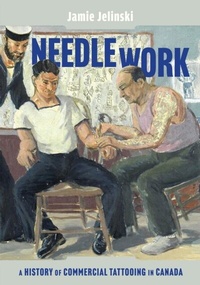
Needle Work
A History of Commercial Tattooing in Canada
1st Edition
Published on 15. June 2024
425 pages
978-0-2280-2199-5 (ISBN)
Description

In 1891 J. Murakami travelled from Japan, via San Francisco, to Vancouver Island and began working in and around Victoria. His occupation: creating permanent images on the skin of paying clients.
From this early example of tattooing as work, Jamie Jelinski takes us from coast to coast with detours to the United States, England, and Japan as he traces the evolution of commercial tattooing in Canada over more than one hundred years. Needle Work offers insight into how tattoo artists navigated regulation, the types of spaces they worked in, and the dynamic relationship between the images they tattooed on customers and other forms of visual culture and artistic enterprise. Merging biographical narratives with an examination of tattooing's place within wider society, Jelinski reveals how these commercial image makers bridged conventional gaps between cultural production and practical, for-profit work, thereby establishing tattooing as a legitimate career.
Richly illustrated and drawing on archives, print media, and objects held in institutions and private collections across Canada and beyond, Needle Work provides a timely understanding of a vocation that is now familiar but whose intricate history has rarely been considered.
From this early example of tattooing as work, Jamie Jelinski takes us from coast to coast with detours to the United States, England, and Japan as he traces the evolution of commercial tattooing in Canada over more than one hundred years. Needle Work offers insight into how tattoo artists navigated regulation, the types of spaces they worked in, and the dynamic relationship between the images they tattooed on customers and other forms of visual culture and artistic enterprise. Merging biographical narratives with an examination of tattooing's place within wider society, Jelinski reveals how these commercial image makers bridged conventional gaps between cultural production and practical, for-profit work, thereby establishing tattooing as a legitimate career.
Richly illustrated and drawing on archives, print media, and objects held in institutions and private collections across Canada and beyond, Needle Work provides a timely understanding of a vocation that is now familiar but whose intricate history has rarely been considered.
Reviews / Votes
"This meticulously researched volume is essential reading on the understudied development, practice, business, and (art) history of commercial tattooing in Canada. As the first book dedicated to the subject, Needle Work breaks new theoretical ground on mechanized body marking and honours the contributions of groundbreaking and long-forgotten tattoo practitioners working north of the American border." Lars Krutak, author of Tattoo Traditions of Native North America: Ancient and Contemporary Expressions of Identity "Joseph 'Sailor Joe' Simmons would probably be pissed off that you don't recognize his name. Canadian-born Simmons hustled his way across North America during the early to mid-twentieth century, showing off his world-record number of tattoos, organizing a 'Pigmy Village' exhibition, and marketing his 'positively painless' tattooing method to the public while evading the FBI and RCMP. Simmons's story is just one of the threads woven through Jamie Jelinski's Needle Work. Wonderfully illustrated, it is the first study devoted entirely to the development of Canada's rich modern tattooing tradition. Jelinski introduces the reader to a cast of innovators, agitators, and entrepreneurs, drawing from the art, lives, and businesses of these and other tattooists to explore the twentieth-century trajectory of professional tattooing in Canada. A must-have for researchers, students, and tattooists wanting to better understand the history of this line of work." Aaron Deter-Wolf, co-editor of Ancient Ink: The Archaeology of Tattooing "A landmark publication that takes the tattoo industry as a subject for serious, extended art historical study. Needle Work is a vibrant, compelling combination of excellent archival research, careful and innovative methods, and focused visual analysis. By locating his study in Canada, Jelinski takes a deep dive into a tattoo scene about which little is known even within the industry, placing it into conversation with tattooing in the United Kingdom, in the United States, and around the world. The book has much to reveal not only about tattooing, but about human lives in general." Matt Lodder, author of Painted People: Humanity in 21 Tattoos "Jelinski has given us a deeply respectful study of the tattooing industry." Charlotte Gray, Canada's History << Enrichi d'une vaste collection de photos d'archives, Needle Work est une immersion fascinante et assez pointue destinee a un lectorat averti. >> Quebec Science << Needle Work *propose une histoire rocambolesque et imagee de ce monde en ebullition. A premiere vue, toute cette encre bue par de mauvaises peaux semblait un phenomene marginal, mais en realite, il s'agissait aussi d'une histoire profondement sociale, culturelle, artistique et politique. Une histoire entre panique morale, hygienisme et journaux a scandale. Une histoire etrangement pancanadienne, que le chercheur Jamie Jelinski raconte avec erudition. >> *Nouveau Projet "Needle Work is a valuable resource for anyone interested in art, history, or the evolution of tattoo culture. A captivating and comprehensive book." Montreal Review of Books "[Needle Work] does an outstanding job illuminating and extending earlier literature, not only on tattooing but also on several other areas of scholarship. Jelinski has made his text available to a wide-ranging audience." Canadian Historical Review "Jelinski is a supple storyteller. [Needle Work] is valuable for its facts and footnotes. Illustrations in colour and black and white support the painstaking research and the rollicking narrative romps." OrnamentumMore details
Series
Language
English
Place of publication
Montreal, QC
Canada
Target group
Professional and scholarly
Edition type
Digital original
Illustrations
153 photos, colour inserts
153 photos, colour throughout
File size
50,88 MB
ISBN-13
978-0-2280-2199-5 (9780228021995)
Copyright in bibliographic data and cover images is held by Nielsen Book Services Limited or by the publishers or by their respective licensors: all rights reserved.
Schweitzer Classification
Other editions
Additional editions
Book
06/2024
McGill-Queen's University Press
€70.00
Shipment within 15-20 days
Person
Jamie Jelinski is lecturer in visual culture in the Department of Communication and Media at the University of Liverpool.
Content
- Cover
- NEEDLE WORK
- Title
- Copyright
- CONTENTS
- Acknowledgments
- INTRODUCTION "Not the Type of Profession You Could Pursue in a Trade School": Understanding Commercial Tattooing
- 1 "What Happened in the Tattoo Shop?": Regulation and Resilience across Canada, 1881-1989
- 2 Who and Where Was "Sailor Joe"? Media, Amusement, and Investigation by the FBI and RCMP, 1887-1981
- 3 "Samples Can Be Seen on the Premises": Changing Spaces in Victoria and Vancouver, 1891-1983
- 4 "To Heighten the Effect": Relations between Visual Art and Tattooing in Halifax, 1894-1979
- 5 "An Artist's View of Tattooing": Aba Bayefsky in Toronto and Japan, 1970-1995
- EPILOGUE "Everybody Is the Type": Tattoo Conventions and a Century of Commercial Tattooing in Canada
- Figures
- Notes
- Bibliography
- Index
