

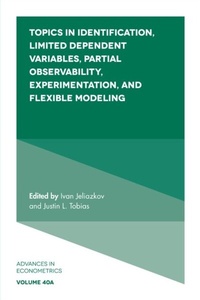
Topics in Identification, Limited Dependent Variables, Partial Observability, Experimentation, and Flexible Modeling
1st Edition
Published on 30. August 2019
336 pages
978-1-78973-243-6 (ISBN)
Description

Volume 40 in the Advances in Econometrics series features twenty-three chapters that are split thematically into two parts. Part A presents novel contributions to the analysis of time series and panel data with applications in macroeconomics, finance, cognitive science and psychology, neuroscience, and labor economics. Part B examines innovations in stochastic frontier analysis, nonparametric and semiparametric modeling and estimation, A/B experiments, big-data analysis, and quantile regression. Individual chapters, written by both distinguished researchers and promising young scholars, cover many important topics in statistical and econometric theory and practice. Papers primarily, though not exclusively, adopt Bayesian methods for estimation and inference, although researchers of all persuasions should find considerable interest in the chapters contained in this work. The volume was prepared to honor the career and research contributions of Professor Dale J. Poirier.
For researchers in econometrics, this volume includes the most up-to-date research across a wide range of topics.
For researchers in econometrics, this volume includes the most up-to-date research across a wide range of topics.
Reviews / Votes
The first of two volumes in honor of the scholarship of professor Dale J. Poirier, this volume consists of 12 chapters on econometrics methods related to identification, limited dependent variables, partial observability, experimentation, and flexible modeling, including both Bayesian and classical contributions to theory and application. The volume begins with an interview with Poirier, then addresses macroeconomic nowcasting using Google probabilities; sentiment-based overlapping community discovery of Reddit's newsfeed users; a psychological model of violence and Israeli and Palestinian fatalities in the Second Intifada; Bayesian methodology for modeling local activation and global connectivity using data on magnetic resonance signals in the brain; robust estimation of ARMA (autoregressive moving average) models with near root cancellation; and the estimation of a stochastic volatility model. Others discuss a novel approach to the modeling of expectation formation and learning in models with time-varying parameters, particularly endogenous gain learning; an approach for checking the sensitivity of predictive modeling to prior hyperparameters; the estimation of a panel model and the use of a Stein-type shrinkage estimator; an out-of-sample Granger causality testing procedure; and the effect of compulsory schooling laws on educational attainment and labor market earnings. Essays were presented at a conference at the U. of California, Irvine, in June 2018, and contributors are data scientists, economists, and other researchers working in Europe, North America, Australia, China, and Saudi Arabia. -- Copyright 2019 * Portland, OR *More details
Series
Language
English
Place of publication
Bingley
United Kingdom
Target group
Professional and scholarly
File size
8,20 MB
ISBN-13
978-1-78973-243-6 (9781789732436)
Copyright in bibliographic data and cover images is held by Nielsen Book Services Limited or by the publishers or by their respective licensors: all rights reserved.
Schweitzer Classification
Other editions
Additional editions
Ivan Jeliazkov | Justin Tobias
Topics in Identification, Limited Dependent Variables, Partial Observability, Experimentation, and Flexible Modeling
Book
08/2019
Emerald Publishing Limited
€162.40
Shipment within 10-20 days
Persons
Ivan Jeliazkov is Associate Professor of Economics at the University of California, Irvine. He has served as Series Editor for Advances in Econometrics since 2010 and has also worked on the editorial boards of JASA/TAS Reviews and the International Journal of Mathematical Modelling and Numerical Optimisation. His research encompasses Bayesian modelling and inference, simulation-based estimation, nonparametric modelling, discrete data analysis, and model comparison.
Justin Tobias is Professor and Head of the Economics Department at Purdue University. He received his PhD from the University of Chicago in 1999 and has contributed to and served as an Associate Editor for several leading econometrics journals, including the Journal of Applied Econometrics and Journal of Business and Economic Statistics. His work focuses primarily on the development and application of Bayesian microeconometric methods.
Justin Tobias is Professor and Head of the Economics Department at Purdue University. He received his PhD from the University of Chicago in 1999 and has contributed to and served as an Associate Editor for several leading econometrics journals, including the Journal of Applied Econometrics and Journal of Business and Economic Statistics. His work focuses primarily on the development and application of Bayesian microeconometric methods.
Content
Foreword; Ivan Jeliazkov and Justin L. Tobias 1. An Interview with Dale Poirier; Ivan Jeliazkov, Dale J. Poirier and Justin L. Tobias
2. Macroeconomic Nowcasting Using Google Probabilities; Gary Koop and Luca Onorante
3. Sentiment-Based Overlapping Community Discovery; Fulya Ozcan
4. Violence in the Decond Intifada: A Demonstration of Bayesian Generative Cognitive Modeling; Percy Mistry and Michael D. Lee
5. A Bayesian Model for Activation and Connectivity in Task-Related fMRI Data; Zhe Yu, Raquel Prado, Steve C. Cramer, Erin B. Quinlan and Hernando Ombao
6. Robust Estimation of ARMA Models with Near Root Cancellation; Timothy Cogley and Richard Startz
7. A Simple Efficient Moment-Based Estimator for the Stochastic Volatility Model; Md. Nazmul Ahsan and Jean-Marie Dufour
8. A New Approach to Modeling Endogenous Gain Learning; Eric Gaus and Srikanth Ramamurthy
9. How Sensitive are VAR Forecasts to Prior Hyperparameters? An Automated Sensitivity Analysis; Joshua C.C. Chan, Liana Jacobi and Dan Zhu
10. Stein-like Shrinkage Estimation of Panel Data Models with Common Correlated Effects; Bai Huang, Tae-Hwy Lee and Aman Ullah
11. Predictive Testing for Granger Causality via Posterior Simulation and Cross Validation; Gary J. Cornwall, Jeffrey A. Mills, Beau A. Sauley and Huibin Weng
12. New Evidence on the Effect of Compulsory Schooling Laws; Theodore F. Figinski, Alicia Lloro and Phillip Li
2. Macroeconomic Nowcasting Using Google Probabilities; Gary Koop and Luca Onorante
3. Sentiment-Based Overlapping Community Discovery; Fulya Ozcan
4. Violence in the Decond Intifada: A Demonstration of Bayesian Generative Cognitive Modeling; Percy Mistry and Michael D. Lee
5. A Bayesian Model for Activation and Connectivity in Task-Related fMRI Data; Zhe Yu, Raquel Prado, Steve C. Cramer, Erin B. Quinlan and Hernando Ombao
6. Robust Estimation of ARMA Models with Near Root Cancellation; Timothy Cogley and Richard Startz
7. A Simple Efficient Moment-Based Estimator for the Stochastic Volatility Model; Md. Nazmul Ahsan and Jean-Marie Dufour
8. A New Approach to Modeling Endogenous Gain Learning; Eric Gaus and Srikanth Ramamurthy
9. How Sensitive are VAR Forecasts to Prior Hyperparameters? An Automated Sensitivity Analysis; Joshua C.C. Chan, Liana Jacobi and Dan Zhu
10. Stein-like Shrinkage Estimation of Panel Data Models with Common Correlated Effects; Bai Huang, Tae-Hwy Lee and Aman Ullah
11. Predictive Testing for Granger Causality via Posterior Simulation and Cross Validation; Gary J. Cornwall, Jeffrey A. Mills, Beau A. Sauley and Huibin Weng
12. New Evidence on the Effect of Compulsory Schooling Laws; Theodore F. Figinski, Alicia Lloro and Phillip Li
