

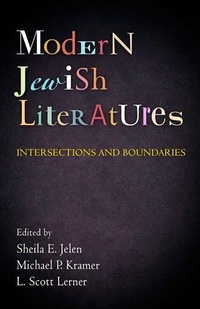
Modern Jewish Literatures
Intersections and Boundaries
1st Edition
Published on 6. June 2011
368 pages
978-0-8122-0436-0 (ISBN)
Description

Is there such a thing as a distinctive Jewish literature? While definitions have been offered, none has been universally accepted. Modern Jewish literature lacks the basic markers of national literatures: it has neither a common geography nor a shared language-though works in Hebrew or Yiddish are almost certainly included-and the field is so diverse that it cannot be contained within the bounds of one literary category.
Each of the fifteen essays collected in Modern Jewish Literatures takes on the above question by describing a movement across boundaries-between languages, cultures, genres, or spaces. Works in Hebrew and Yiddish are amply represented, but works in English, French, German, Italian, Ladino, and Russian are also considered. Topics range from the poetry of the Israeli nationalist Natan Alterman to the Russian poet Osip Mandelstam; from turn-of-the-century Ottoman Jewish journalism to wire-recorded Holocaust testimonies; from the intellectual salons of late eighteenth-century Berlin to the shelves of a Jewish bookstore in twentieth-century Los Angeles.
The literary world described in Modern Jewish Literatures is demarcated chronologically by the Enlightenment, the Haskalah, and the French Revolution, on one end, and the fiftieth anniversary of the State of Israel on the other. The particular terms of the encounter between a Jewish past and present for modern Jews has varied greatly, by continent, country, or village, by language, and by social standing, among other things. What unites the subjects of these studies is not a common ethnic, religious, or cultural history but rather a shared endeavor to use literary production and writing in general as the laboratory in which to explore and represent Jewish experience in the modern world.
Each of the fifteen essays collected in Modern Jewish Literatures takes on the above question by describing a movement across boundaries-between languages, cultures, genres, or spaces. Works in Hebrew and Yiddish are amply represented, but works in English, French, German, Italian, Ladino, and Russian are also considered. Topics range from the poetry of the Israeli nationalist Natan Alterman to the Russian poet Osip Mandelstam; from turn-of-the-century Ottoman Jewish journalism to wire-recorded Holocaust testimonies; from the intellectual salons of late eighteenth-century Berlin to the shelves of a Jewish bookstore in twentieth-century Los Angeles.
The literary world described in Modern Jewish Literatures is demarcated chronologically by the Enlightenment, the Haskalah, and the French Revolution, on one end, and the fiftieth anniversary of the State of Israel on the other. The particular terms of the encounter between a Jewish past and present for modern Jews has varied greatly, by continent, country, or village, by language, and by social standing, among other things. What unites the subjects of these studies is not a common ethnic, religious, or cultural history but rather a shared endeavor to use literary production and writing in general as the laboratory in which to explore and represent Jewish experience in the modern world.
More details
Series
Language
English
Place of publication
Pennsylvania
United States
Target group
College/higher education
Illustrations
9 illus.
9 illus.
File size
3,11 MB
ISBN-13
978-0-8122-0436-0 (9780812204360)
Copyright in bibliographic data and cover images is held by Nielsen Book Services Limited or by the publishers or by their respective licensors: all rights reserved.
Schweitzer Classification
Other editions
Additional editions
Sheila E. Jelen | Michael P. Kramer | L. Scott Lerner
Modern Jewish Literatures
Intersections and Boundaries
Book
01/2011
University of Pennsylvania Press
€74.50
Shipment within 10-20 days
Persons
Sheila E. Jelen teaches English and Jewish studies at the University of Maryland. Michael P. Kramer is Professor of English at Bar-Ilan University in Israel. L. Scott Lerner is Professor of French and Italian at Franklin and Marshall College.
Content
Preface
-David B. Ruderman
Introduction: Intersections and Boundaries in Modern Jewish Literary Study
-Sheila E. Jelen, Michael P. Kramer, L. Scott Lerner
Chapter 1. Literary Culture and Jewish Space around 1800: The Berlin Salons Revisited
-Liliane Weissberg
Chapter 2. Joseph Salvador's Jerusalem Lost and Jerusalem Regained
-L. Scott Lerner
Chapter 3. The Merchant at the Threshold: Rashel Khin, Osip Mandelstam, and the Poetics of Apostasy
-Amelia Glaser
Chapter 4. Shmuel Saadi Halevy/Sam LEvy Between Ladino and French: Reconstructing a Writer's Social Identity
-Olga Borovaya
Chapter 5. I. L. Peretz's "Between Two Mountains": Neo-Hasidism and Jewish Literary Modernity
-Nicham Ross
Chapter 6. Neither Here nor There: The Critique of Ideological Progress in Sholem Aleichem's Kasrilevke Stories
-Marc Caplan
Chapter 7. Brenner: Between Hebrew and Yiddish
-Anita Shapira
Chapter 8. Eisig Silberschlag and the Persistence of the Erotic in American Hebrew Poetry
-Alan Mintz
Chapter 9. The Art of Sex in Yiddish Poems: Celia Dropkin and Her Contemporaries
-Kathryn Hellerstein
Chapter 10. Ethnopoetics in the Works of Malkah Shapiro and Ita Kalish: Gender, Popular Ethnography, and the Literary Face of Jewish Eastern Europe
-Sheila E. Jelen
Chapter 11. Eternal Jews and Dead Dogs: The Diasporic Other in Natan Alterman's The Seventh Column
-Gideon Nevo
Chapter 12. Inserted Notes: David Boder's DP Interview Project and the Languages of the Holocaust
-Alan Rosen
Chapter 13. Unpacking My Father's Bookstore
-Laurence Roth
Chapter 14. The Art of Assimilation: Ironies, Ambiguities, Aesthetics
-Michael P. Kramer
Chapter 15. Hebraism and Yiddishism: Paradigms of Modern Jewish Literary History
-Anita Norich
List of Contributors
Index
-David B. Ruderman
Introduction: Intersections and Boundaries in Modern Jewish Literary Study
-Sheila E. Jelen, Michael P. Kramer, L. Scott Lerner
Chapter 1. Literary Culture and Jewish Space around 1800: The Berlin Salons Revisited
-Liliane Weissberg
Chapter 2. Joseph Salvador's Jerusalem Lost and Jerusalem Regained
-L. Scott Lerner
Chapter 3. The Merchant at the Threshold: Rashel Khin, Osip Mandelstam, and the Poetics of Apostasy
-Amelia Glaser
Chapter 4. Shmuel Saadi Halevy/Sam LEvy Between Ladino and French: Reconstructing a Writer's Social Identity
-Olga Borovaya
Chapter 5. I. L. Peretz's "Between Two Mountains": Neo-Hasidism and Jewish Literary Modernity
-Nicham Ross
Chapter 6. Neither Here nor There: The Critique of Ideological Progress in Sholem Aleichem's Kasrilevke Stories
-Marc Caplan
Chapter 7. Brenner: Between Hebrew and Yiddish
-Anita Shapira
Chapter 8. Eisig Silberschlag and the Persistence of the Erotic in American Hebrew Poetry
-Alan Mintz
Chapter 9. The Art of Sex in Yiddish Poems: Celia Dropkin and Her Contemporaries
-Kathryn Hellerstein
Chapter 10. Ethnopoetics in the Works of Malkah Shapiro and Ita Kalish: Gender, Popular Ethnography, and the Literary Face of Jewish Eastern Europe
-Sheila E. Jelen
Chapter 11. Eternal Jews and Dead Dogs: The Diasporic Other in Natan Alterman's The Seventh Column
-Gideon Nevo
Chapter 12. Inserted Notes: David Boder's DP Interview Project and the Languages of the Holocaust
-Alan Rosen
Chapter 13. Unpacking My Father's Bookstore
-Laurence Roth
Chapter 14. The Art of Assimilation: Ironies, Ambiguities, Aesthetics
-Michael P. Kramer
Chapter 15. Hebraism and Yiddishism: Paradigms of Modern Jewish Literary History
-Anita Norich
List of Contributors
Index
