

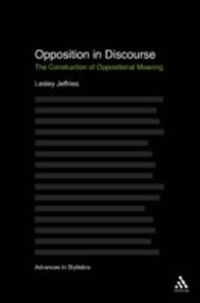
Opposition In Discourse
The Construction of Oppositional Meaning
1st Edition
Published on 29. January 2010
160 pages
978-1-4411-9863-1 (ISBN)
Description

Lesley Jeffries introduces a phenomenon which has not been given the attention it deserves - the contextual construction of oppositional meaning. These are opposites not recognisable as such out of context but that are clearly set up this way in the text concerned.
The significance of oppositional meaning is well-known, and has been discussed by scholars for millennia, from Philosophy to Politics. But the main emphasis has always been on the conventional opposite: the opposite recognised by lexical semantics.
Starting from socio-cultural viewpoints, moving to original research and then concluding with a new theoretical formulation, this book introduces and consolidates a significant new approach to the analysis of oppositional meaning. It closes with a discussion of the importance of constructed opposition in hegemonic practice and makes a case for the inclusion of opposition as a central tool of critical discourse analysis. It will be essential reading for researchers and graduates in stylistics, linguistics and language studies.
The significance of oppositional meaning is well-known, and has been discussed by scholars for millennia, from Philosophy to Politics. But the main emphasis has always been on the conventional opposite: the opposite recognised by lexical semantics.
Starting from socio-cultural viewpoints, moving to original research and then concluding with a new theoretical formulation, this book introduces and consolidates a significant new approach to the analysis of oppositional meaning. It closes with a discussion of the importance of constructed opposition in hegemonic practice and makes a case for the inclusion of opposition as a central tool of critical discourse analysis. It will be essential reading for researchers and graduates in stylistics, linguistics and language studies.
Reviews / Votes
'The focus of this book is on how 'created' oppositions are triggered, constructed and construed in language. Examples are drawn from a wealth of sources - including poems, medical texts and newspaper stories - with oppositions cleverly unravelled and their ability to influence our thoughts and our reality gradually exposed. The findings contribute usefully to the growing body of knowledge about antonyms and other oppositions, and to the contexts in which they occur; the ramifications are significant for language-based studies of literature, popular culture and the media.' - Steven Jones, Director of Undergraduate Studies, School of Education, The University of Manchester, UKMore details
Series
Edition
1. Auflage
Language
English
Place of publication
New York
United States
Target group
Professional and scholarly
ISBN-13
978-1-4411-9863-1 (9781441198631)
Copyright in bibliographic data and cover images is held by Nielsen Book Services Limited or by the publishers or by their respective licensors: all rights reserved.
Schweitzer Classification
Other editions
Additional editions
Book
01/2012
Continuum Publishing Corporation
€55.60
Shipment within 15-20 days
Person
Content
1. What are opposites?
2. How opposites are constructed in texts and what they mean
3. Textual/meaningful effects of textual opposition
4. The role of opposition-construction in discourse meanings
5. The significance of opposition in language and texts
Bibliography
Index
2. How opposites are constructed in texts and what they mean
3. Textual/meaningful effects of textual opposition
4. The role of opposition-construction in discourse meanings
5. The significance of opposition in language and texts
Bibliography
Index
