

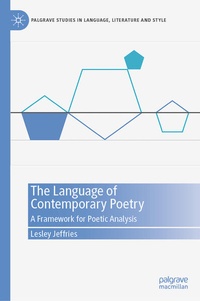
The Language of Contemporary Poetry
Description

This book introduces a new way of looking at how poems mean, drawing on the framework first developed in the author's book Critical Stylistics , but applied here to aesthetic more than ideological meaning. The aim is to empower readers of poetry to articulate the features of poetic language that they come across and explain to themselves and others why these features convey the meanings that they do. While this volume focuses on contemporary poets writing in English and mostly based in the UK and Ireland, the framework will work just as well for other eras' poetry, as well as for other cultures and languages.
More details
Other editions
Additional editions
Person
Lesley Jeffries is a retired Professor of English Language and Linguistics and an independent scholar living and working in Leeds, UK. She has published widely in stylistics, focussing on the style of contemporary poetry and ideology in news reporting and political discourse. She is also co-editor (with Dan Mcintyre) of Babel: The Language Magazine.
Content
Chapter 1. Contemporary poetry and textual meaning.- Part 1: Core Features Of Textual Meaning.- Chapter 2. Naming and Describing: people, places and things in poems.- Chapter 3. Representing processes: actions, states and events in poetry .- Chapter 4. Prioritising: Subordination and information structure in poems.- Chapter 5. Representing time, space and society: constructing the world of the poem.- Part 2: Intermittent Features Of Textual Meaning.- Chapter 6. Equating and Contrasting: Constructing equivalence and opposition in poems.- Chapter 7. Enumerating and Exemplifying: Lists and open meaning in poems.- Chapter 8. Negating: Poetic construction of what is not.- Chapter 9. Hypothesising: Possible Worlds, hypothetical scenarios and wish fulfilment in poems.- Chapter 10. Alluding: Implying and Assuming in poems.- Chapter 11. Presenting others' speech and thought: Multiple voices in poems.- Chapter 12. Evoking: experiencing the poem's world.- Part Three: Conclusions.- Chapter 13. Putting it all together: Integrated analysis of poems.- Chapter 14. Textual meaning, linguistic theory and the stylistics of poetry.
