

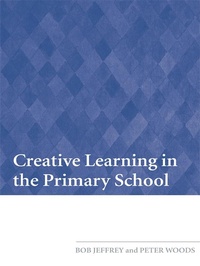
Creative Learning in the Primary School
Published on 8. January 2009
192 pages
978-1-134-03987-6 (ISBN)
Description

Creative Learning in the Primary School uses ethnographic research to consider the main features of creative teaching and learning within the context of contemporary policy reforms. In particular, the authors are interested in the clash between two oppositional discourses - creativity and performativity - and how they are resolved in creative teacher practice. The book complements previous work by these authors on creative teaching by giving more consideration to creative learning.
The first section of the book explores the nature of creative teaching and learning by examining four key features: relevance, control, ownership and innovation. The authors devote a chapter to each of these aspects, outlining their properties and illustrating them with a wide range of examples, mainly from recent practice in primary schools.
The second section presents some instructive examples of schools promoting creative learning, and how creative primary schools have responded to the policy reforms of recent years. The chapters focus specifically on:
how pupils act as a powerful resource for creative learning for each other and for their teachers;
how teachers have appropriated the reforms to enhance their creativity;
and how one school has moved over a period of ten years from heavy constraint to high creativity.
The blend of analysis, case-study material and implications for practice will make this book attractive to primary teachers, school managers, policy makers, teacher educators and researchers.
The first section of the book explores the nature of creative teaching and learning by examining four key features: relevance, control, ownership and innovation. The authors devote a chapter to each of these aspects, outlining their properties and illustrating them with a wide range of examples, mainly from recent practice in primary schools.
The second section presents some instructive examples of schools promoting creative learning, and how creative primary schools have responded to the policy reforms of recent years. The chapters focus specifically on:
how pupils act as a powerful resource for creative learning for each other and for their teachers;
how teachers have appropriated the reforms to enhance their creativity;
and how one school has moved over a period of ten years from heavy constraint to high creativity.
The blend of analysis, case-study material and implications for practice will make this book attractive to primary teachers, school managers, policy makers, teacher educators and researchers.
Reviews / Votes
"The authors are very well recognised in the field and the proposed synthesis of their work will provide a powerful book."Dominic Wyse, Senior Lecturer, Faculty of Education, University of Cambridge, UK
"In the current climate of performativity being the main driver in many education systems internationally it is important to address how creative learning can still be nourished and can flourish. Being based on empirical research this book will be able to provide answers to teachers who wish to teach creatively.
The particular advantage of the proposed book is that it focuses on creative learning (rather than teaching) and incorporates the pupils' perspectives on that learning. Further the fact that much of the text is based on empirical research rather than theory alone will make the book more attractive to a teacher audience."
Geri Smyth, Reader in the Department of Childhood and Primary Studies, University of Strathclyde, UK
More details
Language
English
Place of publication
London
United Kingdom
Publishing group
Taylor & Francis Ltd
Target group
College/higher education
Professional and scholarly
Illustrations
2 s/w Tabellen, 2 s/w Zeichnungen, 2 s/w Abbildungen
2 Tables, black and white; 2 Line drawings, black and white; 2 Illustrations, black and white
File size
1,51 MB
ISBN-13
978-1-134-03987-6 (9781134039876)
Copyright in bibliographic data and cover images is held by Nielsen Book Services Limited or by the publishers or by their respective licensors: all rights reserved.
Schweitzer Classification
Other editions
Additional editions
Bob Jeffrey | Peter Woods
Creative Learning in the Primary School
Book
12/2008
1st Edition
Routledge
€206.00
Shipment within 15-20 days
Bob Jeffrey | Peter Woods
Creative Learning in the Primary School
Book
12/2008
1st Edition
Routledge
€69.00
Shipment within 15-20 days
Persons
Content
Introduction
Section A The nature of creative learning
Chapter 1 The relevance of creative teaching: Learners' views
Chapter 2 Control of learning
Chapter 3 Ownership of practice
Chapter 4 Innovation
Section B Creating opportunities for creative learning
Chapter 5 Achieving breakthroughs in learning: Students as critical others
Chapter 6 Countering learner 'instrumentalism' through creative mediation
Chapter 7 Recovering creativity teaching and learning: using critical events
Chapter 8 Reintroducing creativity: becoming a 'particularly successful school'
Chapter 9 The future of creative learning
References
Section A The nature of creative learning
Chapter 1 The relevance of creative teaching: Learners' views
Chapter 2 Control of learning
Chapter 3 Ownership of practice
Chapter 4 Innovation
Section B Creating opportunities for creative learning
Chapter 5 Achieving breakthroughs in learning: Students as critical others
Chapter 6 Countering learner 'instrumentalism' through creative mediation
Chapter 7 Recovering creativity teaching and learning: using critical events
Chapter 8 Reintroducing creativity: becoming a 'particularly successful school'
Chapter 9 The future of creative learning
References
