

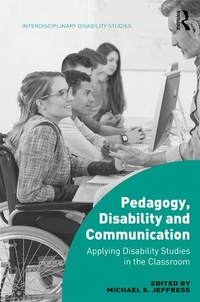
Pedagogy, Disability and Communication
Applying Disability Studies in the Classroom
Published on 28. April 2017
248 pages
978-1-315-39941-6 (ISBN)
Description

Research has long substantiated the fact that living with a disability creates significant and complex challenges to identity negotiation, the practice of communication, and the development of interpersonal relationships. Furthermore, individuals without disabilities often lack the knowledge and tools to experience self-efficacy in communicating with their differently-abled peers. So how do these challenges translate to the incorporation of disability studies in a classroom context and the need to foster an inclusive environment for differently-abled students?
Bringing together a range of perspectives from communication and disability studies scholars, this collection provides a theoretical foundation along with practical solutions for the inclusion of disability studies within the everyday curriculum. It examines a variety of aspects of communication studies including interpersonal, intercultural, health, political and business communication as well as ethics, gender and public speaking, offering case study examples and pedagogical strategies as to the best way to approach the subject of disability in education.
It will be of interest to students, researchers and educators in communication and disability studies as well as scholars of sociology and social policy, gender studies, public health and pedagogy. It will also appeal to anyone who has wondered how to bring about a greater degree of inclusion and ethics within the classroom.
Bringing together a range of perspectives from communication and disability studies scholars, this collection provides a theoretical foundation along with practical solutions for the inclusion of disability studies within the everyday curriculum. It examines a variety of aspects of communication studies including interpersonal, intercultural, health, political and business communication as well as ethics, gender and public speaking, offering case study examples and pedagogical strategies as to the best way to approach the subject of disability in education.
It will be of interest to students, researchers and educators in communication and disability studies as well as scholars of sociology and social policy, gender studies, public health and pedagogy. It will also appeal to anyone who has wondered how to bring about a greater degree of inclusion and ethics within the classroom.
Reviews / Votes
'Disability is everywhere in the social world; assumptions about bodies and ways of moving through the world are fundamental to human interaction. Pedagogy, Disability and Communication provides tools for use in a variety of classrooms to help students communicate more ethically and effectively while generating insights that can enhance access and opportunity for all.'Jim Ferris, Ability Center Endowed Chair in Disability Studies, University of Toledo
The value of this collection lies in the underlying foundation and principle of a nothing about us without us approach by the editor, Michael S. Jeffress in collating contributions that effectively highlight scholars in the field who are leading the way in challenging the status quo of disability and curriculum design in higher education. These scholars illuminate the pathway for further reform in disability studies and for transforming the higher education environment. The pedagogical strategies suggested in the book may be adapted and also useful in many other courses in the higher education environment. Pedagogy, Disability and Communication is essential reading and a valuable resource for scholars, students, and researchers who value practical examples of pedagogy supported by theoretical underpinnings which challenge notions of disability through their curriculum and ultimately co-create new understandings and meanings of disability in higher education courses.
Dr Satine Winter, Griffith University, Mt Gravatt, Brisbane, Australia
This valuable collection of interdisciplinary essays not only helps in understanding the complex challenges of negotiating disability identity, but through philosophical and theoretical foundations and practical examples it provides various step-by-step manuals to communicate ethically and inclusively in the classroom with one another.
Armineh Soorenian, Independent Researcher, UK
More details
Series
Language
English
Place of publication
London
United Kingdom
Publishing group
Taylor & Francis Ltd
Target group
College/higher education
Professional and scholarly
Illustrations
3 s/w Abbildungen, 1 s/w Tabelle, 2 s/w Photographien bzw. Rasterbilder, 1 s/w Zeichnung
1 Tables, black and white; 1 Line drawings, black and white; 2 Halftones, black and white; 3 Illustrations, black and white
File size
16,07 MB
ISBN-13
978-1-315-39941-6 (9781315399416)
Copyright in bibliographic data and cover images is held by Nielsen Book Services Limited or by the publishers or by their respective licensors: all rights reserved.
Schweitzer Classification
Other editions
Additional editions
Michael S. Jeffress
Pedagogy, Disability and Communication
Applying Disability Studies in the Classroom
Book
01/2019
1st Edition
Routledge
€69.80
Shipment within 15-20 days
Michael S. Jeffress
Pedagogy, Disability and Communication
Applying Disability Studies in the Classroom
Book
04/2017
1st Edition
Routledge
€233.20
Shipment within 10-20 days
Person
Michael S. Jeffress (Ph.D., Regent University) is a Lecturer in Communication Studies in the Department of Literary, Cultural and Communication Studies at The University of the West Indies in St. Augustine, Trinidad. He has been involved in disability advocacy work since the mid-1990s, after his son Ryan was diagnosed with Duchenne muscular dystrophy. In 2014, he received the Top Paper Award from the Disability Issues Caucus of the National Communication Association. His previous title in the Interdisciplinary Disability Studies series is Communication, Sport and Disability: The Case of Power Soccer.
Content
Notes on contributors
List of abbreviations
Preface (Michael S. Jeffress)
Chapter 1: Disability Studies in the Communication Ethics Classroom: Pedagogies of Justice and Voice (Joy M. Cypher)
Chapter 2: Creating a College Course on Communication and Disability (Elaine Bass Jenks)
Chapter 3: Exploring Communication between the Differently Abled and the Temporarily Able-Bodied in a Special Topics Course (J. W. Smith, Stephanie Doehling, and Katherine Rush)
Chapter 4: Incorporating Disability Studies into the Communication Classroom through a High Impact Engagement Nonverbal Communication Assignment (Paula K. Baldwin and Michael S. Jeffress)
Chapter 5: Sexuality and People with Disabilities: A Workshop within an Interpersonal Communication Course (Kaori Miyawaki, Kate Ksobiech, Suzen Wildermuth, and Elizabeth Houtz)
Chapter 6: Reframing the Gender Communication Classroom: Utilizing Disability Pedagogy (Brian Grewe, Jr.)
Chapter 7: Bodies of Dis-Ease: Towards the Re-Conception of "Health" in Health Communication (Andrew Spieldenner and Elena Anadolis)
Chapter 8: Disability Cultures and the Intercultural Communication Course (Alberto Gonzalez and Andrew Donofrio)
Chapter 9: Disability and Communication in the Virtual Classroom (Michael G. Strawser)
Chapter 10: Eyes Wide Open: Student Involvement in ASD Research and TBI Critical Experiential Learning in a Media Literacy Class (Laura C. Farrell and Ginnifer L. Mastarone)
Chapter 11: Enhancing Campus Accessibility: A Disability Studies Approach to Teaching Technical Communication (Rebecca Miner)
Chapter 12: Exploring the Intersection of Ableism, Image Building and Hegemonic Masculinity in the Political Communication Classroom (Emily Stones)
Chapter 13: Unleashing Disability Perspectives in the Public Speaking Course (Bettina Brockmann and Michael S. Jeffress)
List of abbreviations
Preface (Michael S. Jeffress)
Chapter 1: Disability Studies in the Communication Ethics Classroom: Pedagogies of Justice and Voice (Joy M. Cypher)
Chapter 2: Creating a College Course on Communication and Disability (Elaine Bass Jenks)
Chapter 3: Exploring Communication between the Differently Abled and the Temporarily Able-Bodied in a Special Topics Course (J. W. Smith, Stephanie Doehling, and Katherine Rush)
Chapter 4: Incorporating Disability Studies into the Communication Classroom through a High Impact Engagement Nonverbal Communication Assignment (Paula K. Baldwin and Michael S. Jeffress)
Chapter 5: Sexuality and People with Disabilities: A Workshop within an Interpersonal Communication Course (Kaori Miyawaki, Kate Ksobiech, Suzen Wildermuth, and Elizabeth Houtz)
Chapter 6: Reframing the Gender Communication Classroom: Utilizing Disability Pedagogy (Brian Grewe, Jr.)
Chapter 7: Bodies of Dis-Ease: Towards the Re-Conception of "Health" in Health Communication (Andrew Spieldenner and Elena Anadolis)
Chapter 8: Disability Cultures and the Intercultural Communication Course (Alberto Gonzalez and Andrew Donofrio)
Chapter 9: Disability and Communication in the Virtual Classroom (Michael G. Strawser)
Chapter 10: Eyes Wide Open: Student Involvement in ASD Research and TBI Critical Experiential Learning in a Media Literacy Class (Laura C. Farrell and Ginnifer L. Mastarone)
Chapter 11: Enhancing Campus Accessibility: A Disability Studies Approach to Teaching Technical Communication (Rebecca Miner)
Chapter 12: Exploring the Intersection of Ableism, Image Building and Hegemonic Masculinity in the Political Communication Classroom (Emily Stones)
Chapter 13: Unleashing Disability Perspectives in the Public Speaking Course (Bettina Brockmann and Michael S. Jeffress)
