

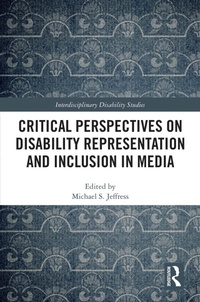
Critical Perspectives on Disability Representation and Inclusion in Media
Will be published approx. on 7. July 2026
326 pages
978-1-040-86532-3 (ISBN)
Description

Drawing on a wide variety of print and digital media sources, this book discusses the need for inclusion and authentic portrayals of disability and neurodiversity in the media, as the primary way that most people learn about them.
Containing 15 newly written chapters drawing on representations of disability in popular culture from film, television, social media, and print media in both the Global North and the Global South, including the United States, Ukraine, Japan, India and Italy, this volume shows that although disability and neurodiversity have long been framed using a limited range of stereotypical tropes such as victims, supercrips, or suffering patients, and have functioned as what scholars refer to as narrative prosthesis, storylines and characters involving prominent disability themes and representations are making their way into an increasing number of mainstream media productions and publications. The question remains whether the increased quantity is correlated with increased quality of representation and inclusion for people with disabilities.
This insightful volume will be of interest to all scholars and students of disability studies, cultural studies, media and film studies, gender studies, and sociology more broadly.
Containing 15 newly written chapters drawing on representations of disability in popular culture from film, television, social media, and print media in both the Global North and the Global South, including the United States, Ukraine, Japan, India and Italy, this volume shows that although disability and neurodiversity have long been framed using a limited range of stereotypical tropes such as victims, supercrips, or suffering patients, and have functioned as what scholars refer to as narrative prosthesis, storylines and characters involving prominent disability themes and representations are making their way into an increasing number of mainstream media productions and publications. The question remains whether the increased quantity is correlated with increased quality of representation and inclusion for people with disabilities.
This insightful volume will be of interest to all scholars and students of disability studies, cultural studies, media and film studies, gender studies, and sociology more broadly.
More details
Series
Language
English
Place of publication
London
United Kingdom
Publishing group
Taylor & Francis Ltd
Target group
College/higher education
Illustrations
11 Tables, black and white; 3 Line drawings, black and white; 3 Illustrations, black and white
File size
13,74 MB
ISBN-13
978-1-040-86532-3 (9781040865323)
Copyright in bibliographic data and cover images is held by Nielsen Book Services Limited or by the publishers or by their respective licensors: all rights reserved.
Schweitzer Classification
Other editions
Additional editions
Michael S. Jeffress
Critical Perspectives on Disability Representation and Inclusion in Media
Book
approx. 07/2026
1st Edition
Routledge
€191.50
Not yet published
Person
Michael S. Jeffress is a full professor at Medical University of the Americas in Nevis, West Indies. He has been involved in disability advocacy work since the late- 1990s, after his son was diagnosed with Duchenne muscular dystrophy. Critical Perspectives on Disability Representation and Inclusion in Media is his fourth edited volume in Routledge's Interdisciplinary Disability Studies Series, in addition to his monograph Communication, Sport and Disability: The Case of Power Soccer published in 2015.
Content
Section 1: Disability in Media: Television and Film Perspectives 1.A Street for Everyone: Sesame Street's Pioneering Commitment to Educating Children with Disabilities through Inclusive Television Programming and Educational Advocacy 2.Moving Away from Rain Man: Fictional Representation of Autism in Contemporary Audiovisual Media in the U.S. 3."Whale, Whale!" (Re)framing and (Dis)abling an Albino Villain in Black Lightning 4.The Incompatibility of Disability in Star Trek: Strange New Worlds 5.Disability Representation in Love on the Spectrum and Its Impact on Audience Perceptions 6.Disability in Advertising: A Case Study of Super Bowl Advertisements between 2020 and 2024 7.Emerging Trends in Mediated Depictions of d/Deafness in Narrative Film from 2014-2024 8.Representation that Gets Rewarded: Disability Portrayals in Academy Award Recognized Films Section 2: Disability in Media: Online Perspectives 9.Rolling Over the Line: A Qualitative Analysis of Joe Eurell's Naturally Lazy 10.Deconstructing Digital Discourses: Critical Disability Studies Analysis of Social Media Posts by Parents of Autistic Children 11.Trolls and Allies: A Qualitative Analysis of the Comment Sections of Instagram Influencers in Interabled Relationships Section 3: Disability in Media: International Perspectives 12.Deaf, Not Silent: Sound and Savagery in Myroslav Slaboshpytskyi's The Tribe [????'?] 13.Address an absence: To know, understand and co-construct digital access in Italy 14.A Critical Examination of Disability-Inclusive Advertisements in Hyundai's Samarth Campaign 15.The Representation of Disability in Contemporary Japanese Novels and the Possibility of a Post-Narrative Prosthesis: A Textual Analysis of Reader Reviews
