

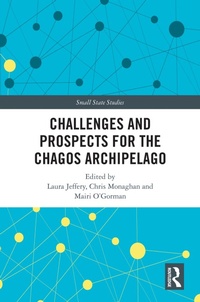
Challenges and Prospects for the Chagos Archipelago
1st Edition
Published on 21. November 2024
320 pages
978-1-040-22761-9 (ISBN)
Description

Challenges and Prospects for the Chagos Archipelago considers the origins, challenges and future of Chagos, bringing together leading experts and academics specialising in differing aspects of the Chagos dispute.
In 1965, as part of negotiations leading to Mauritian independence in 1968, the UK government excised the Chagos Archipelago from the colony of Mauritius to form part of a new overseas territory, the British Indian Ocean Territory (BIOT). The UK then set about removing the population of the Chagos Islands in order to allow the United States to construct a military base. As a consequence of the UK's acquisition of the Chagos Islands and the expulsion of the Chagossian population, there has been wide ranging litigation brought by Mauritius and the Chagossians. This has reached the International Court of Justice, the United Nations General Assembly, the European Court of Human Rights and the UK Supreme Court. This book offers a wide-ranging debate between experts and practitioners, including those of Chagossian and Mauritian heritage, touching upon key developments and offering an inclusive approach that transcends traditional disciplinary silos. Issues such as international and constitutional law, human rights, colonialism and decolonisation, using creative writing to express the experience of banishment, international relations, environmentalism, and globalisation, will be explored as part of a dialogue that sheds new light on the Chagos dispute. Edited by experts on Chagos, the contributors are drawn from across the globe, and all have a distinctive take on what has happened, what it means for the world and the region, and how Chagos will both shape and be shaped by the future.
This book will be of great interest to students, academics and researchers from across the humanities and social sciences, including political science, international relations, law, sociology, socio-legal studies, human rights, social anthropology, indigenous rights, history, colonialism, postcolonialism, and cultural studies, as well as practitioners, policymakers and general readers who are interested in Chagos.
In 1965, as part of negotiations leading to Mauritian independence in 1968, the UK government excised the Chagos Archipelago from the colony of Mauritius to form part of a new overseas territory, the British Indian Ocean Territory (BIOT). The UK then set about removing the population of the Chagos Islands in order to allow the United States to construct a military base. As a consequence of the UK's acquisition of the Chagos Islands and the expulsion of the Chagossian population, there has been wide ranging litigation brought by Mauritius and the Chagossians. This has reached the International Court of Justice, the United Nations General Assembly, the European Court of Human Rights and the UK Supreme Court. This book offers a wide-ranging debate between experts and practitioners, including those of Chagossian and Mauritian heritage, touching upon key developments and offering an inclusive approach that transcends traditional disciplinary silos. Issues such as international and constitutional law, human rights, colonialism and decolonisation, using creative writing to express the experience of banishment, international relations, environmentalism, and globalisation, will be explored as part of a dialogue that sheds new light on the Chagos dispute. Edited by experts on Chagos, the contributors are drawn from across the globe, and all have a distinctive take on what has happened, what it means for the world and the region, and how Chagos will both shape and be shaped by the future.
This book will be of great interest to students, academics and researchers from across the humanities and social sciences, including political science, international relations, law, sociology, socio-legal studies, human rights, social anthropology, indigenous rights, history, colonialism, postcolonialism, and cultural studies, as well as practitioners, policymakers and general readers who are interested in Chagos.
Reviews / Votes
"The Chagossians were brutally expelled from their Indian Ocean home by UK officials who referred to them as 'Tarzans and Men Fridays'. In 2008 Lord Hoffman denied their right of return, casting them as incapable of living 'Crusoe-like'. The declaration of a 'no take' Marine Protected Area in 2010 further limited their conditions of return. As this language reveals, the expulsion and exile of the Chagossians repeats the gestures and practices of unbridled colonial power; and shows the complicity of law and science. But as the essays and artistic works in this book show, the collusion of successive U.S and U.K governments are resisted effectively at every turn. How are empires and nations created and remade? Can a fully decolonised nation avoid marginalising an ethnic or indigenous minority? How are environmental and 'green' agendas deployed for neo-colonial ends? This timely and multi-disciplinary book addresses these urgent questions that apply well beyond the fate of the Chagossians."Stewart Motha, Professor of Law, Birkbeck, University of London, UK
"This extraordinary, polyvocal anthology amply documents the historic case of the Chagos islanders and their grotesque treatment at the hands of successive British Governments. It is an indispensable resource that illuminates the juridical, geopolitical, cultural and human dimensions of this long-running scandal. Anybody interested in the persistent politics of empire and colony has much to learn much from it."
Paul Gilroy, Professor of the Humanities, University College London, UK
"Urgent and uncompromising, this multilayered volume is a powerful reminder of Chagossians' on-going resistance to British and US colonisation in the 21st century."
Olivette Otele, Distinguished Research Professor of the Legacies and Memory of Slavery, Faculty of Law, SOAS, London, UK
More details
Series
Edition
1. Auflage
Language
English
Place of publication
London
United Kingdom
Publishing group
Taylor & Francis Ltd
Target group
College/higher education
Professional and scholarly
Illustrations
1 Line drawings, black and white; 12 Halftones, black and white; 13 Illustrations, black and white
ISBN-13
978-1-040-22761-9 (9781040227619)
Copyright in bibliographic data and cover images is held by Nielsen Book Services Limited or by the publishers or by their respective licensors: all rights reserved.
Schweitzer Classification
Other editions
Additional editions
Laura Jeffery | Chris Monaghan | Mairi O'Gorman
Challenges and Prospects for the Chagos Archipelago
Book
05/2026
1st Edition
Routledge
€57.00
Shipment within 10-20 days
Laura Jeffery | Chris Monaghan | Mairi O'Gorman
Challenges and Prospects for the Chagos Archipelago
Book
11/2024
1st Edition
Routledge
€196.80
Shipment within 10-20 days
Persons
Laura Jeffery is Professor of Anthropology of Migration in the School of Social and Political Sciences at the University of Edinburgh, UK. She has worked with the Chagossian community since 2002.
Chris Monaghan is Head of Law and Principal Lecturer in Law at the University of Worcester, UK. He has interests in the Chagos Islands legal dispute, Constitutional Law, the role of Parliament, executive accountability, and the global use of impeachment.
Mairi O'Gorman is a social anthropologist who holds a PhD from the University of Edinburgh, UK. Her doctoral thesis, Tree of Knowledge, Tree of Life: materials, intimacy and being Creole in London and Seychelles (2019), was based on ethnographic fieldwork in both places.
Chris Monaghan is Head of Law and Principal Lecturer in Law at the University of Worcester, UK. He has interests in the Chagos Islands legal dispute, Constitutional Law, the role of Parliament, executive accountability, and the global use of impeachment.
Mairi O'Gorman is a social anthropologist who holds a PhD from the University of Edinburgh, UK. Her doctoral thesis, Tree of Knowledge, Tree of Life: materials, intimacy and being Creole in London and Seychelles (2019), was based on ethnographic fieldwork in both places.
Content
Zistwar Sagosian, nu tu bizin amenn li Introduction 1. The Chagos saga: 21st century dispute about incomplete decolonisation 2. The Chagos Archipelago in late eighteenth- and nineteenth-century Indian Ocean world history 3. Origins, legacies, and future: the Chagossians, a population in exile So immaculate - Peros Banhos, Saloman, Diego Garcia 4. Chagos: plantation or paradise? Island edens and Indian Ocean empires, 1600-2023 5. Human rights and the Marine Protected Area around the Chagos Archipelago 6. Return of the Chagos Islands to Mauritius and Chagossian identity: constitutional, legal, and political perspectives 7. Political and legal debates about Chagossian ethnicity and indigeneity 8. Intergenerational challenges, cultural identity, and future prospects for Chagossian communities in the UK ayapana in a british plastic plant pot 9. Certainty and uncertainty: native and older generation Chagossian perspectives from Mauritius amid the UK Government's Nationality and Borders Act 2022 Limuria is in Our trust 10. Voicing the trauma of the lost territory: creative writing, therapy and the Chagos Refugees Group This poem is intuitively aware of the erasure of the Chagos Archipelago... 11. "Notes for an Essay: On a Literature of Solidarity" from Diego Garcia, A Novel 12. The British courts and the Chagos story: an exercise in colonial justice 13. Stakeholders or bystanders? An attempt by Seychellois Chagossians to intervene in the International Tribunal for the Law of the Sea 14. The 1966 BIOT Agreement and Polaris 15. The power behind the throne: the US Government must face its responsibility for the Chagossian exile 'UK Ambassador Lobbied Senators To Hide Diego Garcia's Role In Rendition' 16. The Indo-Pacific and the Chagos Archipelago: two logics, two futures 17. Flagpole fights, courtroom clashes, and coconut crabs 18. Why has it taken 25 years for the UK to start negotiating an overall settlement on Chagos with Mauritius? An ode to the Chagossian zistwar 19. Afterword
