

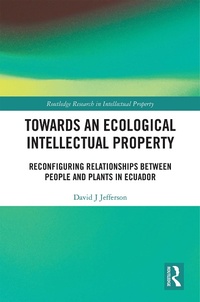
Towards an Ecological Intellectual Property
Reconfiguring Relationships Between People and Plants in Ecuador
1st Edition
Published on 8. June 2020
238 pages
978-1-000-08928-8 (ISBN)
Description

This book focuses on analysing how legal systems set the terms for interactions between human beings and plants.
The story that the book recounts is one of experimental lawmaking in Ecuador, a country where over the past decade, governmental officials and civil society advocates have attempted to reconfigure how human individuals and institutions relate to nature, by following an "eco-centric" approach to lawmaking. In doing so, Ecuadorian legislators, administrators, and judges have taken seriously the ontologies of non-human entities, including plants, through a process that has required the continuous navigation of tensions with certain "logics" that pervade conventional legal regimes. The book endeavours to disrupt these conventional assumptions and approaches to lawmaking by taking seriously alternative strategies to reconstitute interactions between people and plants. In doing so, the book argues in favour of an "ecological turn" in laws that govern vegetal life. The analysis is based on a close examination of the experiences that lawmakers in Ecuador have had when experimenting with innovative approaches to re-form relationships between human and non-human beings. Concretely, these experiments have yielded constitutional, legislative, and regulatory changes that inform the inquiry of how intellectual property and plant genetic resources laws - both in Ecuador and worldwide - could become more "ecological" in nature.
The argument that the book develops is based on extensive ethnographic fieldwork and empirical research in Ecuador, complemented by archival and doctrinal legal analysis. The contents of the book will be of interest to an academic audience of legal scholars and postgraduate students in law, in addition to scholars and students in the fields of anthropology, sociology, socio-legal studies, and science and technology studies.
The story that the book recounts is one of experimental lawmaking in Ecuador, a country where over the past decade, governmental officials and civil society advocates have attempted to reconfigure how human individuals and institutions relate to nature, by following an "eco-centric" approach to lawmaking. In doing so, Ecuadorian legislators, administrators, and judges have taken seriously the ontologies of non-human entities, including plants, through a process that has required the continuous navigation of tensions with certain "logics" that pervade conventional legal regimes. The book endeavours to disrupt these conventional assumptions and approaches to lawmaking by taking seriously alternative strategies to reconstitute interactions between people and plants. In doing so, the book argues in favour of an "ecological turn" in laws that govern vegetal life. The analysis is based on a close examination of the experiences that lawmakers in Ecuador have had when experimenting with innovative approaches to re-form relationships between human and non-human beings. Concretely, these experiments have yielded constitutional, legislative, and regulatory changes that inform the inquiry of how intellectual property and plant genetic resources laws - both in Ecuador and worldwide - could become more "ecological" in nature.
The argument that the book develops is based on extensive ethnographic fieldwork and empirical research in Ecuador, complemented by archival and doctrinal legal analysis. The contents of the book will be of interest to an academic audience of legal scholars and postgraduate students in law, in addition to scholars and students in the fields of anthropology, sociology, socio-legal studies, and science and technology studies.
More details
Series
Edition
1. Auflage
Language
English
Place of publication
London
United Kingdom
Publishing group
Taylor & Francis Ltd
Target group
College/higher education
Illustrations
9 Tables, black and white; 3 Line drawings, black and white; 4 Halftones, black and white; 7 Illustrations, black and white
File size
4,91 MB
ISBN-13
978-1-000-08928-8 (9781000089288)
Copyright in bibliographic data and cover images is held by Nielsen Book Services Limited or by the publishers or by their respective licensors: all rights reserved.
Schweitzer Classification
Other editions
Additional editions
David J. Jefferson
Towards an Ecological Intellectual Property
Reconfiguring Relationships Between People and Plants in Ecuador
Book
01/2023
1st Edition
Routledge
€63.30
Shipment within 15-20 days
David J. Jefferson
Towards an Ecological Intellectual Property
Reconfiguring Relationships Between People and Plants in Ecuador
Book
08/2020
Routledge
Unfortunately, price unknown
Available (delivery time upon request)
David J. Jefferson
Towards an Ecological Intellectual Property
Reconfiguring Relationships Between People and Plants in Ecuador
Book
07/2020
1st Edition
Routledge
€206.40
Shipment within 15-20 days
Person
David J Jefferson is Research Fellow and Member of the Australian Research Council (ARC) Laureate Project Harnessing Intellectual Property to Build Food Security in the TC Beirne School of Law, The University of Queensland, Australia. David holds a PhD in Law from the University of Queensland and a JD from the University of California, Davis.
Content
Table of Contents
Acknowledgements
Introduction
A Note on Methodology
Structure of the Book and Chapter Summaries
Part 1: Conventional Approaches to the Governance of Human-Plant Interactions
Chapter 1. Taking Plants Seriously in Law
1.1. Challenging the Epistemology of Plants
1.2. Recognising Nature as a Subject with Rights
1.3. Eco-centric Ecuador: Constitutional Protections for Pachamama
1.4. Towards an "Ecological Turn" in Law
Chapter 2. Turning Plants into Intellectual Property
2.1. Plants as Inventions
2.2. The Emergence of Systems for Plant Breeders' Rights
2.3. Alternatives to the Plant Breeders' Rights Model of Intellectual Property for Plants
Chapter 3. Universalising an Instrumental Approach to Plants in Law
3.1. The Contraction of Policy Space for Intellectual Property Lawmaking
3.2. The Expansion of UPOV as Explained by Free Trade Agreements
Chapter 4. The Logic of Plant Genetic Resources
4.1. The End of the Common Heritage Approach
4.2. The Emergence of the Global Biodiversity Treaties
4.3. The Instrumental, Economic, and Proprietary Logics of Plant Genetic Resources
Part 2: Experimenting with an Eco-Centric Approach: An Ecuadorian Story
Chapter 5. Reconfiguring Intellectual Property in Ecuador
5.1. The Ingenios Act: Intellectual Property Meets Sumak Kawsay
5.2. The Making of the Ingenios Act
5.3. The Aspirations of the Ingenios Act
5.4. The New Institutionalism of the Ingenios Act
5.5. The Ingenios Act: Reimagination or Recapitulation?
Chapter 6. The Ecuadorian Approach to Intellectual Property for Plants
6.1. The Reconstitution of the Plant Variety in the Ingenios Act
6.2. The Limits of Intellectual Property for Plants in the Ingenios Act
Chapter 7. Alternatives to Conventional Legal Imaginaries for Human-Plant Interactions
7.1. Seed Law as an Alternative to Intellectual Property
7.2. Traditional Knowledge Protection as an Alternative to Intellectual Property
7.3. Food Sovereignty as an Alternative to Intellectual Property
Chapter 8. Lessons from the Ecuadorian Experiment with an Ecological Turn in Lawmaking
8.1. Pachamama Goes to Court: Adjudicating the Rights of Nature
8.2. What the Rights of Nature Jurisprudence Means for Plants
8.3. Lessons from Eco-Centric Experiments in Lawmaking
Bibliography
Appendix I: Tables
Appendix II: Figures
Acknowledgements
Introduction
A Note on Methodology
Structure of the Book and Chapter Summaries
Part 1: Conventional Approaches to the Governance of Human-Plant Interactions
Chapter 1. Taking Plants Seriously in Law
1.1. Challenging the Epistemology of Plants
1.2. Recognising Nature as a Subject with Rights
1.3. Eco-centric Ecuador: Constitutional Protections for Pachamama
1.4. Towards an "Ecological Turn" in Law
Chapter 2. Turning Plants into Intellectual Property
2.1. Plants as Inventions
2.2. The Emergence of Systems for Plant Breeders' Rights
2.3. Alternatives to the Plant Breeders' Rights Model of Intellectual Property for Plants
Chapter 3. Universalising an Instrumental Approach to Plants in Law
3.1. The Contraction of Policy Space for Intellectual Property Lawmaking
3.2. The Expansion of UPOV as Explained by Free Trade Agreements
Chapter 4. The Logic of Plant Genetic Resources
4.1. The End of the Common Heritage Approach
4.2. The Emergence of the Global Biodiversity Treaties
4.3. The Instrumental, Economic, and Proprietary Logics of Plant Genetic Resources
Part 2: Experimenting with an Eco-Centric Approach: An Ecuadorian Story
Chapter 5. Reconfiguring Intellectual Property in Ecuador
5.1. The Ingenios Act: Intellectual Property Meets Sumak Kawsay
5.2. The Making of the Ingenios Act
5.3. The Aspirations of the Ingenios Act
5.4. The New Institutionalism of the Ingenios Act
5.5. The Ingenios Act: Reimagination or Recapitulation?
Chapter 6. The Ecuadorian Approach to Intellectual Property for Plants
6.1. The Reconstitution of the Plant Variety in the Ingenios Act
6.2. The Limits of Intellectual Property for Plants in the Ingenios Act
Chapter 7. Alternatives to Conventional Legal Imaginaries for Human-Plant Interactions
7.1. Seed Law as an Alternative to Intellectual Property
7.2. Traditional Knowledge Protection as an Alternative to Intellectual Property
7.3. Food Sovereignty as an Alternative to Intellectual Property
Chapter 8. Lessons from the Ecuadorian Experiment with an Ecological Turn in Lawmaking
8.1. Pachamama Goes to Court: Adjudicating the Rights of Nature
8.2. What the Rights of Nature Jurisprudence Means for Plants
8.3. Lessons from Eco-Centric Experiments in Lawmaking
Bibliography
Appendix I: Tables
Appendix II: Figures
