

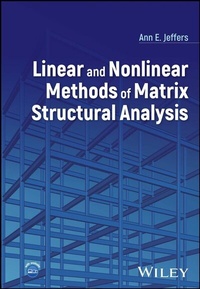
Linear and Nonlinear Methods of Matrix Structural Analysis
Description

Develop more advanced structural models with this must-have text
Recent technological advances have made computer models an integral part of structural design. In particular, nonlinear matrix structural analysis has permitted the widespread deployment of advanced analytical techniques to model, for instance, structural frames subjected to extreme loads. No existing text, however, introduces both linear and nonlinear matrix structural analysis for the benefit of structural engineers.
Linear and Nonlinear Methods of Matrix Structural Analysis meets this need with a thorough and practical overview of these techniques and their applications in structural design. Moving from fundamentals to more advanced subjects, this volume permits informed decision-making about the creation and assessment of structural models. It promises to equip structural engineers with a new and cutting-edge set of analytical tools.
Linear and Nonlinear Methods of Matrix Structural Analysis readers will also find:
- Detailed discussion of how to produce code for performing linear and nonlinear matrix structural analysis
- Coverage of how to analyze trusses, beams, and frames under different loads
- A discussion of advanced topics like connections, joints, slabs, shear walls, and pushover analysis
- Learning objectives, worked-through examples, and end-of-chapter problems to facilitate concept acquisition and retention
Linear and Nonlinear Methods of Matrix Structural Analysis is ideal for graduate and advanced undergraduate students in structural engineering, civil engineering and related subjects.
More details
Other editions
Additional editions
Person
Ann E. Jeffers is Associate Professor in the Department of Civil and Environmental Engineering at the University of Michigan, USA. She has taught and published widely on structural analysis, engineering for natural and manmade hazards, multiphysics simulation, and other related subjects.
Content
Preface ix
Acknowledgments xi
Acronyms xiii
About the Companion Website xix
Part I Linear Analysis 1
1 A Primer on Matrix Structural Analysis 3
1.1 The Force Method 4
1.2 The Displacement Method 7
1.3 Matrix Structural Analysis 9
1.4 Formulation of the 1D Bar Element 12
1.5 Partitioning and the Solution of Matrix Equations 13
1.6 Computer Code 17
1.7 Summary 23
1.8 Practice Problems 24
2 Plane Trusses 27
2.1 Derivation of the Local Stiffness: Direct Stiffness Method 27
2.2 Derivation of the Local Stiffness: Flexibility Method 29
2.3 Coordinate Transformation and Global Stiffness 32
2.4 Calculating Internal Forces 37
2.5 Temperature Change 43
2.6 Inclined Supports 48
2.7 Computer Code 50
2.8 Summary 52
2.9 Practice Problems 53
Reference 55
3 Plane Beams 57
3.1 Elastic Beam Theory 57
3.2 Derivation of the Stiffness Matrix: Direct Stiffness Method 59
3.3 Derivation of the Stiffness Matrix: Flexibility Method 64
3.4 Member Loads 67
3.5 Releases (Hinges) 71
3.6 Shear Deformations 75
3.7 Computer Code 77
3.8 Summary 80
3.9 Practice Problems 82
Reference 84
4 Plane Frames 85
4.1 Derivation of the Local Stiffness Matrix: Direct Stiffness Method 85
4.2 Derivation of the Local Stiffness Matrix: Flexibility Method 86
4.3 Coordinate Transformations 89
4.4 Releases (Hinges) 96
4.5 Constraints 101
4.6 Computer Code 105
4.7 Summary 107
4.8 Practice Problems 108
Reference 110
5 Space Trusses and Frames 111
5.1 Overview of 3D Elements 111
5.2 Torsion 112
5.3 Combined Flexure and Torsion 114
5.4 3D Elements in Local Coordinates 115
5.5 Coordinate Transformations 118
5.6 Calculation of the Direction Cosines 120
5.7 Element Stiffness in Global Coordinates 124
5.8 Computer Code 129
5.9 Summary 129
5.10 Practice Problems 129
References 131
Part II Nonlinear Analysis 133
6 Introduction to Nonlinear Analysis 135
6.1 Overview 135
6.2 Material Nonlinear Analysis 137
6.3 Geometric Nonlinear Analysis 145
6.4 Levels of Analysis 150
6.5 Summary 153
6.6 Practice Problems 153
References 155
7 Solving Nonlinear Systems of Equations 157
7.1 Newton-Raphson Method 157
7.2 Modified Newton-Raphson Method 164
7.3 Hardening Curves 165
7.4 Limitations 168
7.5 Summary 168
7.6 Practice Problems 169
References 170
8 Geometric Nonlinear Analysis 171
8.1 Total Lagrangian Formulation 172
8.2 Determining Critical Loads Using Eigenvalue Analysis 181
8.3 Corotational Formulation 186
8.4 Determining Critical Loads Using Incremental, Iterative Analysis 190
8.5 Summary 192
8.6 Practice Problems 193
References 196
9 Nonlinear Material and Section Responses for Steel and Concrete 197
9.1 Fundamentals of Material Behavior 198
9.2 Uniaxial Plasticity Models 201
9.3 Loading, Unloading, Reloading, and Reversed Loading 204
9.4 Plasticity in 2D and 3D 212
9.5 Computer Code for Nonlinear Stress-Strain Models 213
9.6 Section Force-Deformation Relationships 214
9.7 Interaction Diagrams 216
9.8 Summary 218
9.9 Practice Problems 219
References 219
10 Material Nonlinear Analysis 221
10.1 Virtual Work Formulation 221
10.2 Lumped Plasticity Frame Element 225
10.3 Distributed Plasticity Frame Element 232
10.4 Combined Geometric and Material Nonlinear Analysis 249
10.5 Summary 250
10.6 Practice Problems 250
References 253
Part III Advanced Topics 255
11 Joints and Connections 257
11.1 Rigid Offsets 257
11.2 Panel Zone Deformations 261
11.3 Connections and the Component Model 263
11.4 Summary 267
References 267
12 Slabs and Shear Walls 269
12.1 Shell Elements 270
12.2 Compatibility Between Shell and Frame Elements 273
12.3 Slabs 274
12.4 Composite Beams 276
12.5 Shear Walls 277
12.6 Summary 279
References 279
13 Nonlinear Static Pushover Analysis 281
13.1 Analysis Procedure 282
13.2 Leaning Columns 283
13.3 Steel Concentrically Braced Frame 285
13.4 Reinforced Concrete Moment Frame 290
13.5 Summary 293
References 294
A Linear Algebra 295
A. 1 Matrix Properties 295
A. 2 Matrix Operations 296
A. 3 Gauss Elimination 300
A. 4 Ill-conditioning in Matrix Structural Analysis 305
A. 5 Banded Matrices and Sparse Matrix Storage 306
Reference 307
B Error Analysis 309
B. 1 Sources of Error 309
B. 2 Quantification of Error 310
B. 3 Verification and Validation 310
Index 313
Chapter 1
A Primer on Matrix Structural Analysis
After reading this chapter, you will be able to:
- Analyze structural members using force and displacement methods
- Derive the stiffness matrix for a 1D bar element
- Assemble elements into a system of equilibrium equations for a structure
- Partition a set of equilibrium equations and solve for unknown displacements and reaction forces
- Write a computer program to analyze a system of 1D bar elements
Matrix structural analysis is a computational technique for analyzing structural systems. As such, the technique requires the system of equilibrium equations to be assembled and solved in an automated fashion to keep the user's input to a minimum. The use of matrices leads to simple algebraic calculations that require little computational resources, even for large problems. Moreover, the models that are used in matrix structural analysis are relatively easy to construct in commercial software. Nevertheless, as with all engineering software, it takes a trained user to ensure that the results obtained from an analysis are logical and, presumably, correct. As a result, the method requires a deep level of understanding of structural mechanics, which is why it is treated as an advanced method of analysis in most engineering programs.
In this chapter, we will look at the theory behind matrix structural analysis, which is rooted in a method known as the displacement method or the direct stiffness method. We will use a statically indeterminate beam to illustrate some of the fundamental differences between the displacement method and the more intuitive force method. We will then use a simple example of an elastic, 1D bar under uniaxial load to come up with a simple process that will allow us to use matrix methods to analyze any type of structural system. From there, we will generalize, giving us a procedure that is directly applicable to other elements, including beams and frames.
1.1 The Force Method
Students who have taken a course on structural analysis have undoubtedly encountered a method for analyzing statically indeterminate structures called the force method or flexibility method. In the force method, a selection of structural forces is specified as redundant because the forces are not needed for stability. Removal of redundant forces results in a structure that is both stable and statically determinant. Using superposition, each redundant force is then introduced to the system and conditions of compatibility are written. The process yields a system of simultaneous equations that may be used to determine the unknown redundant forces.
To illustrate the force method, consider the fixed-fixed beam shown in Figure 1.1, which carries a point load . Using the force method we must first determine the degree of static indeterminacy. In this case, because we have three equilibrium equations (i.e. summing forces in the -direction is zero, summing forces in the -direction is zero, and summing the moments about a point is zero) and six unknown reaction forces, we would say that the beam is statically indeterminate to the third degree (i.e. 6 - 3 = 3). This means that we need three equations of compatibility in addition to our three equilibrium equations to solve for the reaction forces , , , , , and .
Figure 1.1 Statically indeterminate beam with point load at mid-span.
If we choose the reaction forces , , and at the right end of the beam as our redundant forces, the structure, once the redundant forces are removed, is simply a cantilever beam, as shown in Figure 1.2. When we take away the support at the right, the end of the beam displaces (Figure 1.2a). The reaction forces , , and must then be applied to close the fictitious gap in the system, as shown in Figure 1.2b. Using superposition, we can write the compatibility equations, which basically state that the sum of the displacements in , , and directions at the right end of the structure shown in Figure 1.2 must be zero due to the fact that there is a fixed support in our original structure. In other words,
(1.1)where the components of deflection are shown in Figure 1.2.
Figure 1.2 Beam with (a) the redundant forces removed and (b) the redundant forces applied.
Because the structures in Figure 1.2 are statically determinate, we can analyze the twelve components of deflection that appear in Eq. (1.1). Keep in mind that the externally applied force is known, and the redundant forces , , and are the unknown reaction forces. We can quantitatively evaluate , , and (Figure 1.2a), whereas the deflections in the structure with the redundant forces applied (Figure 1.2b) are in terms of the unknown reaction forces. In particular, from principles of mechanics, we know that , where is the length, is the cross-sectional area, and is the modulus of elasticity. Since this problem is linear elastic and deformations are small, we can calculate the deformations produced by unit forces and then scale the deformations by the unknown reaction forces. We define the flexibility coefficient as the deformation in the beam due to a unit force. For a unit force applied at Redundant 1, this gives
(1.2)Then, . Note that we give the flexibility coefficient in Eq. (1.2) the subscript (1,1) because it is the deformation in the first direction produced by the redundant force in the first direction . Note that and are zero because the axial force does not produce transverse deformation or rotation, assuming displacements are small.
We use the same procedure to determine the remaining flexibility coefficients. Because bending does not produce axial deformation when deformations are small, we find that flexibility coefficients and are zero. The remaining flexibility coefficients are nonzero and are obtained using methods for analyzing deflections in beams (e.g. the method of virtual work). These flexibility coefficients are left for the reader to derive. Following the derivation, we find
(1.3)If we express the remaining deflections in terms of flexibility coefficients and their respective unknown forces, and we move the deformations due to load to the right-hand side, then Eq. (1.1) becomes
(1.4)In matrix form,
(1.5)If we denote the matrix of flexibility coefficients as , the unknown force vector as , and the known displacement vector as , then the solution to the problem can be obtained by inverting the flexibility matrix, i.e. . Using our flexibility coefficients and solving for the deflections , , and gives
(1.6)Solving Eq. (1.6) gives
(1.7)The minus sign on means that the moment acts in the opposite direction from that assumed in Figure 1.2.
Using our equations of equilibrium, we can then determine the reactions , , and . In particular, summing forces in the -direction gives , summing forces in the -direction gives , and summing moments gives .
While the force method is widely used in introductory-level structural mechanics, it cannot be automated in a computer code because governing equations are not unique, i.e. they depend on the forces chosen as redundant. Moreover, the deflections in the compatibility equations are not easily calculated, leading to a process that cannot be scaled to large problems. In addition, once the compatibility equations are solved and the redundant forces are known, it is not trivial to go back to the original structure and analyze deformations and forces at other locations in the structure. In this problem, we may want, for example, to know the deflection at mid-span in the beam. In this case, we would need to invoke a method for evaluating beam deflections, such as the method of virtual work, which requires additional work. For these reasons, the force method is generally not used to analyze large structural systems.
1.2 The Displacement Method
While the force and displacement methods are complementary, the displacement method, unlike the force method, is ideal for computational analysis because it addresses the limitations discussed in the previous section. In the displacement method, we discretize the structural system into elements and nodes. A degree of freedom (DOF) is defined as an unknown displacement or rotation at a node. The degree of kinematic indeterminacy is defined as the total number of unconstrained degrees of freedom in the structure. For the kinematic degrees of freedom, a system of equations is written based on nodal equilibrium. The primary unknown quantities are the displacements, whereas the forces (i.e. the externally applied forces, like in our example) are known. Rather than determine flexibility coefficients, we derive stiffness coefficients, where the stiffness coefficient is the force in direction associated with a unit displacement imposed in direction .
Table 1.1 shows a summary of the force and displacement methods, from which an interesting parallel between the two methods can be seen.
Table 1.1 A comparison between the force and displacement methods.
Method Primary Unknowns Equations Used for the Solution Coefficients of the Unknowns Solution to the System of Equations Force Forces...