

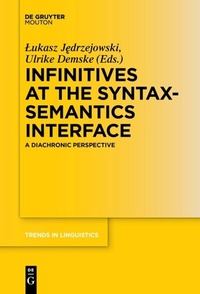
Infinitives at the Syntax-Semantics Interface
A Diachronic Perspective
1st Edition
Published on 26. June 2017
X, 362 pages
978-3-11-052058-3 (ISBN)
Description

The major aim of this volume is to investigate infinitival structures from a diachronic point of view and, simultaneously, to embed the diachronic findings into the ongoing theoretical discussion on non-finite clauses in general. All contributions subscribe to a dynamic approach to infinitival clauses by investigating their origin, development and loss in miscellaneous patterns and across different languages.
More details
Other editions
Additional editions
Lukasz Jedrzejowski | Ulrike Demske
Infinitives at the Syntax-Semantics Interface
A Diachronic Perspective
Book
07/2019
1st Edition
De Gruyter Mouton
€39.95
Shipment within 7-9 days
Lukasz Jedrzejowski | Ulrike Demske
Infinitives at the Syntax-Semantics Interface
A Diachronic Perspective
E-Book
06/2017
1st Edition
De Gruyter Mouton
€149.95
Available for download
Lukasz Jedrzejowski | Ulrike Demske
Infinitives at the Syntax-Semantics Interface
A Diachronic Perspective
Book
06/2017
1st Edition
De Gruyter Mouton
€149.95
Shipment within 7-9 days
Persons
Lukasz Jedrzejowski and Ulrike Demske , University of Potsdam, Germany.
Content
- Intro
- Preface and acknowledgments
- Table of contents
- List of contributors
- 1. Infinitival patterns and their diachronic dynamics: Questions and challenges
- I . Acl verbs and restructuring effects
- 2. Restructuring at the syntax-semantics interface
- 3. The Romanian infinitive selected by perception and cognition verbs
- 4. A diachronic perspective on the semantics of AcI clauses in Greek
- II. Infinitive structures versus other non-finite and finite patterns
- 5. Finite, infinitival and verbless complementation: The case of believe, suppose and find
- 6. Early Modern Romanian infinitives: origin and replacement
- 7. Semantic factors for the status of control infinitives in the history of German
- 8. Anti-agreeing infinitives in Old Hungarian
- 9. The emergence of expressions for purpose relations in older Indo-European languages
- 10. Main clause infinitival predicates and their equivalents in Slavic: Why they are not instances of insubordination
- Language index
- Subject index
