

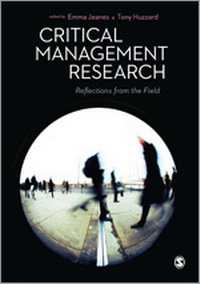
Critical Management Research
Reflections from the Field
1st Edition
Published on 1. October 2014
256 pages
978-1-4739-0867-3 (ISBN)
Description

This is an invaluable collection of reflections and experiences from world-class researchers undertaking Critical Management Studies (CMS).
The editors and contributors reflect on ethics and reflexivity in critical management research, and explore the identity of the critical researcher both as an individual and working within collaborative projects. Using contemporary accounts from those engaged in real world fieldwork they outline what critical management is, and explore its relationship to management research.
The book discusses the implications of critical management when:
Developing research questions
Managing research relationships
Using various methods of data collection
Writing accounts of your research, findings and analysis.
Grounded in practical problems and processes this title sets out and then answers the challenges faced by critical researchers doing research in organization and management studies.
The editors and contributors reflect on ethics and reflexivity in critical management research, and explore the identity of the critical researcher both as an individual and working within collaborative projects. Using contemporary accounts from those engaged in real world fieldwork they outline what critical management is, and explore its relationship to management research.
The book discusses the implications of critical management when:
Developing research questions
Managing research relationships
Using various methods of data collection
Writing accounts of your research, findings and analysis.
Grounded in practical problems and processes this title sets out and then answers the challenges faced by critical researchers doing research in organization and management studies.
Reviews / Votes
A seasoned group of authors share their insights form spending years in the field conducting research. This is highly recommended for anyone hoping to put critical management studies to work. -- Andre Spicer, Professor of Organisational Behaviour, Cass Business School, City University * Andre Spicer, Professor of Organisational Behaviour, Cass Business School, City University * This collection's 13 chapters are written by 17 authors. They provide a comprehensive overview of the current stage of critical management research (CMR). -- Thomas Klikauer, University of Western Sydney, Australia With the growing interest in critical management studies, this timely volume engages with the practices and dilemmas of 'doing' critical management research. A highly credible international team of authors provide reflections on issues ranging from methodology, ethics and reflexivity to the practices of writing. This collection is an invaluable resource for critically-inclined graduate students and experienced researchers alike.-- Christopher Grey, Professor of Organization Studies, Royal Holloway, University of London * Christopher Grey, Professor of Organization Studies, Royal Holloway, University of London *
All prices
More details
Language
English
Place of publication
London
United Kingdom
Target group
College/higher education
Professional and scholarly
ISBN-13
978-1-4739-0867-3 (9781473908673)
Copyright in bibliographic data and cover images is held by Nielsen Book Services Limited or by the publishers or by their respective licensors: all rights reserved.
Schweitzer Classification
Other editions
Additional editions
Book
10/2014
1st Edition
SAGE Publications Ltd
€196.40
Shipment within 15-20 days
Book
10/2014
1st Edition
SAGE Publications Ltd
€111.50
Shipment within 15-20 days
Persons
Emma Jeanes is based at Exeter University, and is affiliated to Lund University. Her research interests include the experiences of work, gender, discrimination, ethics, reflexivity, and the distinctions between work and life 'outside' of (paid) work. She takes an historical, sociological and philosophical approach to her research. Tony Huzzard is Professor of Organisation Studies at the Department of Business Administration, Lund University and is also Visiting Professor at the Chalmers University of Technology in Gothenburg. He has researched and published widely on organisational development, work organisation and industrial relations. His current research interests are diverse including corporate governance and work organisation, process organising in health care and the branding of business schools.
Content
Introduction - Emma Jeanes and Tony Huzzard
Approaching the field
Problematization meets mystery creation: Generating new ideas and findings through assumption challenging research - Mats Alvesson and Jorgen Sandberg
Researcher collaboration: Learning from experience - Emma Jeanes, Bernadette Loacker and Martyna Sliwa
In the field
Critical ethnographic research: Negotiations, influences, and interests - Daniel Nyberg and Helen Nicholson
Critical action research - Tony Huzzard and Yvonne Johansson
Doing research in your own organization: Being native, going stranger - Mathias Skrutkowski
Critical and compassionate interviewing: Asking until it makes sense - Susanne Ekman
Critical Netnography: Conducting critical research online - Jon Bertilsson
Out of the field
Motifs in the methods section: Representing the qualitative research process - Karen Lee Ashcraft and Catherine S. Ashcraft
Thickening thick descriptions: Overinterpretations in critical organizational ethnography - Peter Svensson
Conceptually grounded analysis: The elusive facticity and ethical upshot of `Organization' - Hugh Willmott
Writing: What can be said, by who, and where? - Martin Parker
Conclusion: Reflexivity, ethics and the researcher - Emma Jeanes and Tony Huzzard
Approaching the field
Problematization meets mystery creation: Generating new ideas and findings through assumption challenging research - Mats Alvesson and Jorgen Sandberg
Researcher collaboration: Learning from experience - Emma Jeanes, Bernadette Loacker and Martyna Sliwa
In the field
Critical ethnographic research: Negotiations, influences, and interests - Daniel Nyberg and Helen Nicholson
Critical action research - Tony Huzzard and Yvonne Johansson
Doing research in your own organization: Being native, going stranger - Mathias Skrutkowski
Critical and compassionate interviewing: Asking until it makes sense - Susanne Ekman
Critical Netnography: Conducting critical research online - Jon Bertilsson
Out of the field
Motifs in the methods section: Representing the qualitative research process - Karen Lee Ashcraft and Catherine S. Ashcraft
Thickening thick descriptions: Overinterpretations in critical organizational ethnography - Peter Svensson
Conceptually grounded analysis: The elusive facticity and ethical upshot of `Organization' - Hugh Willmott
Writing: What can be said, by who, and where? - Martin Parker
Conclusion: Reflexivity, ethics and the researcher - Emma Jeanes and Tony Huzzard
