

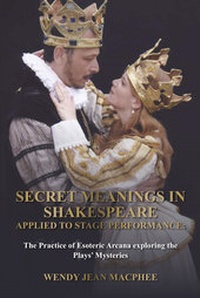
Secret Meanings In Shakespeare Applied To Stage Performance
Description

"Here is a person who shares with me a love of Shakespeare's mysterious depths of understanding. The ancient wisdom traditions underlie andsustain the incredible reflection of our souls in Shakespeare." Sir Mark Rylance, first artistic director of Shakespeare's Globe, London (1995-2005).
Eight arcana - alchemy, Renaissance Platonism (including Divine Love), Renaissance magic, the Cabala, Celtic mysticism and Old World religion, initiation, theurgy and the Bible - are identified by the author inShakespeare's plays as means to uncover long misunderstood mysteries and anomalies of his playwriting. Strange and unlikely events in the stage action of his plays are elucidated as metaphors of these arcana, all readily available to Shakespeare and other playwrights of his day. For example,in The Winter's Tale Shakespeare tells of a seacoast of Bohemia on whichthe ship carrying the baby Perdita, mariners and the courtier Antigonus are wrecked in a storm, the latter being eaten by a bear. A reading of theplay as a metaphor of chemical alchemy, clearly identified by the namesof the characters and the stage action, shows how the scene is indicativeof the alchemical stage of Putrefaction taking place in a bear-shaped vessel. In As You Like It, the reported action in the Forest of Arden where Orlando rescues his brother from a lion and a snake is sourced from severaltransforming arcana leading to brotherly reconciliation.
SECRET MEANINGS IN SHAKESPEARE APPLIED TO STAGE PERFORMANCE is unique in that these meanings have been researched and developed specifically to inform stage performances by an international, professional theatre company - Theatre Set-Up (www.ts-u.co.uk). For over thirty years the author's esoteric interpretations have inspired and clarifiedthe company's productions to widespread critical and audience acclaim.
About the Author
Wendy Jean Macphee (whose doctorate in arcana in Shakespeare was taken at the Shakespeare Institute of The University of Birmingham) was a teacher and lecturer in English, drama and music from 1960 to 2012and was founder, administrator, artistic director, actor and musician forTheatre Set-Up which toured Shakespeare's plays in heritage sites in the UK and in mainland Europe from 1976 to 2011.
All prices
More details
Other editions
Additional editions
Content
LIST OF ILLUSTRATIONS
All production photos are of Theatre Set-Up. Colour photos by Wendy and Michael Gains, black and white photos by Graham Sergeant.
Cover photo: Leontes: 'O she's warm/ If this be magic, let it be an art | Lawful as eating' (V. iii. 109). The Philosophers' Stone achieved with Hermione as a living statue. Leontes (Tony Portacio) and Hermione (Morag Brownlie), The Winter's Tale 2006.
Fig. 1. Hamlet 1976, the first performance of Theatre Set-Up. Above: Old Hamlet's ghost (Raymond Farrell) appearing at Forty Hall, Enfield, through the gates of the arch thought to be designed by the eighteenth-century architect Inigo Jones. Below: Voltimand (Mike Mousley) and Hamlet (Ciaran Hinds) inside the Forty Hall Banqueting Suite.
Fig. 2. A Midsummer Night's Dream 1983. Above: The four elements as the reconciled lovers. Demetrius as earth (Sean Aita), Helena as Fire (Amanda Strevett), Hermia as air (Gwyneth Hammond) and Lysander as water (David Goudge). The colour changed on the circular plinth to gold signifying the last alchemical stage of the Philosophers' Stone. Our Hieroglyphic Monad attached to the plinth. Below: Hermia embodying air and Lysander. The plinth is white, signifying the second stage of four- staged alchemy.
Fig. 3. Diagram of the Cabala Tree of Life. Terms by Gareth Knight, Will Parfitt and Wendy Macphee.
Fig. 4. Christ and the Philosophers' Stone. From: Rosarium Philosophorum in De alchimia opuscula complura veterum philosophorum (Frankfurt, in officina Cyriaci Iacobi, 1550). Copyright The British Library Board. All rights reserved. 1032.c.1, sig. aiv recto.
Fig. 5. The 'Tail Eater, the Oroubos' as the 'base matter' of alchemy with the red-and-white-rose, 'flos sapientum' (the 'wise' flux of the process). From: Hieronymus Reusner, Pandora (Basel, 1588), p. 257. Copyright The British Library Board. All rights reserved. 1032.b.10, p. 257.
Fig. 6. George Ripley's Diagrammatic Wheel of correspondences between the elements, the four directions, the planets, the signs of the zodiac, alchemy and Christianity. From: Compound of Alchymy (London: Thomas Orwin, 1591). Photo: Warburg Institute. Innes Collection FGH4920.
Fig. 7. Multiplicatio represented by lion cubs which symbolise the reproductive power of the Philosophers' Stone, here presented as a lion upon which a queen sits holding an additional image of the Stone as a pelican, pecking its own breast to feed its young. From: J. D. Mylius, Philosophia Reformata, (Frankfurt: apud Lucam Iennis 1622). Copyright The British Library Board. All rights reserved. 1033.i.7, sig. Q3verso.
Fig. 8. Coniunctio. The chemical wedding of 'The Red King and The White Queen'. From: Splendor Solis, attributed to Salomon Trismosin (1582). Copyright The British Library Board. All rights reserved. Ms Harley 3469, fo. 10r.
Fig. 9. The king eats the son. A metaphor for a by-product of the 'base-matter' being consumed within the process in the stage of coniunctio. From: The Book of Lambspring (1678) expanded from the original edition 1625. Translated by A.E. Waite, The Hermetic Museum Restored and Enlarged, 2. vols (London: Elliott, 1893), I, 301.
Fig. 10. The wolf eats the king. The wolf here represents the chemical antimony. The goal of alchemy is anticipated with a 'resurrected king' emerging in the distance from a purging fire. From: Michael Maier, Atalanta Fugiens; Hoc est, Emblemata Nova de Secreti Naturae Chymia, 2nd ed (Oppenheim: Johann Theodor De Bry, 1618). Copyright The Bodleian Libraries, The University of Oxford. VET.D2.e.18, p. 105.
Fig. 11. The raven as symbol of putrefaction. The 'nigredo'eclipse of 'Mercurius Senex' (symbol of Saturn as 'base matter'). From: Herbrandt Jamsthaler, Viatorium Spagyricum (Frankfurt am Main, 1625). Copyright The British Library Board. All rights reserved. 1034.k.2, p. 118.
Fig. 12. Melencholia. Copper plate engraving by Albrecht Dürer (1514). Seven-stage alchemy is represented by the seven-runged ladder rising from the stone which represents the Philosophers' Stone. Copyright Trustees of the British Museum.
Fig. 13. The old king drowning and the birth of the new king. A metaphor for the resurrecting aspect of the alchemical process with the precept 'Die to live'. From: Splendor Solis, attributed to Salomon Trismosin (1582). Copyright The British Library Board. All rights reserved. Ms Harley 3469, fo. 16v.
Fig. 14. Stages in the alchemical process. 'Base matter' is represented by a dragon at the base of the image and the Philosophers' Stone by a phoenix at the top. For a comprehensive description of all the items in the image see C.G. Jung, Psychology and Alchemy, pp. 284-7. From: Andrea Libavius, Alchymia (Frankfurt: J. Saurius, 1606). Copyright The British Library Board. All rights reserved. 535.k.5, p. 55.
Fig. 15. Paulina (Wendy Macphee) as alchemist with Leontes (Tony Portacio) as the 'Red King' in The Winter's Tale, 2006.
Fig. 16. Aenigma Regis. 'The Rebus'(Hermaphrodite) holding serpents and rising from 'base matter' imaged as a three-headed dragon. Seven-stage alchemy is pictured as a flowering tree and the Philosophers' Stone as a lion and pelican feeding its young from its plucked breast. From: Rosarium Philosophorum in De alchimia opuscula complura veterum philosophorum (Frankfurt, in officina Cyriaci Iacobi, 1550) Copyright The British Library Board. All rights reserved. 1032.c.1, sig. Xiii verso.
Fig. 17. Viola (Emma Reynolds) as symbolic hermaphrodite with Olivia (Susannah Coleman) in Twelfth Night , 1997.
Fig. 18. Divine Love, Christianity and initiation: Friar Lawrence (Michael Palmer) marries Romeo (Neil Warhurst) and Juliet (Victoria Stilwell) In Romeo and Juliet, 1996.
Fig. 19. Divine Love and Plato's Phaedrus metaphor of the charioteer. The dying Antony (Tony Portacio) and Cleopatra (Rosalind Cressy) in Antony and Cleopatra, 1998.
Fig. 20. Divine Love. Bassanio (Richard Sanderson) and Portia (Suzie Edwards) in The Merchant of Venice, 2010.
Fig. 21. Divine Love. Florizel (Jack Hughes) and Perdita (Karen Boniface) in The Winter's Tale, 2006.
Fig. 22. Plato's metaphor of the Divided Soul. Antipholus of Ephesus (Daniel O'Brien) and Antipholus of Syracuse (Tony Portacio), in The Comedy of Errors, 1986.
Fig. 23. Initiation. The four lovers in Two Gentlemen of Verona, 1987. Above: Proteus (Tony Portacio). Below: Valentine (Anderson Knight), Sylvia (Claire Fisher), Julia (Emma Gibbins), Proteus (Tony Portacio).
Fig. 24. A diagram of the Cabala Tree of Life, contained in a Vesica Piscis. Christ is identified with the Tree, with spheres corresponding to parts of his body. At the top right of the Tree in Chockmah is the Horn of Plenty indicating that the right side of the Tree has active, masculine characteristics, and at the top left in Binah is the All-seeing Eye of the Great Mother, designating female passive characteristics. The pelican beside the image of St John symbolises the self-sacrifice of Christ. For a full description see Gareth Knight, A Practical Guide to Qabalistic Symbolism. From: Liber sacrosancti euangelii de Iesus Christo domino & deo nostro . lingua Syra, . a Ioh. Evangelista Hebraica dicta (Vienna: Michael Cymbermannus 1556). Copyright The British Library Board. All rights reserved. 218.h.21, fo. 101 verso.
Fig. 25. The Cabala: The Lightning Flash. The order (Kether, Chockmah, Binah, Chesed, Geburah, Tiphareth, Netzach, Hod, Yesod, Malkuth) in which Spirit (which is believed to exist within every person) becomes incarnated in the flesh of humanity. From: Will Parfitt, The Elements of the Qabala, p. 25, with the author's permission.
Fig. 26. The Cabala: The Three Triangles. The top Supernal triangle, which includes Kether, Binah and Chockmah, represents 'The Realm of the Spirit' connecting the individual to others. The middle triangle of Tiphareth, Geburah and Chesed represent 'The Realm of the Soul' referring to the soul of the individual. The lower triangle of Malkuth, Yesod, Hod and Netzach, 'The realm of the personality' refer to the thoughts, feelings and sensations of the individual. From: Will Parfitt, The Elements of the Qabala, p. 4, with the author's permission.
Fig. 27. John Dee's Hieroglyphic Monad. The symbol as it appears in his book, Monas Hieroglyphica, 1564. Copyright The British Library Board. All rights reserved. 90.i.20, title page.
Fig. 28. The spiritual world represented by Ariel (Morag Brownlie) interacts with Prospero (James Clarkson), in The Tempest, 2001.
Fig. 29. Celtic nature spirits: Titania (Libby Machin) and Oberon (Tony Portacio) in A Midsummer Night's Dream, 1995.
Fig. 30. Subjects of the alchemic processes and UnderWorld initiation: Posthumus (Tony Portacio) and Imogen (Emily Outred), in Cymbeline, 2009.
Fig. 31. The symbolic cave of the alchemists and the Celts: Mountain of the Adepts. Seven-stage alchemy culminating in the Philosophers' Stone represented as a phoenix, within an alchemist's cave-laboratory-temple hidden in a...
