
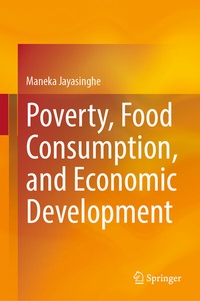
Poverty, Food Consumption, and Economic Development
Description
Alles über E-Books | Antworten auf Fragen rund um E-Books, Kopierschutz und Dateiformate finden Sie in unserem Info- & Hilfebereich.
This book investigates the relationships between economies of scale in food consumption and a number of socio-economic and demographic characteristics of households and household behavioural choices since food is the major share of household expenditure for poor households. The characteristics considered comprise household size, location, income, and gender of the head of household while the behavioural choices considered comprise the decision to consume home-grown food and the decision to adopt domestic technology to aid food preparation and consumption.
The book proposes two theoretical models to rationalize the role of the consumption of home-grown food and the adoption of domestic technology in enhancing economies of scale in food consumption. Econometric models are also used to empirically test the validity of the two theoretical models while adjusted poverty estimations are derived numerically using the estimated equivalence scales. Although data used inapplying these techniques are based on four Household Income and Expenditure Surveys conducted by the Department of Census and Statistics (DCS) in Sri Lanka, the methodology can be used for similar analysis in relation to any other country.
More details
Other editions
Additional editions

Person
Content
System requirements
File format: PDF
Copy protection: Watermark-DRM (Digital Rights Management)
System requirements:
- Computer (Windows; MacOS X; Linux): Use the free software Adobe Reader, Adobe Digital Editions, or any other PDF viewer of your choice (see eBook Help).
- Tablet/Smartphone (Android; iOS): Install the free app Adobe Digital Editions or another reading app for eBooks, e.g., PocketBook (see eBook Help).
- E-reader: Bookeen, Kobo, Pocketbook, Sony, Tolino and many more (only limited: Kindle).
The file format PDF always displays a book page identically on any hardware. This makes PDF suitable for complex layouts such as those used in textbooks and reference books (images, tables, columns, footnotes). Unfortunately, on the small screens of e-readers or smartphones, PDFs are rather annoying, requiring too much scrolling.
This eBook uses Watermark-DRM, a „soft” copy protection. This means that there are no technical restrictions to prevent illegal distribution. However, there is a personalised watermark embedded in the eBook that can be used to identify the purchaser of the eBook in the event of misuse and to provide evidence for legal purposes.
For more information, see our eBook Help page.