

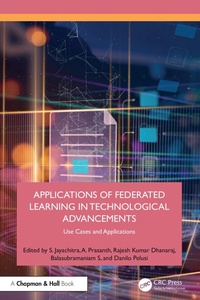
Applications of Federated Learning in Technological Advancements
Use Cases and Applications
Published on 2. September 2025
186 pages
978-1-040-40540-6 (ISBN)
Description

This book explores the applications and advancements of federated learning across diverse sectors, focusing on its integration with cutting- edge technologies like Internet of Things (IoT), artificial intelligence (AI), blockchain, and digital twins. Real-world examples and case studies illustrate federated learning's role in healthcare, smart cities, and maritime applications while addressing critical concerns such as security. It provides insights into federated learning's transformative potential, offering practical strategies for intelligent systems and sustainable environments.
The book particularly:
Focuses on the federated learning-based model optimization, addressing the significance of IoT and federated learning in the evolution of intelligent systems for various applications
Describes the different optimization techniques of federated learning systems from a practical point of view
Highlights economic, social, and environmental impacts of smart technologies and provides insights into IoT, 5G/ 6G communication, and computing standards
Provides analysis of the use cases of federated learning regarding the development of IoT, AI, blockchain, digital twins
Offers strategies for overcoming challenges associated with federated learning systems, including connectivity, computation, threats, privacy, and security issues
It covers fundamental concepts, practical implementations, and trends, to serve as a reference resource for professionals and researchers in the field.
The book particularly:
Focuses on the federated learning-based model optimization, addressing the significance of IoT and federated learning in the evolution of intelligent systems for various applications
Describes the different optimization techniques of federated learning systems from a practical point of view
Highlights economic, social, and environmental impacts of smart technologies and provides insights into IoT, 5G/ 6G communication, and computing standards
Provides analysis of the use cases of federated learning regarding the development of IoT, AI, blockchain, digital twins
Offers strategies for overcoming challenges associated with federated learning systems, including connectivity, computation, threats, privacy, and security issues
It covers fundamental concepts, practical implementations, and trends, to serve as a reference resource for professionals and researchers in the field.
More details
Language
English
Place of publication
London
United Kingdom
Publishing group
Taylor & Francis Ltd
Target group
Professional and scholarly
College/higher education
Illustrations
15 Tables, black and white; 32 Line drawings, black and white; 1 Halftones, black and white; 33 Illustrations, black and white
File size
15,50 MB
ISBN-13
978-1-040-40540-6 (9781040405406)
Copyright in bibliographic data and cover images is held by Nielsen Book Services Limited or by the publishers or by their respective licensors: all rights reserved.
Schweitzer Classification
Other editions
Additional editions
S. Jayachitra | A. Prasanth | Rajesh Kumar Dhanaraj
Applications of Federated Learning in Technological Advancements
Use Cases and Applications
Book
09/2025
1st Edition
Chapman & Hall/CRC
€232.80
Shipment within 10-20 days
Persons
S. Jayachitra, presently working as an Assistant Professor at PSNA College of Engineering and Technology, Dindigul, India. She received B.E. degree in Electronics and Communication Engineering from Anna University, Chennai and M.E degree in Communication Systems from Anna University, Chennai and also pursuing her Ph.D degree in Information and Communication Engineering from Anna University, Chennai, India. She has published more than 25 research articles in reputed International Journals which are indexed in Scopus. She has won two best paper awards and been granted 22 patents.
A. Prasanth received the B.E degree from Anna University, Chennai and the M.E degree in Computer Science and Engineering (with specialization in Networks) from Anna University, Chennai and also received a Ph.D. degree in Information and Communication Engineering from Anna University, Chennai, India. He served as a Recognized Ph.D. Supervisor. Five Scholars are pursuing their research, and two completed their Ph.D under his guidance. His name was included in the World's Top 2% of Scientists list in the years 2023 and 2024.
Rajesh Kumar Dhanaraj is a distinguished Professor at Symbiosis International (Deemed University) in Pune, India. Before joining Symbiosis International University, he served as a Professor at the School of Computing Science & Engineering at Galgotias University in Greater Noida, India. His academic and research achievements have earned him a place among the Top 2% of scientists globally.
Balasubramaniam S (IEEE Senior Member) is working as an Assistant Professor in School of Computer Science and Engineering, Kerala University of Digital Sciences, Innovation and Technology (Formerly IIITM-K), Digital University Kerala, Thiruvananthapuram, Kerala, India. He has totally around 15+ years of experience in teaching, research and industry. He has completed his Post Doctoral Research in Department of Applied Data Science, Noroff University College, Kristiansand, Norway. He holds a Ph.D degree in Computer Science and Engineering from Anna University, Chennai, India in 2015.
Danilo Pelusi received the degree in Physics from the University of Bologna (Italy) and the Ph.D. degree in Computational Astrophysics from the University of Teramo (Italy). Currently, he is an Associate Professor of Computer Science at the Department of Communication Sciences, University of Teramo. He has worked as the editor of books by reputed publishers, and Associate Editor of IEEE Transactions on Emerging Topics in Computational Intelligence (2017-2020), IEEE Access (2018-present), IEEE Transactions on Neural Networks and Learning Systems (2022-present) and IEEE Transactions on Intelligent Transportation Systems (2022-present).
A. Prasanth received the B.E degree from Anna University, Chennai and the M.E degree in Computer Science and Engineering (with specialization in Networks) from Anna University, Chennai and also received a Ph.D. degree in Information and Communication Engineering from Anna University, Chennai, India. He served as a Recognized Ph.D. Supervisor. Five Scholars are pursuing their research, and two completed their Ph.D under his guidance. His name was included in the World's Top 2% of Scientists list in the years 2023 and 2024.
Rajesh Kumar Dhanaraj is a distinguished Professor at Symbiosis International (Deemed University) in Pune, India. Before joining Symbiosis International University, he served as a Professor at the School of Computing Science & Engineering at Galgotias University in Greater Noida, India. His academic and research achievements have earned him a place among the Top 2% of scientists globally.
Balasubramaniam S (IEEE Senior Member) is working as an Assistant Professor in School of Computer Science and Engineering, Kerala University of Digital Sciences, Innovation and Technology (Formerly IIITM-K), Digital University Kerala, Thiruvananthapuram, Kerala, India. He has totally around 15+ years of experience in teaching, research and industry. He has completed his Post Doctoral Research in Department of Applied Data Science, Noroff University College, Kristiansand, Norway. He holds a Ph.D degree in Computer Science and Engineering from Anna University, Chennai, India in 2015.
Danilo Pelusi received the degree in Physics from the University of Bologna (Italy) and the Ph.D. degree in Computational Astrophysics from the University of Teramo (Italy). Currently, he is an Associate Professor of Computer Science at the Department of Communication Sciences, University of Teramo. He has worked as the editor of books by reputed publishers, and Associate Editor of IEEE Transactions on Emerging Topics in Computational Intelligence (2017-2020), IEEE Access (2018-present), IEEE Transactions on Neural Networks and Learning Systems (2022-present) and IEEE Transactions on Intelligent Transportation Systems (2022-present).
Content
1. Journey Towards Federated Learning: Fundamentals, Tools Paradigms, Opportunities and Challenges 2. Federated Learning-based algorithms for deployment and model optimization 3. Automation of AI and IoT-based Data-driven Decision-Making Approaches using Federated Learning Systems 4. Federated Learning for sustainable development using IoT/Edge Computing Systems 5. Advances in 5G/6G enabled federated reinforcement learning in IoT 6. Blockchain Integrated Federated Learning for IoT-based Smart Applications 7. Federated Learning in Heterogeneous Unmanned Aerial Vehicle 8. Advanced Technologies for Federated learning in Smart Cities and its use cases 9.Federated Deep Learning for Cyber-Physical Systems in Real-World Scenarios 10. Use-Cases and Scenarios for Federated Learning Adoption in IoT.
