

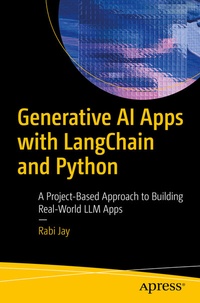
Generative AI Apps with LangChain and Python
Description

Future-proof your programming career through practical projects designed to grasp the intricacies of LangChain's components, from core chains to advanced conversational agents. This hands-on book provides Python developers with the necessary skills to develop real-world Large Language Model (LLM)-based Generative AI applications quickly, regardless of their experience level.
Projects throughout the book offer practical LLM solutions for common business issues, such as information overload, internal knowledge access, and enhanced customer communication. Meanwhile, you'll learn how to optimize workflows, enhance embedding efficiency, select between vector stores, and other optimizations relevant to experienced AI users. The emphasis on real-world applications and practical examples will enable you to customize your own projects to address pain points across various industries.
Developing LangChain-based Generative AI LLM Apps with Python employs a focused toolkit (LangChain, Pinecone, and Streamlit LLM integration) to practically showcase how Python developers can leverage existing skills to build Generative AI solutions. By addressing tangible challenges, you'll learn-by-be doing, enhancing your career possibilities in today's rapidly evolving landscape.
What You Will Learn
- Understand different types of LLMs and how to select the right ones for responsible AI.
- Structure effective prompts.
- Master LangChain concepts, such as chains, models, memory, and agents.
- Apply embeddings effectively for search, content comparison, and understanding similarity.
- Setup and integrate Pinecone vector database for indexing, structuring data, and search.
- Build Q & A applications for multiple doc formats.
- Develop multi-step AI workflow apps using LangChain agents.
Who This Book Is For
Python programmers who aim to develop a basic understanding of AI concepts and move from LLM theory to practical Generative AI application development using LangChain; those seeking a structured guide to enhance their careers by learning to create robust, real-world LLM-powered Generative AI applications; data scientists, analysts, and experienced developers new to LLMs.
More details
Other editions
Additional editions
Person
Rabi Jay has over 15 years of experience driving digital transformation with a unique blend of technical depth and business acumen. His background as a Java and SAP ABAP developer provides insights into the enterprise systems LLMs often needed to integrate with. As a leader in Deloitte's Digital / Cloud Native practice, he has gained cross-industry experience applying AI solutions, positioning him to identify where LLMs offer the greatest potential for business impact.
He is passionate about making complex technology accessible, leading him to authoring books on SAP NetWeaver Portal Technology and "Enterprise AI in the Cloud" along with regular contributions to industry publications. His role as a technical reviewer for Large Language Model Based Solutions, Modern Python Development Using ChatGPT, and as Vice President at HCL America, focused on digital transformation, demonstrate his active engagement in the LLM field. Additionally, he runs a LinkedIn newsletter ("Enterprise AI Transformation") and free LinkedIn course ("Generative AI for Business Innovation").
Content
Chapter 1: Introduction to LangChain and LLMs.- Chapter 2: Integrating LLM APIs with LangChain.- Chapter 3: Building Q&A and Chatbot Apps.- Chapter 4: Exploring LLMs.- Chapter 5: Mastering Prompts for Creative Content.- Chapter 6: Building Chatbots and Automated Analysis Systems Using Chains.- Chapter 7: Building Advanced Q&A and Search applications Using Retrieval-Augmented Generation (RAG).- Chapter 8: Your First Agent App.- Chapter 9: Building Different Types of Agents.- Chapter 10: Projects: Building Agent Apps for Common Use Cases. - Chapter 11: Building & Deploying a ChatGPT Like App Using Streamlit.
