

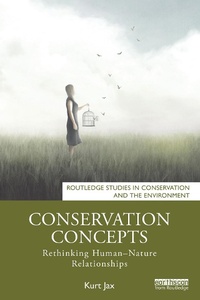
Conservation Concepts
Rethinking Human-Nature Relationships
1st Edition
Published on 31. October 2023
270 pages
978-1-000-99347-9 (ISBN)
Description

This book provides a review of the multitude of conservation concepts, both from a scientific, philosophical, and social science perspective, asking how we want to shape our relationships with nature as humans, and providing guidance on which conservation approaches can help us to do this.
Nature conservation is a contested terrain and there is not only one idea about what constitutes conservation but many different ones, which sometimes are conflicting. Employing a conceptual and historical analysis, this book sorts and interprets the differing conservation concepts, with a special emphasis on narrative analysis as a means for describing human-nature relationships and for linking conservation science to practice and to society at large. Case studies illustrate the philosophical issues and help to analyse major controversies in conservation biology. While the main focus is on Western ideas of conservation, the book also touches upon non-Western, including indigenous, concepts. The approach taken in this book emphasises the often implicit strategic and societal dimensions of conservation concepts, including power relations. In finding a path through the multitude of concepts, the book showcases that it is necessary to maintain the plurality of approaches, in order to successfully address different situations and societal choices. Overall, this book highlights the very tension which conservation biology must withstand between science and society: between what is possible and what we want individually or as a society or even more what is desirable. Bringing some order into this multitude will support more efficient conservation and conservation biology.
This book will be of great interest to students and scholars studying nature conservation from a variety of disciplines, including biology, ecology, anthropology, sociology, geography, and philosophy. It will also be of use to professionals wanting to gain an understanding of the broad spectrum of conservation concepts and approaches and when to apply them.
Nature conservation is a contested terrain and there is not only one idea about what constitutes conservation but many different ones, which sometimes are conflicting. Employing a conceptual and historical analysis, this book sorts and interprets the differing conservation concepts, with a special emphasis on narrative analysis as a means for describing human-nature relationships and for linking conservation science to practice and to society at large. Case studies illustrate the philosophical issues and help to analyse major controversies in conservation biology. While the main focus is on Western ideas of conservation, the book also touches upon non-Western, including indigenous, concepts. The approach taken in this book emphasises the often implicit strategic and societal dimensions of conservation concepts, including power relations. In finding a path through the multitude of concepts, the book showcases that it is necessary to maintain the plurality of approaches, in order to successfully address different situations and societal choices. Overall, this book highlights the very tension which conservation biology must withstand between science and society: between what is possible and what we want individually or as a society or even more what is desirable. Bringing some order into this multitude will support more efficient conservation and conservation biology.
This book will be of great interest to students and scholars studying nature conservation from a variety of disciplines, including biology, ecology, anthropology, sociology, geography, and philosophy. It will also be of use to professionals wanting to gain an understanding of the broad spectrum of conservation concepts and approaches and when to apply them.
More details
Series
Edition
1. Auflage
Language
English
Place of publication
London
United Kingdom
Publishing group
Taylor & Francis Ltd
Target group
College/higher education
Professional and scholarly
Illustrations
8 Tables, black and white; 6 Line drawings, black and white; 12 Halftones, black and white; 18 Illustrations, black and white
ISBN-13
978-1-000-99347-9 (9781000993479)
Copyright in bibliographic data and cover images is held by Nielsen Book Services Limited or by the publishers or by their respective licensors: all rights reserved.
Schweitzer Classification
Other editions
Additional editions
Book
10/2023
1st Edition
Routledge
€61.40
Shipment within 10-20 days
Book
10/2023
1st Edition
Routledge
€196.50
Shipment within 10-20 days
Person
Kurt Jax is Senior Scientist at the Helmholtz Centre for Environmental Research - UFZ in Leipzig, Germany, and Professor of Ecology at the TUM School of Life Sciences at the Technical University of Munich, Germany. He is the author of Ecosystem Functioning (2010).
Content
1. Introduction
2. Situating conservation: definitions, origins, and context
3. Analysing conservation concepts
4. Western and non-Western ideas of nature and nature conservation
5. Moving forward: which conservation concepts for which purposes?
6. Conclusions and outlook
2. Situating conservation: definitions, origins, and context
3. Analysing conservation concepts
4. Western and non-Western ideas of nature and nature conservation
5. Moving forward: which conservation concepts for which purposes?
6. Conclusions and outlook
