

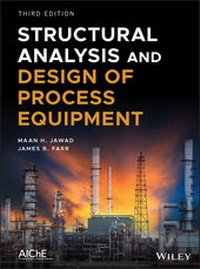
Structural Analysis and Design of Process Equipment
Description

This edition of the classic guide to the analysis and design of process equipment has been thoroughly updated to reflect current practices as well as the latest ASME Codes and API standards. In addition to covering the code requirements governing the design of process equipment, the book supplies structural, mechanical, and chemical engineers with expert guidance to the analysis and design of storage tanks, pressure vessels, boilers, heat exchangers, and related process equipment and its associated external and internal components.
The use of process equipment, such as storage tanks, pressure vessels, and heat exchangers has expanded considerably over the last few decades in both the petroleum and chemical industries. The extremely high pressures and temperatures involved with the processes for which the equipment is designed makes it potentially very dangerous to property and life if the equipment is not designed and manufactured to an exacting standard. Accordingly, codes and standards such as the ASME and API were written to assure safety. Still the only guide covering the design of both API equipment and ASME pressure vessels, Structural Analysis and Design of Process Equipment, 3rd Edition:
* Covers the design of rectangular vessels with various side thicknesses and updated equations for the design of heat exchangers
* Now includes numerical vibration analysis needed for earthquake evaluation
* Relates the requirements of the ASME codes to international standards
* Describes, in detail, the background and assumptions made in deriving many design equations underpinning the ASME and API standards
* Includes methods for designing components that are not covered in either the API or ASME, including ring girders, leg supports, and internal components
* Contains procedures for calculating thermal stresses and discontinuity analysis of various components
Structural Analysis and Design of Process Equipment, 3rd Edition is an indispensable tool-of-the-trade for mechanical engineers and chemical engineers working in the petroleum and chemical industries, manufacturing, as well as plant engineers in need of a reference for process equipment in power plants, petrochemical facilities, and nuclear facilities.
More details
Other editions
Additional editions
Persons
MAAN H. JAWAD, PHD is President of Global Engineering & Technology, consulting on boilers and pressure vessels for the power generation and petrochemical industries. He was Director of Engineering at the Nooter Corporation in St. Louis prior to retiring. He is a graduate of the University of Kansas and Iowa State University and a Fellow of the American Society of Mechanical Engineers. He was awarded the ASME's J. Hall Taylor Medal in 1992 for major contributions to the advancement of Boiler and Pressure Vessel Technology.
JAMES R. FARR (Deceased) was Manager of Codes and Regulation at the Babcock and Wilcox Company, a Fellow of the American Society of Mechanical Engineers, and a member of the American Institute of Chemical Engineers. He is a graduate of Purdue University and served on numerous National and International Committees on pressure vessels.
Content
Preface to the Third Edition xv
Preface to the Second Edition xvii
Preface to the First Edition xix
Acknowledgements xxi
Part I Background and Basic Considerations 1
1 History and Organization of Codes 4
1.1 Use of Process Vessels and Equipment 4
1.2 History of Pressure Vessel Codes in the United States 4
1.3 Organization of the ASME Boiler and Pressure Vessel Code 6
1.4 Organization of the ANSI B31 Code for Pressure Piping 6
1.5 Some Other Pressure Vessel Codes and Standards in the United States 6
1.6 Worldwide Pressure Vessel Codes 7
References 7
Further Reading 7
2 Selection of Vessel, Specifications, Reports, and Allowable Stresses 10
2.1 Selection of Vessel 10
2.2 Which Pressure Vessel Code is Used 10
2.3 Design Specifications and Purchase Orders 10
2.4 Special Design Requirements 11
2.5 Design Reports and Calculations 11
2.6 Materials Specifications 11
2.7 Design Data for New Materials 11
2.8 Factors of Safety 12
2.9 Allowable Tensile Stresses in the ASME Code 12
2.10 Allowable External Pressure Stress and Axial Compressive Stress in the ASME Boiler and Pressure Vessel Code 13
2.11 Allowable Stresses in the ASME Code for Pressure Piping 14
2.12 Allowable Stress in Other Codes of the World 14
References 16
3 Strength Theories, Design Criteria, and Design Equations 18
3.1 Strength Theories 18
3.2 Design Criteria 18
3.3 Design Equations 19
3.4 Stress-Strain Relationships 19
3.5 Strain-Deflection Equations 20
3.6 Force-Stress Expressions 22
References 23
Further Reading 23
4 Materials of Construction 26
4.1 Material Selection 26
4.2 Nonferrous Alloys 31
4.3 Ferrous Alloys 34
4.4 Heat Treating of Steels 35
4.5 Brittle Fracture 35
4.6 Hydrogen Embrittlement 50
4.7 Nonmetallic Vessels 50
References 50
Further Reading 51
Part II Analysis of Components 53
5 Stress in Cylindrical Shells 56
5.1 Stress Due to Internal Pressure 56
5.2 Discontinuity Analysis 60
5.3 Buckling of Cylindrical Shells 69
5.4 Thermal Stress 72
Nomenclature 80
References 81
Further Reading 81
6 Analysis of Formed Heads and Transition Sections 84
6.1 Hemispherical Heads 84
6.2 Ellipsoidal Heads 93
6.3 Torispherical Heads 95
6.4 Conical Heads 95
6.5 Nomenclature 99
References 100
Further Reading 100
7 Stress in Flat Plates 102
7.1 Introduction 102
7.2 Circular Plates 102
7.3 Rectangular Plates 106
7.4 Circular Plates on Elastic Foundations 107
Nomenclature 109
Reference 109
Further Reading 109
Part III Design of Components 111
8 Design of Cylindrical Shells 114
8.1 ASME Design Equations 114
8.2 Evaluation of Discontinuity Stresses 115
8.3 ASME Procedure[2] for External Pressure Design in VIII- 1 121
8.4 Design of Stiffening Rings 126
8.5 Allowable Gaps in Stiffening Rings 129
8.6 Out-of-Roundness of Cylindrical Shells Under External Pressure 129
8.7 Design for Axial Compression 132
Nomenclature 132
References 133
Further Reading 133
9 Design of Formed Heads and Transition Sections 136
9.1 Introduction 136
9.2 ASME Design Equations for Hemispherical Heads 137
9.3 ASME Design Equations for Ellipsoidal, Flanged, and Dished Heads 139
9.4 ASME Design Equations for Conical Heads 143
Nomenclature 147
References 148
Further Reading 148
10 Blind Flanges, Cover Plates, and Flanges 150
10.1 Introduction 150
10.2 Circular Flat Plates and Heads with Uniform Loading 151
10.3 ASME Code Formula for Circular Flat Heads and Covers 153
10.4 Comparison of Theory and ASME Code Formula for Circular Flat Heads and Covers Without Bolting 154
10.5 Bolted Flanged Connections 154
10.6 Contact Facings 155
10.7 Gaskets 155
10.8 Bolting Design 161
10.9 Blind Flanges 163
10.10 Bolted Flanged Connections with Ring-Type Gaskets 164
10.11 Reverse Flanges 170
10.12 Full-Face Gasket Flange 171
10.13 Flange Calculation Sheets 176
10.14 Flat-Face Flange with Metal-to-Metal Contact Outside of the Bolt Circle 177
10.15 Spherically Dished Covers 177
Nomenclature 184
References 184
Further Reading 185
11 Openings, Nozzles, and External Loadings 188
11.1 General 188
11.2 Stresses and Loadings at Openings 188
11.3 Theory of Reinforced Openings 192
11.4 Reinforcement Limits 193
11.5 Ligament Efficiency of Openings in Shells 215
11.6 Fatigue Evaluation of Nozzles Under Internal Pressure 217
11.7 External Loadings 218
References 230
Bibliography 231
12 Vessel Supports 234
12.1 Introduction 234
12.2 Skirt and Base-Ring Design 234
12.3 Design of Support Legs 241
12.4 Lug-Supported Vessels 242
12.5 Ring Girders 243
12.6 Saddle Supports 245
Nomenclature 248
References 249
Further Reading 249
Part IV Theory and Design of Special Equipment 251
13 Flat-Bottom Tanks 254
13.1 Introduction 254
13.2 API 650 Tanks 254
13.3 API 620 Tanks 263
13.4 Aluminum Tanks 270
13.5 AWWA Standard D 100 271
References 273
Further Reading 273
14 Heat-Transfer Equipment 276
14.1 Types of Heat Exchangers 276
14.2 TEMA Design of Tubesheets in U-tube Exchangers 276
14.3 Theoretical Analysis of Tubesheets in U-tube Exchangers 280
14.4 ASME Equations for Tubesheets in U-tube Exchangers 283
14.5 Theoretical Analysis of Fixed Tubesheets 291
14.6 ASME Equations for Fixed Tubesheets 293
14.7 Expansion Joints 300
14.8 Tube-to-Tubesheet Junctions 303
References 305
Further Reading 305
15 Vessels for High Pressures 308
15.1 Basic Equations 308
15.2 Prestressing (Autofrettaging) of Solid-Wall Vessels 309
15.3 Layered Vessels 311
15.4 Prestressing of Layered Vessels 315
15.5 Wire-Wound Vessels 317
Nomenclature 317
References 318
Further Reading 318
16 Tall Vessels 320
16.1 Design Considerations 320
16.2 Earthquake Loading 320
16.3 Wind Loading 331
16.4 Vessel Under Internal Pressure Only 336
16.5 Vessel Under Internal Pressure and External Loading 338
16.6 Vessel Under External Pressure Only 340
16.7 Vessel Under External Pressure and External Loading 341
References 342
Bibliography 342
17 Vessels of Noncircular Cross Section 344
17.1 Types of Vessels 344
17.2 Rules in Codes 345
17.3 Openings in Vessels with Noncircular Cross Section 345
17.4 Ligament Efficiency for Constant-Diameter Openings 345
17.5 Ligament Efficiency for Multidiameter Openings Subject to Membrane Stress 349
17.6 Ligament Efficiency for Multidiameter Openings Subject to Bending Stress 350
17.7 Design Methods and Allowable Stresses 352
17.8 Basic Equations 353
17.9 Equations in the ASME Code, VIII- 1 356
17.10 Design of Noncircular Vessels in Other Codes 360
17.11 Forces in Box Headers due to Internal Pressure 361
References 364
Further Reading 364
18 Power Boilers 366
18.1 General 366
18.2 Materials 366
18.3 General Design Requirements 366
18.4 Formed Heads under Internal Pressure 368
18.5 Loadings on Structural Attachments 368
18.6 Watertube Boilers 369
18.7 Firetube Boilers 373
References 373
A Guide to ASME Code 375
B Sample of Heat-Exchanger Specification Sheet 383
C Sample of API Specification Sheets 387
D Sample of Pressure Vessel design data Sheets 393
E Sample Materials for Process Equipment 407
F Required Data for Material Approval in the ASME Code 411
G Procedure for Providing Data for Code Charts for External-Pressure Design 413
H Corrosion Charts 415
I Various ASME Design Equations 431
J Joint Efficiency Factors 433
K Simplified Curves for External Loading on Cylindrical Shells 445
l Conversion Tables 453
Index 455
1
History and Organization of Codes
Old timers.
Source: (Top) Courtesy Babcock & Wilcox Company; (bottom) Courtesy Nooter Corporation.
1.1 Use of Process Vessels and Equipment
Throughout the world, the use of process equipment has expanded considerably. In the petroleum industry, process vessels are used at all stages of oil processing. At the beginning of the cycle, they are used to store crude oil. Many different types of these vessels process the crude oil into oil and gasoline for the consumer. The vessels store petroleum at tank farms after processing and finally serve to hold the gasoline in service stations for the consumer's use. The use of process vessels in the chemical business is equally extensive. Process vessels are used everywhere.
Pressure vessels are made in all sizes and shapes. The smaller ones may be no larger than a fraction of an inch in diameter, whereas the larger vessels may be 150 ft. or more in diameter. Some are buried in the ground or deep in the ocean; most are positioned on the ground or supported on platforms; and some actually are found in storage tanks and hydraulic units in aircraft.
The internal pressure to which the process equipment is designed is as varied as the size and shape. Internal pressure may be as low as 1 in. water-gage pressure or as high as 300 000 psi or more. The usual range of pressure for monoblock construction is about 15 to about 5000 psi, although there are many vessels designed for pressures below and above that range. The American Society of Mechanical Engineers (ASME) Boiler and Pressure Code, Section VIII, Division 1 [1], specifies a range of internal pressure from 15 psi at the bottom to no upper limit; however, at an internal pressure above 3000 psi, the ASME Code, VIII-1, requires that special design considerations may be necessary [1]. However, any pressure vessel that meets all the requirements of the ASME Code, regardless of the internal or external design pressure, may still be accepted by the authorized inspector and stamped by the manufacturer with the ASME Code symbol. Some other pressure equipment, such as American Petroleum Institute (API) [2] storage tanks, may be designed for and contain internal pressure not more than that generated by the static head of fluid contained in the tank.
1.2 History of Pressure Vessel Codes in the United States
Through the late 1800s and early 1900s, explosions in boilers and pressure vessels were frequent. A firetube boiler explosion on the Mississippi River steamboat Sultana on April 27, 1865, resulted in sinking of the boat within 20 minutes and the death of 1500 soldiers who were going home after the Civil War. This type of catastrophe continued unabated into the early 1900s. In 1905, a destructive explosion of a firetube boiler in a shoe factory in Brockton, Massachusetts (Figure 1.1) killed 58 people, injured 117 others, and caused $400 000 in property damage. In 1906, another explosion in a shoe factory in Lynn, Massachusetts, resulted in death, injury, and extensive property damage. After this accident, the Massachusetts governor directed the formation of a Board of Boiler Rules. The first set of rules for the design and construction of boilers was approved in Massachusetts on August 30, 1907. This code was three pages long!
Figure 1.1 Firetube boiler explosion in shoe factory in Brockton, Massachusetts in 1905.
Source: Courtesy Hartford Steam Boiler Inspection and Insurance Co., Hartford, Ct.
In 1911, Colonel E. D. Meier, the president of the ASME, established a committee to write a set of rules for the design and construction of boilers and pressure vessels. On February 13, 1915, the first ASME Boiler Code was issued. It was entitled "Boiler Construction Code, 1914 Edition." This was the beginning of the various sections of the ASME Boiler and Pressure Vessel Code, which ultimately became Section I, Power Boilers [3].
The first ASME Code for pressure vessels was issued as "Rules for the Construction of Unfired Pressure Vessels," Section VIII, 1925 edition. The rules applied to vessels over 6 in. in diameter, volume over 1.5 ft [3], and pressure over 30 psi. In December 1931, a Joint API-ASME Committee was formed to develop an unfired pressure vessel code for the petroleum industry. The first edition was issued in 1934. For the next 17 years, two separate unfired pressure vessel codes existed. In 1951, the last API-ASME Code was issued as a separate document [4]. In 1952, the two codes were consolidated into one code - the ASME Unfired Pressure Vessel Code, Section VIII. This continued until the 1968 edition. At that time, the original code became Section VIII, Division 1, Pressure Vessels, and another new part was issued, which was Section VIII, Division 2, Alternative Rules for Pressure Vessels.
The ANSI/ASME Boiler and Pressure Vessel Code is issued by the ASME with approval by the American National Standards Institute (ANSI) as an ANSI/ASME document. One or more sections of the ANSI/ASME Boiler and Pressure Vessel Code have been established as the legal requirements in 47 of the 50 states in the United States and in all the provinces of Canada. Also, in many other countries of the world, the ASME Boiler and Pressure Vessel Code is used to construct boilers and pressure vessels.
In the United States, most piping systems are built according to the ANSI/ASME Code for Pressure Piping B31. There are a number of different piping code sections for different types of systems. The piping section that is used for boilers in combination with Section I of the ASME Boiler and Pressure Vessel Code is the Code for Power Piping, B31.1 [5]. The piping section that is often used with Section VIII, Division 1, is the code for Chemical Plant and Petroleum Refinery Piping, B31.3 [6].
1.3 Organization of the ASME Boiler and Pressure Vessel Code
The ASME Boiler and Pressure Vessel Code is divided into many sections, divisions, parts, and subparts. Some of these sections relate to a specific kind of equipment and application; others relate to specific materials and methods for application and control of equipment; and others relate to care and inspection of installed equipment. The following sections specifically relate to the design and construction of boiler, pressure vessel, and nuclear components:
Sections.
- I. Rules for Construction of Power Boilers
- II. Materials
- Part A. Ferrous Material Specifications
- Part B. Nonferrous Material Specifications
- Part C. Specifications for Welding Rods, Electrodes, and Filler Metals
- Part D. Properties
- III. Rules for Construction of Nuclear Facility Components
- Division 1.
- Subsection NB. Class 1 Components.
- Subsection NC. Class 2 Components.
- Subsection ND. Class 3 Components.
- Subsection NE. Class MC Components.
- Subsection NF. Supports.
- Subsection NG. Core Support Structures.
- Division 5. High-Temperature Reactors.
- Division 1.
- IV. Rules for Construction of Heating Boilers
- V. Rules for Construction of Pressure Vessels
- Division 1.
- Division 2. Alternative Rules.
- Division 3. Alternative Rules for Construction of High Pressure Vessels.
- VI. Fiber-Reinforced Plastic Pressure Vessels
- VII. Rules for Construction and Continued Service of Transport Tanks
A new edition of the ASME Boiler and Pressure Vessel Code is issued every 2 years. A new edition incorporates all the changes made to the previous edition. The new edition of the code becomes mandatory when it appears.
Code Cases [7] are also issued periodically after each code meeting. They contain permissive rules for materials and special constructions that have not been sufficiently developed to include them in the code itself. Finally, there are Code Interpretations [8]. These are in the form of questions and replies that further explain the items in the code that have been misunderstood.
1.4 Organization of the ANSI B31 Code for Pressure Piping
In the United States, the most frequently used design rules for pressure piping are the ANSI B31 Code for Pressure Piping. This code is divided into many sections for different kinds of piping applications. Some sections are related to specific sections of the ASME Boiler and Pressure Vessel code as follows:
B31.1 Power Piping
B31.3 Process Piping
B31.4 Pipeline Transportation Systems for Liquids and Slurries
B31.5 Refrigeration Piping and Heat Transfer Components
B31.8 Gas Transmission and Distribution Piping Systems
B31.9 Building Services Piping
B31.12 Hydrogen Piping and Pipelines
The ANSI B31 Piping Code Committee prepares and issues new editions and addenda with dates that correspond with the ASME Boiler and Pressure Vessel Code and addenda. However, the issue dates and mandatory dates do not always correspond with each other.
1.5 Some Other Pressure Vessel Codes and Standards in the United States
In addition to the ANSI/ASME Boiler and Pressure Vessel Code and the ANSI B31 Code for Pressure Piping, many other codes and standards are commonly used for the design of process vessels in the United States. Some of them are as follows:
ANSI/API Standard 620. Design and Construction of Large, Welded,...
