

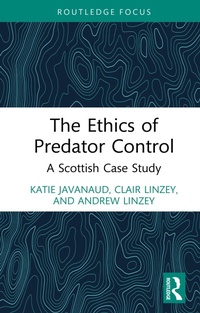
The Ethics of Predator Control
A Scottish Case Study
Published on 26. September 2025
122 pages
978-1-040-75713-0 (ISBN)
Description

This book offers a timely contribution to the ethical discourse on predator control, particularly in the context of Scottish moor management. It provides a detailed examination of the moral arguments surrounding animal welfare and conservation, engaging with contemporary debates in environmental ethics, wildlife management, and animal rights.
Organised into two parts, Part 1 comprises a report by the Oxford Centre for Animal Ethics on the ethics of predator control for members of the Scottish Parliament. The central argument critically assesses the morality of predator control, aligning with broader discussions on sentience, suffering, and human responsibilities towards nonhuman animals. Part 1 also proposes the promulgation of a new charter for free-living animals. This legislation should begin with the recognition of sentiency and enshrine in law the value and dignity of free-living animals such that their right to live unmolested is respected. Part 2 contains detailed rebuttals of subsequent criticisms of the report. Over 120 scholars worldwide have endorsed the report.
Given the growing interest in rewilding, biodiversity conservation, and ethical hunting debates, this book has the potential to be a significant resource for scholars, policymakers, and advocacy groups. It will also be of interest to students and academics in the fields of ethics, conservation, philosophy, ecology, and animal law.
Organised into two parts, Part 1 comprises a report by the Oxford Centre for Animal Ethics on the ethics of predator control for members of the Scottish Parliament. The central argument critically assesses the morality of predator control, aligning with broader discussions on sentience, suffering, and human responsibilities towards nonhuman animals. Part 1 also proposes the promulgation of a new charter for free-living animals. This legislation should begin with the recognition of sentiency and enshrine in law the value and dignity of free-living animals such that their right to live unmolested is respected. Part 2 contains detailed rebuttals of subsequent criticisms of the report. Over 120 scholars worldwide have endorsed the report.
Given the growing interest in rewilding, biodiversity conservation, and ethical hunting debates, this book has the potential to be a significant resource for scholars, policymakers, and advocacy groups. It will also be of interest to students and academics in the fields of ethics, conservation, philosophy, ecology, and animal law.
More details
Language
English
Place of publication
London
United Kingdom
Publishing group
Taylor & Francis Ltd
Target group
Professional and scholarly
College/higher education
File size
0,64 MB
ISBN-13
978-1-040-75713-0 (9781040757130)
Copyright in bibliographic data and cover images is held by Nielsen Book Services Limited or by the publishers or by their respective licensors: all rights reserved.
Schweitzer Classification
Other editions
Additional editions
Book
09/2025
1st Edition
Routledge
€78.20
Shipment within 15-20 days
Persons
Katie Javanaud, DPhil, is an associate fellow of the Oxford Centre for Animal Ethics. She obtained her doctorate from the University of Oxford, where her research focused on Buddhist ethics. She then taught Indian Philosophy and Religion and co-taught the Ethics of Eating at Princeton University, where she was a visiting researcher and lecturer. She is primarily interested in applied ethics, particularly animal and environmental ethics. Her publications include 'The Ethics of Horse-Riding,' Journal of Animal Ethics, 12(2), 2022; 'The World on Fire: A Buddhist Response to the Climate Crisis,' Religions, 11(8), 2020; 'Tracing the Trajectory of Buddhist Free Will Theorizing,' Journal of Buddhist Ethics, 25, 2018; 'Reformulating the Buddhist Free Will Problem: Why There Can Be No Definitive Solution,' Journal of Indian Philosophy, 46(4), 2018; 'The Case for In Vitro Ethical Fur' (co-authored), Journal of Animal Ethics, 8(2), 2018; and 'The Future of SeaWorld' (co-authored), Journal of Animal Ethics, 8(2), 2018. She is a former president of the Oxford University Animal Ethics Society.
Clair Linzey, PhD, is a research fellow in animal ethics at Wycliffe Hall in the University of Oxford and the deputy director of the Oxford Centre for Animal Ethics. She is also the Frances Power Cobbe Professor of Animal Theology at the Graduate Theological Foundation and the director of the Annual Oxford Animal Ethics Summer School. She serves as co-editor of the Journal of Animal Ethics and co-editor of the Palgrave Macmillan Animal Ethics Series, which has published more than 40 books on animal-related issues. She is the author of Developing Animal Theology (Routledge, 2021) and co-author of An Ethical Critique of Fur Factory Farming (Palgrave Macmillan, 2022). Her co-edited volumes include Animal Ethics for Veterinarians (University of Illinois Press, 2017), The Palgrave Handbook of Practical Animal Ethics (Palgrave Macmillan, 2018), The Routledge Handbook of Religion and Animal Ethics (Routledge, 2018), and Animal Ethics and Animal Law (Lexington, 2023).
Andrew Linzey, PhD, DD, HonDD, is director of the Oxford Centre for Animal Ethics and has been a member of the Faculty of Theology in the University of Oxford for 28 years. He is a visiting professor of animal theology at the University of Winchester, a special professor at Saint Xavier University, Chicago, and a professor of animal ethics at the Graduate Theological Foundation. He is the author or editor of more than 30 books, including Animal Theology (SCM Press/University of Illinois Press, 1994); Why Animal Suffering Matters (Oxford University Press, 2009); The Global Guide to Animal Protection (University of Illinois Press, 2013); and The Palgrave Handbook of Practical Animal Ethics (Palgrave Macmillan, 2018). In 2001, he was awarded a Doctor of Divinity degree by the Archbishop of Canterbury in recognition of his 'unique and massive pioneering work at a scholarly level in the area of the theology of creation with particular reference to the rights and welfare of God's sentient creatures'.
Clair Linzey, PhD, is a research fellow in animal ethics at Wycliffe Hall in the University of Oxford and the deputy director of the Oxford Centre for Animal Ethics. She is also the Frances Power Cobbe Professor of Animal Theology at the Graduate Theological Foundation and the director of the Annual Oxford Animal Ethics Summer School. She serves as co-editor of the Journal of Animal Ethics and co-editor of the Palgrave Macmillan Animal Ethics Series, which has published more than 40 books on animal-related issues. She is the author of Developing Animal Theology (Routledge, 2021) and co-author of An Ethical Critique of Fur Factory Farming (Palgrave Macmillan, 2022). Her co-edited volumes include Animal Ethics for Veterinarians (University of Illinois Press, 2017), The Palgrave Handbook of Practical Animal Ethics (Palgrave Macmillan, 2018), The Routledge Handbook of Religion and Animal Ethics (Routledge, 2018), and Animal Ethics and Animal Law (Lexington, 2023).
Andrew Linzey, PhD, DD, HonDD, is director of the Oxford Centre for Animal Ethics and has been a member of the Faculty of Theology in the University of Oxford for 28 years. He is a visiting professor of animal theology at the University of Winchester, a special professor at Saint Xavier University, Chicago, and a professor of animal ethics at the Graduate Theological Foundation. He is the author or editor of more than 30 books, including Animal Theology (SCM Press/University of Illinois Press, 1994); Why Animal Suffering Matters (Oxford University Press, 2009); The Global Guide to Animal Protection (University of Illinois Press, 2013); and The Palgrave Handbook of Practical Animal Ethics (Palgrave Macmillan, 2018). In 2001, he was awarded a Doctor of Divinity degree by the Archbishop of Canterbury in recognition of his 'unique and massive pioneering work at a scholarly level in the area of the theology of creation with particular reference to the rights and welfare of God's sentient creatures'.
Content
Part 1: Killing To Kill: A Report of The Oxford Centre for Animal Ethics 1.1. Introduction 1.2. Outlining the Facts 1.3. The Putative Justifications for 'Predator Control' 1.4. The Impossibility of the Humane Killing of 'Predators' 1.5. The Moral Reckoning 1.6. Summary and Conclusion Part 2: Non-Moral Covers for Killing: A Response to Critics 2.1. Department of Conservation Traps 2.2. 'Predator Control' as a Tool for Conservation 2.3. 'Non-Target' Species 2.4. Reading the Research 2.5 Summary and Conclusion 2.6. A Brief Historical Afterword
