

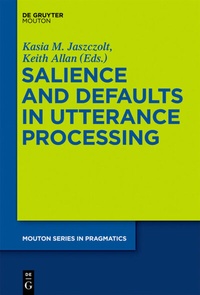
Salience and Defaults in Utterance Processing
Description

The book addresses controversies around the conscious vs automatic processing of contextual information and the distinction between literal and nonliteral meaning. It sheds new light on the relation of the literal/nonliteral distinction to the distinction between the automatic and conscious retrieval of information. The question of literal meaning is inherently interwoven with the question of lexical salience on one hand and default interpretations on the other. This volume addresses these interconnected issues, stressing their mutual interdependence. It contributes new, ground-breaking insights into the questions of literalness, semantics-pragmatics interface, automatic (default) retrieval and contextual pragmatic enrichment, modelling of discourse processing, lexical pragmatics, and other related issues.
More details
Other editions
Additional editions
Persons
Content
2 - Chapter 1. Introduction [Seite 9]
3 - Chapter 2. Default meanings, salient meanings, and automatic processing [Seite 19]
4 - Chapter 3. Salient meanings: The whens and wheres [Seite 43]
5 - Chapter 4. Graded salience effects on irony production and interpretation [Seite 61]
6 - Chapter 5. Salience in language production [Seite 89]
7 - Chapter 6. On salience and enrichment in expressions of negation [Seite 111]
8 - Chapter 7. Understanding acronyms: The time course of accessibility [Seite 159]
9 - Chapter 8. Graded salience: Probabilistic meanings in the lexicon [Seite 173]
10 - Chapter 9. Practices and defaults in interpreting disjunction [Seite 197]
11 - Index [Seite 235]
