

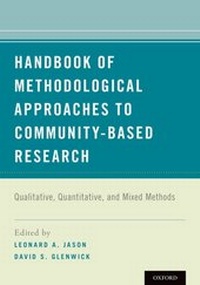
Handbook of Methodological Approaches to Community-Based Research: Qualitative, Quantitative, and Mixed Methods
Qualitative, Quantitative, and Mixed Methods
1st Edition
Published on 8. December 2015
409 pages
978-0-19-024366-1 (ISBN)
Description

The field of community psychology has focused on individuals and groups behavior in interaction with their social contexts, with an emphasis on prevention, early intervention, wellness promotion, and competency development. Over the past few decades, however, community-based applications of the newest research methodologies have not kept pace with the development of theory and methodology with regard to multilevel data collection and analysis. The Handbook of Methodological Approaches to Community-Based Research is intended to aid the community-oriented researcher in learning about and applying cutting-edge quantitative, qualitative, and mixed methods approaches. The Handbook presents a number of innovative methodologies relevant to community-based research, illustrating their applicability to specific social problems and projects. These methodological approaches explore individuals and groups in interaction with their communities and provide examples of how to implement and evaluate interventions conducted at the community level. The chapters discuss how particular methodologies can be used to help gather and analyze data dealing with community-based issues. Furthermore, they illustrate the benefits that occur when community theorists, interventionists, and methodologists work together to better understand complicated person-environment systems and the change processes within communities.
More details
Other editions
Additional editions
Leonard A. Jason | David S. Glenwick
Handbook of Methodological Approaches to Community-Based Research
Qualitative, Quantitative, and Mixed Methods
Book
02/2016
Oxford University Press Inc
€118.70
Shipment within 15-20 days
Content
- Cover
- Handbook of Methodological Approaches to Community-Based Research
- Copyright
- Contents
- Foreword
- Acknowledgments
- About The Editors
- Contributors
- 1. Introduction to Community-Based Methodological Approaches
- SECTION I Qualitative Approaches
- 2. Introduction to Qualitative Approaches
- 3. Grounded Theory
- 4. Thematic Analysis
- 5. Community Narratives
- 6. Appreciative Inquiry
- 7. The Delphi Method
- 8. Ethnographic Approaches
- 9. Photovoice and House Meetings as Tools Within Participatory Action Research
- 10. Geographic Information Systems
- 11. Causal Layered Analysis
- 12. Emotional Textual Analysis
- SECTION II Quantitative Approaches
- 13. Introduction to Quantitative Methods
- 14. Latent Growth Curves
- 15. Latent Class Analysis and Latent Profile Analysis
- 16. Multilevel Structural Equation Modeling
- 17. Cluster-Randomized Trials
- 18. Behavioral and Time-Series Approaches
- 19. Data Mining
- 20. Agent-Based Models
- 21. Social Network Analysis
- 22. Dynamic Social Networks
- SECTION III Mixed Methods Approaches
- 23. Introduction to Mixed Methods Approaches
- 24. Action Research
- 25. Community-Based Participatory Action Research
- 26. Youth-Led Participatory Action Research
- 27. Participatory Mixed Methods Research Across Cultures
- 28. Photoethnography in Community-Based Participatory Research
- 29. Data Visualization
- 30. Concept Mapping
- 31. Functional Analysis of Community Concerns in Participatory Action Research
- 32. Network Analysis and Stakeholder Analysis in Mixed Methods Research
- 33. Mixed Methodology in Multilevel,Multisetting Inquiry
- 34. Mixed Methods and Dialectical Pluralism
- 35. Community Profiling in Participatory Action Research
- Afterword
- Index
