

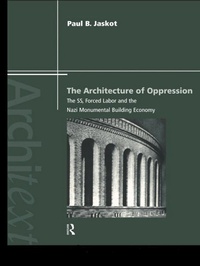
The Architecture of Oppression
The SS, Forced Labor and the Nazi Monumental Building Economy
Published on 4. January 2002
216 pages
978-1-134-59462-7 (ISBN)
Description

This book re-evaluates the architectural history of Nazi Germany and looks at the development of the forced-labour concentration camp system. Through an analysis of such major Nazi building projects as the Nuremberg Party Rally Grounds and the rebuilding of Berlin, Jaskot ties together the development of the German building economy, state architectural goals and the rise of the SS as a political and economic force. As a result, The Architecture of Oppression contributes to our understanding of the conjunction of culture and politics in the Nazi period as well as the agency of architects and SS administrators in enabling this process.
Reviews / Votes
'Paul Jaskot's book is a welcome injection of life into what had become a stale debate.' - Building Design, April 20, 2000'It does cast a significant new light on attempts to strip Nazi architecture of its political and moral associations.' - Building Design, April 20, 2000
'Jaskot's attention to actions rather than motives, and to quarries rather than aesthetics, gives precision and weight to his argument about the importance placed upon monumental architecture in Nazi Germany,' - Harvard Design Magazine
'This book is the result of painstaking research ... Jaskot has put another nail in the coffin of Leon Krier's extraordinary attempt to exonerate the Nazi monuments by removing them from their political context.' - The Architectural Review
'The Architecture of Oppression could become a prime reference for the issues of art, architecture, and urban design, and the role of politics in general and the Nazis in particular.' - Town Planning Review
'An invaluable understanding of the politics of architecture, one that complements and enhances those investigations to Nazi architecture's expression, ideological function with which we are already familiar.' - Oxford Art Journal
'An important contribution shedding light upon the manifold interrelations between politics, architecture and the economy of the camp system.' - Planning Perspectives, 17 February 2002
More details
Series
Language
English
Place of publication
London
United Kingdom
Publishing group
Taylor & Francis Ltd
Target group
College/higher education
File size
5,38 MB
ISBN-13
978-1-134-59462-7 (9781134594627)
Copyright in bibliographic data and cover images is held by Nielsen Book Services Limited or by the publishers or by their respective licensors: all rights reserved.
Schweitzer Classification
Other editions
Additional editions
Paul B. Jaskot
The Architecture of Oppression
The SS, Forced Labor and the Nazi Monumental Building Economy
Book
11/1999
1st Edition
Routledge
€193.50
Shipment within 15-20 days
Paul B. Jaskot
The Architecture of Oppression
The SS, Forced Labor and the Nazi Monumental Building Economy
Book
11/1999
1st Edition
Routledge
€112.84
Shipment within 15-20 days
Person
Paul B. Jaskot is Assistant Professor in the department of Art and Art History at DePaul University in Chicago. His work focuses on the relationship between culture and politics in modern European Art and Architecture.
Content
List of Illustrations. Acknowledgments. Abbreviations. 1. Introduction: The Architectural Policy of the SS. 2. The Interest of the SS in the Monumental Building Economy. 3. The Party Rally Grounds at Nuremberg: SS Economic Goals and National Socialist Architectural Policy. 4. The Rebuilding of Berlin: The Interdependence of the GBI and the SS. 5. The Political Function of SS Architecture.6.Conclusion. Notes. Bibliography. Index.
