

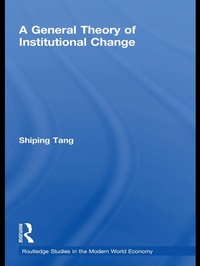
A General Theory of Institutional Change
Published on 10. December 2010
144 pages
978-1-136-85147-6 (ISBN)
Description

Institutional change is a central driving force behind social changes, and thus a central topic in all major fields of social sciences. Yet, no general theory of institutional change exists.
Drawing from a diverse literature, this book develops a general theory of institutional change, based on a social evolutionary synthesis of the conflict approach and the harmony approach. The book argues that because the whole process of institutional change can be understood as a process of selecting a few ideas and turning them into institutions, competition of ideas and struggle for power to make rules are often at the heart of institutional change. The general theory not only integrates more specific theories and insights on institutional change that have been scattered in different fields into a coherent general theory but also provides fundamental new insights and points to new directions for future research.
This book makes a fundamental contribution to all major fields of social sciences: sociology (sociological theory), political sciences, institutional economics, and political theory. It should be of general interest to scholars and students in all major fields of social science.
Drawing from a diverse literature, this book develops a general theory of institutional change, based on a social evolutionary synthesis of the conflict approach and the harmony approach. The book argues that because the whole process of institutional change can be understood as a process of selecting a few ideas and turning them into institutions, competition of ideas and struggle for power to make rules are often at the heart of institutional change. The general theory not only integrates more specific theories and insights on institutional change that have been scattered in different fields into a coherent general theory but also provides fundamental new insights and points to new directions for future research.
This book makes a fundamental contribution to all major fields of social sciences: sociology (sociological theory), political sciences, institutional economics, and political theory. It should be of general interest to scholars and students in all major fields of social science.
Reviews / Votes
'This book is a provocative effort to use evolutionary ideas as the basis for a new general theory of institutional change. The proposed theory offers a promising way of bridging conflict and consensus approaches to institutions in substantive research. I recommend it to all students of institutional formation and change.'James Mahoney, Professor, Northwestern University
'With impressive erudition, Shiping Tang advances a far-reaching general theory of institutional change. Engaging with classical and contemporary social and political theorists , Tang has formulated a bold account of institutions and institutional change that adds a new voice to cutting-edge debates on institutional change.'
Daniel Ziblatt, author of Structuring the State, Professor of Government, Harvard University
'What is required to produce a general theory of institutional change? Shiping Tang develops a social evolutionary approach in which ideas and power--not a mechanical selection process--play a central role. A terrific introduction to the theoretical landscape.'
Stephen Haggard, Professor, University of California, San Diego
'Shiping Tang seeks to provide us with a general theory of institutional change, based on a social evolutionary approach. Tang is exceptionally well read in social theory and provides us with a thought provoking analysis.'
Dr Mark Haugaard, National University of Ireland, Galway 'This book is a provocative effort to use evolutionary ideas as the basis for a new general theory of institutional change. The proposed theory offers a promising way of bridging conflict and consensus approaches to institutions in substantive research. I recommend it to all students of institutional formation and change.'
James Mahoney, Professor, Northwestern University
'With impressive erudition, Shiping Tang advances a far-reaching general theory of institutional change. Engaging with classical and contemporary social and political theorists , Tang has formulated a bold account of institutions and institutional change that adds a new voice to cutting-edge debates on institutional change.'
Daniel Ziblatt, author of Structuring the State, Professor of Government, Harvard University
'What is required to produce a general theory of institutional change? Shiping Tang develops a social evolutionary approach in which ideas and power--not a mechanical selection process--play a central role. A terrific introduction to the theoretical landscape.'
Stephen Haggard, Professor, University of California, San Diego
'Shiping Tang seeks to provide us with a general theory of institutional change, based on a social evolutionary approach. Tang is exceptionally well read in social theory and provides us with a thought provoking analysis.'
Dr Mark Haugaard, National University of Ireland, Galway
More details
Series
Language
English
Place of publication
London
United Kingdom
Publishing group
Taylor & Francis Ltd
Target group
College/higher education
Illustrations
6 s/w Tabellen
6 Tables, black and white
File size
0,97 MB
ISBN-13
978-1-136-85147-6 (9781136851476)
Copyright in bibliographic data and cover images is held by Nielsen Book Services Limited or by the publishers or by their respective licensors: all rights reserved.
Schweitzer Classification
Other editions
Additional editions
H. A. Jaschke
A General Theory of Institutional Change
Book
01/2016
Routledge
€57.20
Article exhausted; check different version
H. A. Jaschke
A General Theory of Institutional Change
Book
12/2010
1st Edition
Routledge
€126.47
Article exhausted; check different version
Person
Shiping Tang is Professor at the School of International Relations and Public Affairs (SIRPA), Fudan Univeristy, Shanghai, China. He has a very broad research interest and has published widely. He is the author of A Theory of Security Strategy for Our Time: Defensive Realism (Palgrave-Macmillan 2010), A General Theory of Institutional Change (Routledge, 2011), and Social Evolution of International Politics (Oxford, 2013, forthcoming). He is also the co-editor of Living with China: Regional States and China through Crises and Turning Points (Palgrave-Macmillan 2009). His most recent journal publications include articles in Chinese Journal of International Politics, European Journal of International Relations, International Security, International Studies Review, Journal of Economic Issues, Journal of Strategic Studies, Review of International Studies, Philosophy of the Social Sciences, Security Studies, and World Politics.
Content
1. Two Major Approaches toward Institutional Change 2. Toward a General Theory of Institutional Change 3. A General Theory of Institutional Change 4. Assessing the General Theory 5. Power/Institutions and Society Conclusion: Understanding Social Changes
