

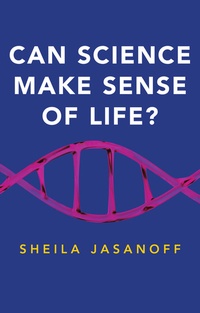
Can Science Make Sense of Life?
Description

Since the discovery of the structure of DNA and the birth of the genetic age, a powerful vocabulary has emerged to express science's growing command over the matter of life. Armed with knowledge of the code that governs all living things, biology and biotechnology are poised to edit, even rewrite, the texts of life to correct nature's mistakes.
Yet, how far should the capacity to manipulate what life is at the molecular level authorize science to define what life is for? This book looks at flash points in law, politics, ethics, and culture to argue that science's promises of perfectibility have gone too far. Science may have editorial control over the material elements of life, but it does not supersede the languages of sense-making that have helped define human values across millennia: the meanings of autonomy, integrity, and privacy; the bonds of kinship, family, and society; and the place of humans in nature.
More details
Other editions
Additional editions
Person
Sheila Jasanoff is Pforzheimer Professor of Science and Technology Studies at the Harvard Kennedy School
Content
Prolouge 1
1 A New Lens on Life 13
2 Book of Revelations 37
3 Life and Law: Constitutional Turns 64
4 Life in the Gray Zone 92
5 Language Games 117
6 A New Biopower 142
7 Life's Purposes 169
Notes 180
References 187
Index 202
1
A New Lens on Life
In 1897, Paul Gauguin, in failing health and overcome with grief at the sudden loss of his favorite daughter, began painting a work he imagined as his last testament (Richardson 2009). Five feet high and twelve feet long, as wide as the inside of his Tahitian hut, the monumental painting laid out in a brilliant, dreamlike sequence many elements from the artist's personal symbolic repertoire: a sleeping child, mysterious figures whispering in the shadows, intertwined branches and tree trunks, an androgynous figure in the middle reaching up to pluck some fruit, scattered birds and animals, a stone idol with upraised hands, and an old woman marking the end of the allegorical life cycle. The colors are unearthly. Yellow-orange bodies glow against a background of acid blues, indigo, and deep green. Matte gold corners hint at a solid backing from which the tapestry-like composition seems to be peeling away. In the top left, Gauguin wrote the inscription that gives his masterpiece its name: Where Do We Come From / What Are We / Where Are We Going.1
On its face, this most iconic of Gauguin's Tahitian paintings is a culmination of his long fascination with local mythology and its cultural milieu. The central figure, in particular, is a mahu, a man-woman or thirdgender person, recognized and given special status in the cultures of the Pacific islands, though abhorred by colonizing Christian missionaries whose cultural common sense left no space for transgender persons (Geertz 1975). But the words that give the work its meaning seem to have sprung unbidden from the abandoned reservoir of Gauguin's early Catholic education in France. As a schoolboy, the future artist was taught by the eloquent and charismatic Bishop of Orleans, Félix-Antoine-Philibert Dupanloup, whose catechism for young students included questions about human origins and purposes: Where does humanity come from? Where is it going to? How does humanity proceed (Gauguin and Russell 2016)? In painting the arc of life at what he felt to be his own life's end, Gauguin reverted to these age-old questions about human existence that have preoccupied religious and philosophical minds since the beginnings of recorded thought.
Gauguin's last years in Tahiti, from 1895 to 1903, coincided with years of ferment in other worlds, the worlds of science, commerce, and industry from which the artist, sick and embittered, had fled. There, the nature of life was also the center of attention, but from entirely different angles and with very different consequences. Those were revolutionary years for modern biology, riding high on momentum built throughout the nineteenth century. The discoveries of that period set the stage, in turn, for the advances in the second half of the twentieth century that raised biology to a pedestal among the sciences previously reserved for atomic physics. Most important for our understanding of what life is and what it means, biology in those years came indoors, from the unruliness of the field to the systematic study of evolution, and ultimately into the sanitized orderliness of the lab, where new technologies increased our sense of mastery over life's processes. In turn, the manipulation of the matter of life in labs opened the door to commercial exploitation in medicine and agriculture and more ambitious plans for improving on nature's handiwork. Those shifts, the subject of this chapter, provide essential groundwork for understanding how biology positioned itself as the prime custodian of the meaning and purpose of human life and its place in the wider scheme of life on Earth.
Advances in the biological sciences fundamentally reshaped our thinking about the questions that perplexed Gauguin and his spiritual teacher: where life begins and ends; what is at stake in belonging to a species, kinship group, or family; what counts as normal or abnormal, healthy or diseased, and changeable or fixed in the natural order of things. The material descriptions of life offered by modern biology gradually took on prescriptive force, as if they were the foundation on which we should build our conceptions of good human futures, and as if those visions in turn should guide our technological interventions. Powerful new techniques for designing and redesigning life came to be seen as answers to old, value-laden questions, such as what counts as a well-lived life and who should be responsible for safeguarding lives on this planet. Science does not explicitly claim to offer full-blown answers to any of these questions, especially about the right ways to ensure life's protection and flourishing. Yet, as outlined in this chapter, biology and biotechnology have continually proclaimed themselves as humanity's most compelling instruments for making sense of life - those with the greatest power to answer the eternal questions posed by Gauguin's Tahitian masterpiece.
Origin stories: the evolution of life
From 1831 to 1836, long before Gauguin painted his enigmatic reflection on life and death, Charles Darwin undertook his famous voyage on the HMS Beagle to uncover in his own way one of life's basic mysteries: where do we come from? An avid beetle collector and botanist in his college years in Cambridge, Darwin acquired a passion for geology and the interpretation of strata well before setting sail on the Beagle. In the Galapagos archipelago, he was drawn to considering how diversity arose among living things, most famously in the finches he collected that are now named after him (Sulloway 1982). Discovery took root then; fame and adulation followed much later. Trained in theology as well as in natural history, and acutely sensitive to possible accusations of error, Darwin waited twenty years before going public in 1859 with his revolutionary work, On the Origin of Species.2 Despite the outcry it provoked (and continues to provoke) in science, religion, and public culture (Wilson 2017), Darwin's claim that humans and other forms of life evolved through natural selection and adaptation proved hugely influential. Sigmund Freud, lecturing on the principles of psychoanalysis some sixty years later, called the theory of evolution the "second discontinuity," on a par with the first discontinuity of the Copernican Revolution, which decentered Earth from its anchoring place in the solar system. Darwin's research, Freud wrote, had "robbed man of his apparent superiority under special creation, and rebuked him with his descent from the animal kingdom, and his ineradicable animal nature" (1920, 247). Evolution, in other words, was one of those rare breaks with past beliefs, a true scientific revolution.
The skeptical habits of thought that allowed Darwin to question foundational presuppositions about the biological origins of life did not extend to his theories about human cultures. Yet, here too an implicit commitment to lawlike progression could be detected. The Victorian moralist observed foreign human forms and practices with a dyspeptic eye from the secure perch of his own elevated position in an enlightened society. His adventures included a ten-day stop in Tahiti in November 1835, where, unlike Gauguin, he found the women "far inferior in every respect to the men" (1860, 430). He also commended Christian missionaries for having abolished "human sacrifices, and the power of an idolatrous priesthood," while reducing "dishonesty, intemperance, and licentiousness" in the indigenous populations (1860, 440). This kind of talk presupposes a kind of universalism in the dynamics of social progress. Theorists such as Herbert Spencer soon picked up on this thread, and "social Darwinism" emerged as a popular framework in accounting for progress.
Like any other transformative idea, Darwin's theory of evolution itself had a longer history and was carried out amidst other scientific efforts that help explain its hold on the modern imagination. Evolution was already in the air as an explanation for the complexity of life forms, in particular through the work of the French natural historian, botanist, and taxonomist Jean-Baptiste Lamarck in the early nineteenth century. Lamarck is now remembered largely for his discredited theory that acquired characteristics can be inherited. Even for those who held different views about the mechanics of evolution, however, he provided inspiration that complexity and diversity among organisms were not simply matters of chance or divine will. The development of life was governed by laws, and these biological rules of inheritance could be systematically studied and deciphered. Darwin was just one of the figures, if possibly the most renowned, who took up and carried forward that invitation to decode nature's laws, including the origins of species, through scientific scrutiny.
If Lamarck and later explorers like Darwin were preoccupied with variation among species across time and space, other pioneering naturalists of that period were more interested in how species pass on their characteristics through generations of offspring. A dozen years younger than Darwin, but with an active life more or less coincident with his, Gregor Johann Mendel, an Augustinian monk in St. Thomas's Abbey in the Moravian city of Brno, began studying the effects of crossbreeding pea plants in his monastery's small experimental garden. Encouraged by his teachers and colleagues, Mendel observed what happened when common edible peas carrying one set of distinctive traits - such as for plant...
