

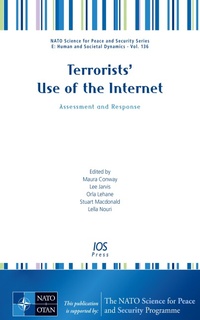
Terrorists' Use of the Internet
Assessment and Response
1st Edition
Published on 2. June 2017
416 pages
978-1-61499-765-8 (ISBN)
Description

Terrorist use of the Internet has become a focus of media, policy, and scholarly attention in recent years. Terrorists use the Internet in a variety of ways, the most important being for propaganda purposes and operations-related content, but it is also potentially a means or target of attack.
This book presents revised versions of a selection of papers delivered at the NATO Advanced Research Workshop (ARW) on 'Terrorists' Use of the Internet' held in Dublin, Ireland in June 2016. One aim of the workshop was to nurture dialogue between members of the academic, policy and practitioner communities, so the 60 delegates from 13 countries who attended the workshop included representatives from each of these. The participants encompassed a wide range of expertise (including engineering, computer science, law, criminology, political science, international relations, history, and linguistics) and the chapters contained herein reflect these diverse professional and disciplinary backgrounds. The workshop also aimed to address the convergence of threats. Following an introduction which provides an overview of the various ways in which terrorists use the Internet, the book's remaining 25 chapters are grouped into 5 sections on cyber terrorism and critical infrastructure protection; cyber-enabled terrorist financing; jihadi online propaganda; online counterterrorism; and innovative approaches and responses.
The book will be of interest to all those who need to maintain an awareness of the ways in which terrorists use the Internet and require an insight into how the threats posed by this use can be countered.
This book presents revised versions of a selection of papers delivered at the NATO Advanced Research Workshop (ARW) on 'Terrorists' Use of the Internet' held in Dublin, Ireland in June 2016. One aim of the workshop was to nurture dialogue between members of the academic, policy and practitioner communities, so the 60 delegates from 13 countries who attended the workshop included representatives from each of these. The participants encompassed a wide range of expertise (including engineering, computer science, law, criminology, political science, international relations, history, and linguistics) and the chapters contained herein reflect these diverse professional and disciplinary backgrounds. The workshop also aimed to address the convergence of threats. Following an introduction which provides an overview of the various ways in which terrorists use the Internet, the book's remaining 25 chapters are grouped into 5 sections on cyber terrorism and critical infrastructure protection; cyber-enabled terrorist financing; jihadi online propaganda; online counterterrorism; and innovative approaches and responses.
The book will be of interest to all those who need to maintain an awareness of the ways in which terrorists use the Internet and require an insight into how the threats posed by this use can be countered.
More details
Series
Language
English
Place of publication
London
Netherlands
Publishing group
IOS Press
Target group
Professional and scholarly
File size
5,86 MB
ISBN-13
978-1-61499-765-8 (9781614997658)
Copyright in bibliographic data and cover images is held by Nielsen Book Services Limited or by the publishers or by their respective licensors: all rights reserved.
Schweitzer Classification
Other editions
Additional editions
Book
06/2017
1st Edition
IOS Press,US
€154.50
Shipment within 10-15 days
Content
- Title Page
- Preface
- The Cyberterrorism Project
- Contents
- Terrorist Use of the Internet and Cyberspace: Issues and Responses
- Cyberterrorism and Critical Infrastructure Protection
- Cyberterrorism: A Challenge for External and Internal Security
- Preliminary Analysis of Cyberterrorism Threats to Internet of Things (IoT) Applications
- Critical Infrastructure Cyber-Security Risk Management
- The Terrorist - Hacker/Hacktivist Distinction: An Investigation of Self-Identified Hackers and Hacktivists
- Cyber-Enabled Terrorist Financing
- Online Terrorist Financing
- Cybercrime-Funded Terrorism and the Threats Posed by Future Technologies: Appealing Economics and Targets
- Jihadi Online Propaganda: Purposes and Effects
- Between the Arab Revolutions and the Islamic State's Caliphate: al-Qaeda Leaders' Online Propaganda 2012-2014
- Radicalisers as Regulators: An Examination of Dabiq Magazine
- The Role of Discourse Analysis in Terrorism Studies: Comparing Inspire and Dabiq
- Learning from ISIS's Virtual Propaganda War for Western Muslims: A Comparison of Inspire and Dabiq
- Online Jihadi Instructional Content: The Role of Magazines
- Online Counterterrorism
- Public Actors, Private Actors, and Cooperative Approaches
- Hard and Soft Power Approaches to Countering Online Extremism
- Anglosphere Approaches to Counter-Terrorism in Cyberspace
- Prosecuting Terrorist Activity in Canada
- An Efficient Response to ISIS in Cyberspace: Public-Private Partnership
- Prevention, Anti-Radicalisation and the Role of Social Media: A View from Germany
- Online CVE Strategies
- Counter-Terrorism Strategic Communications: Back to the Future - Lessons from Past and Present
- Interrupting Engagement with Online Extremist Content: Utilising "Noisy" Foreign Fighters
- Interpreting Public Reactions to Terrorist Events Using Open Source Network Analysis
- Surveillance
- Reframing 'Mass Surveillance'
- Beyond Big Data: Surveillance, Metadata and Technology-Enabled Intelligence Opportunities in Counter-Terrorism
- National Security, Terrorism and the Legality of Secret Surveillance: The Case of France
- Innovative Approaches/Responses
- Internet Forensics as a Tool for Responding to Cyber-Fronts
- (En)gendering Cyberterrorism in the UK News Media: A Discursive Analysis
- Predicting the Emergence of Self-Radicalisation Through Social Media: A Complex Systems Approach
- Subject Index
- Author Index
