

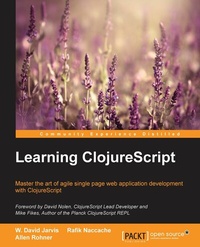
Learning ClojureScript
Master the art of agile single page web application development with ClojureScript
Published on 8. July 2025
320 pages
978-1-78588-779-6 (ISBN)
Description

Master the art of agile single page web application development with ClojureScript
Key Features
[*]Set up interactive development workflows for the browser or Node.js thanks to the ClojureScript ecosystem
[*]Learn the basics of interactive single page web app development taking advantage of the functional nature of ClojureScript
[*]Delve into advanced rich web application development concepts such as Om, along with core.async, using zippers and logic programming, and preparing code for production with testing or optimizing via the Google Closure Compiler
Book DescriptionClojure is an expressive language that makes it possible to easily tackle complex software development challenges. Its bias toward interactive development has made it a powerful tool, enabling high developer productivity. In this book, you will first learn how to construct an interactive development experience for ClojureScript.. You will be guided through ClojureScript language concepts, looking at the basics first, then being introduced to advanced concepts such as functional programming or macro writing. After that, we elaborate on the subject of single page web applications, showcasing how to build a simple one, then covering different possible enhancements. We move on to study more advanced ClojureScript concepts, where you will be shown how to address some complex algorithmic cases. Finally, you'll learn about optional type-checking for your programs, how you can write portable code, test it, and put the advanced compilation mode of the Google Closure Compiler to good use. What you will learn
[*]Understand how the ClojureScript compiler operates
[*]Set up interactive development workflows for ClojureScript
[*]Grasp the basics of the ClojureScript language, including basic syntax, data structures, variable scoping, namespaces, and finally the powerful sequence abstraction
[*]Delve into advanced concepts such as functional programming, macro writing, asynchronous programming, app routing, and real-time web
[*]Develop simple one page web applications
[*]Explore techniques to make your web apps aware of the external world through external or embedded database access or Oauth 2 integration
[*]Learn more advanced ClojureScript concepts like in app routing, real-time web
[*]Prepare your work for production, getting insights into optional type-checking, writing portable Clojure/ClojureScript code, and testing
Who this book is forThis book is for web application developers who want to benefit from the power of ClojureScript to get an agile and highly productive development platform that targets mainly browser JavaScript. You are not required to be fluent in Clojure, but it will be easier for you if you have a basic understanding of browser and server-side JavaScript.
Key Features
[*]Set up interactive development workflows for the browser or Node.js thanks to the ClojureScript ecosystem
[*]Learn the basics of interactive single page web app development taking advantage of the functional nature of ClojureScript
[*]Delve into advanced rich web application development concepts such as Om, along with core.async, using zippers and logic programming, and preparing code for production with testing or optimizing via the Google Closure Compiler
Book DescriptionClojure is an expressive language that makes it possible to easily tackle complex software development challenges. Its bias toward interactive development has made it a powerful tool, enabling high developer productivity. In this book, you will first learn how to construct an interactive development experience for ClojureScript.. You will be guided through ClojureScript language concepts, looking at the basics first, then being introduced to advanced concepts such as functional programming or macro writing. After that, we elaborate on the subject of single page web applications, showcasing how to build a simple one, then covering different possible enhancements. We move on to study more advanced ClojureScript concepts, where you will be shown how to address some complex algorithmic cases. Finally, you'll learn about optional type-checking for your programs, how you can write portable code, test it, and put the advanced compilation mode of the Google Closure Compiler to good use. What you will learn
[*]Understand how the ClojureScript compiler operates
[*]Set up interactive development workflows for ClojureScript
[*]Grasp the basics of the ClojureScript language, including basic syntax, data structures, variable scoping, namespaces, and finally the powerful sequence abstraction
[*]Delve into advanced concepts such as functional programming, macro writing, asynchronous programming, app routing, and real-time web
[*]Develop simple one page web applications
[*]Explore techniques to make your web apps aware of the external world through external or embedded database access or Oauth 2 integration
[*]Learn more advanced ClojureScript concepts like in app routing, real-time web
[*]Prepare your work for production, getting insights into optional type-checking, writing portable Clojure/ClojureScript code, and testing
Who this book is forThis book is for web application developers who want to benefit from the power of ClojureScript to get an agile and highly productive development platform that targets mainly browser JavaScript. You are not required to be fluent in Clojure, but it will be easier for you if you have a basic understanding of browser and server-side JavaScript.
All prices
More details
Edition
Digital original
Language
English
Place of publication
Birmingham
United Kingdom
Target group
Professional and scholarly
US School Grade: College Graduate Student
Edition type
Digital original
File size
4,75 MB
ISBN-13
978-1-78588-779-6 (9781785887796)
Copyright in bibliographic data and cover images is held by Nielsen Book Services Limited or by the publishers or by their respective licensors: all rights reserved.
Schweitzer Classification
Other editions
Additional editions
W. David Jarvis | Rafik Naccache | Allen Rohner
Learning ClojureScript
Master the art of agile single page web application development with ClojureScript
Book
06/2016
Packt Publishing
€51.30
Shipment within 3-4 weeks
Persons
Rohner Allen :
Allen Rohner is a software engineer and entrepreneur living in Austin, Texas. He is the founder of numerous startups. A few, including CircleCI, have even been successful. Allen has been using Clojure and ClojureScript professionally since 2009, with commitments in Clojure core and dozens of other open source libraries. He has given multiple talks at Clojure/West and Clojure/conj. Currently, Allen is working on a startup called Rasterize (https://rasterize.io), which helps companies improve conversion rate by optimizing website load times. While Allen has occasionally had blog posts go to #1 on Hacker News, this is the first 'real' book that he's collaborated on.Jarvis W. David :
W. David Jarvis is a software engineer living in San Francisco, California. In his spare time, he enjoys hiking, gardening, playing pool in dive bars, and overthinking everything. He is active in the open source Clojure and ClojureScript communities, and software authored by him has been downloaded over 10,000 times. David has worked for a number of companies now living or dead, including Aggregate Knowledge, CircleCI, Standard Treasury, and Airbnb. He is currently responsible for the build, test, and deployment infrastructure at Airbnb. The "W" is for "William" (now you know!). While David has made the unfortunate mistake of exposing his previous scribblings to the world, this is his first actual book.
Allen Rohner is a software engineer and entrepreneur living in Austin, Texas. He is the founder of numerous startups. A few, including CircleCI, have even been successful. Allen has been using Clojure and ClojureScript professionally since 2009, with commitments in Clojure core and dozens of other open source libraries. He has given multiple talks at Clojure/West and Clojure/conj. Currently, Allen is working on a startup called Rasterize (https://rasterize.io), which helps companies improve conversion rate by optimizing website load times. While Allen has occasionally had blog posts go to #1 on Hacker News, this is the first 'real' book that he's collaborated on.Jarvis W. David :
W. David Jarvis is a software engineer living in San Francisco, California. In his spare time, he enjoys hiking, gardening, playing pool in dive bars, and overthinking everything. He is active in the open source Clojure and ClojureScript communities, and software authored by him has been downloaded over 10,000 times. David has worked for a number of companies now living or dead, including Aggregate Knowledge, CircleCI, Standard Treasury, and Airbnb. He is currently responsible for the build, test, and deployment infrastructure at Airbnb. The "W" is for "William" (now you know!). While David has made the unfortunate mistake of exposing his previous scribblings to the world, this is his first actual book.
Content
Table of Contents
Getting Ready For Clojurescript Development
ClojureScript Language Fundamentals
Advanced Clojurescript Concepts
Web App Basics With Clojurescript
Building Single Page Apps
Building Richer Web Apps
Going further with Clojurescript
Bundling Clojurescript for Production
Getting Ready For Clojurescript Development
ClojureScript Language Fundamentals
Advanced Clojurescript Concepts
Web App Basics With Clojurescript
Building Single Page Apps
Building Richer Web Apps
Going further with Clojurescript
Bundling Clojurescript for Production

