

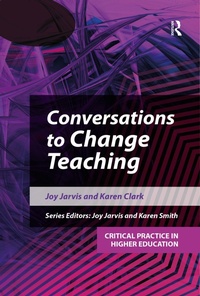
Conversations to Change Teaching
Published on 28. February 2025
94 pages
978-1-040-37194-7 (ISBN)
Description

This book highlights the importance of academic staff having focused conversations about teaching. The emphasis is on using this approach to build individual and team capacity and to bring about institutional change. It emphasises the distributed nature of expertise in teaching which exists at all levels in universities and how conversation can be harnessed to develop and share this. Drawing on research related to dialogue, coaching, communities of practice and building learning organisations, the text identifies simple yet effective ways to engage in learning conversations, develop educational practice, and achieve institutional goals.
Critical Practice in Higher Education provides a scholarly and practical entry point for academics into key areas of higher education practice. Each book in the series explores an individual topic in depth, providing an overview in relation to current thinking and practice, informed by recent research. The series will be of interest to those engaged in the study of higher education, those involved in leading learning and teaching or working in academic development, and individuals seeking to explore particular topics of professional interest. Through critical engagement, this series aims to promote an expanded notion of being an academic - connecting research, teaching, scholarship, community engagement and leadership - while developing confidence and authority.
Critical Practice in Higher Education provides a scholarly and practical entry point for academics into key areas of higher education practice. Each book in the series explores an individual topic in depth, providing an overview in relation to current thinking and practice, informed by recent research. The series will be of interest to those engaged in the study of higher education, those involved in leading learning and teaching or working in academic development, and individuals seeking to explore particular topics of professional interest. Through critical engagement, this series aims to promote an expanded notion of being an academic - connecting research, teaching, scholarship, community engagement and leadership - while developing confidence and authority.
Reviews / Votes
In Conversations to Change Teaching, Jarvis and Clark provide rich illustrations of the different forms of conversations around teaching that can and are held formally and informally in universities today. Through examples from their own practice and drawing on some pertinent literature we are led through different strategies and approaches that reflect the potential strengths of conversations whilst being mindful of the power relations involved in some conversations, for example, teaching observations and the observee-observer dynamic. The authors bring to the fore the importance of paying close attention to our language and willingness to listen and learn by all involved with the conversations and how to use noticing as a way of structuring how we talk with each other about teaching and learning.Throughout the book, the authors reflect the values of the scholarship of teaching and learning to underpin teaching conversations so practice is enhanced based on evidence-informed approaches. Opportunities for staff to engage with the scholarship of teaching and learning through and as a consequence of their conversations are identified. Each chapter finished with a useful set of critical questions for practice and a short summary with 1 or 2 key articles suggested for the reader to follow up on. This short book would be of value to all staff involved in supporting and developing the teaching practice of peers, leading teaching development programmes and staff keen to maintain their own professional development with regards to their own teaching practice.
Dr Jane Pritchard, Oxford Brookes University
More details
Series
Language
English
Place of publication
London
United Kingdom
Publishing group
Taylor & Francis Ltd
Target group
Professional and scholarly
File size
4,53 MB
ISBN-13
978-1-040-37194-7 (9781040371947)
Copyright in bibliographic data and cover images is held by Nielsen Book Services Limited or by the publishers or by their respective licensors: all rights reserved.
Schweitzer Classification
Other editions
Additional editions
Joy Jarvis | Karen Clark
Conversations to Change Teaching
Book
05/2020
1st Edition
Critical Publishing Ltd
€40.80
Shipment within 3-4 weeks
Persons
Joy Jarvis is currently Professor of Educational Practice at the University of Hertfordshire and a UK National Teaching Fellow. She has experience in a wide range of education contexts and works to create effective learning experiences for students and colleagues. She is particularly interested in the professional learning of those engaged in educational practice in higher education settings and has undertaken a range of projects, working with colleagues locally, nationally and internationally, to develop practice in teaching and leadership of teaching. Joy works with doctoral students exploring aspects of educational practice and encourages them to be adventurous in their methodological approaches and to share their findings in a range of contexts to enable practice change.
Karen Clark is programme leader of a Postgraduate Certificate in Learning and Teaching in Higher Education at the University of Hertfordshire, which attracts colleagues from every academic school at the institution. She is engaged with a range of work involving professional learning and recognition, curriculum development and staff-student collaboration. She draws on conversations about teaching both formal and informal in many different contexts from peer review, programme development and teaching observation to lunch groups and chats fueled by coffee and cake.
Karen Mpamhanga (formerly Karen Smith) is Professor of Higher Education and Professional Learning in the School of Education at the University of Hertfordshire. Her research focuses on how higher education policies and practices impact on those who work and study within universities. Karen has worked within educational development and on lecturer development programmes. She holds a Principal Fellowship of the Higher Education Academy and is currently the Director of the University of Hertfordshire's Professional Doctorate in Education. Karen also leads collaborative research and development in her School, where she engages in externally funded research and evaluation and supports the development of scholarly educational practice through practitioner research.
Karen Clark is programme leader of a Postgraduate Certificate in Learning and Teaching in Higher Education at the University of Hertfordshire, which attracts colleagues from every academic school at the institution. She is engaged with a range of work involving professional learning and recognition, curriculum development and staff-student collaboration. She draws on conversations about teaching both formal and informal in many different contexts from peer review, programme development and teaching observation to lunch groups and chats fueled by coffee and cake.
Karen Mpamhanga (formerly Karen Smith) is Professor of Higher Education and Professional Learning in the School of Education at the University of Hertfordshire. Her research focuses on how higher education policies and practices impact on those who work and study within universities. Karen has worked within educational development and on lecturer development programmes. She holds a Principal Fellowship of the Higher Education Academy and is currently the Director of the University of Hertfordshire's Professional Doctorate in Education. Karen also leads collaborative research and development in her School, where she engages in externally funded research and evaluation and supports the development of scholarly educational practice through practitioner research.
Content
Chapter 1 Why conversations to change teaching? Chapter 2 Conversations around peer review Chapter 3 Developing collegial conversations Chapter 4 Creating and sustaining group conversations Chapter 5 Conversations with students about teaching Chapter 6 Building reflective conversation in assessment of teaching Chapter 7 Leading conversations to change teaching
